49 works in this view — arrow keys or swipe to move between them.
Dance in Art
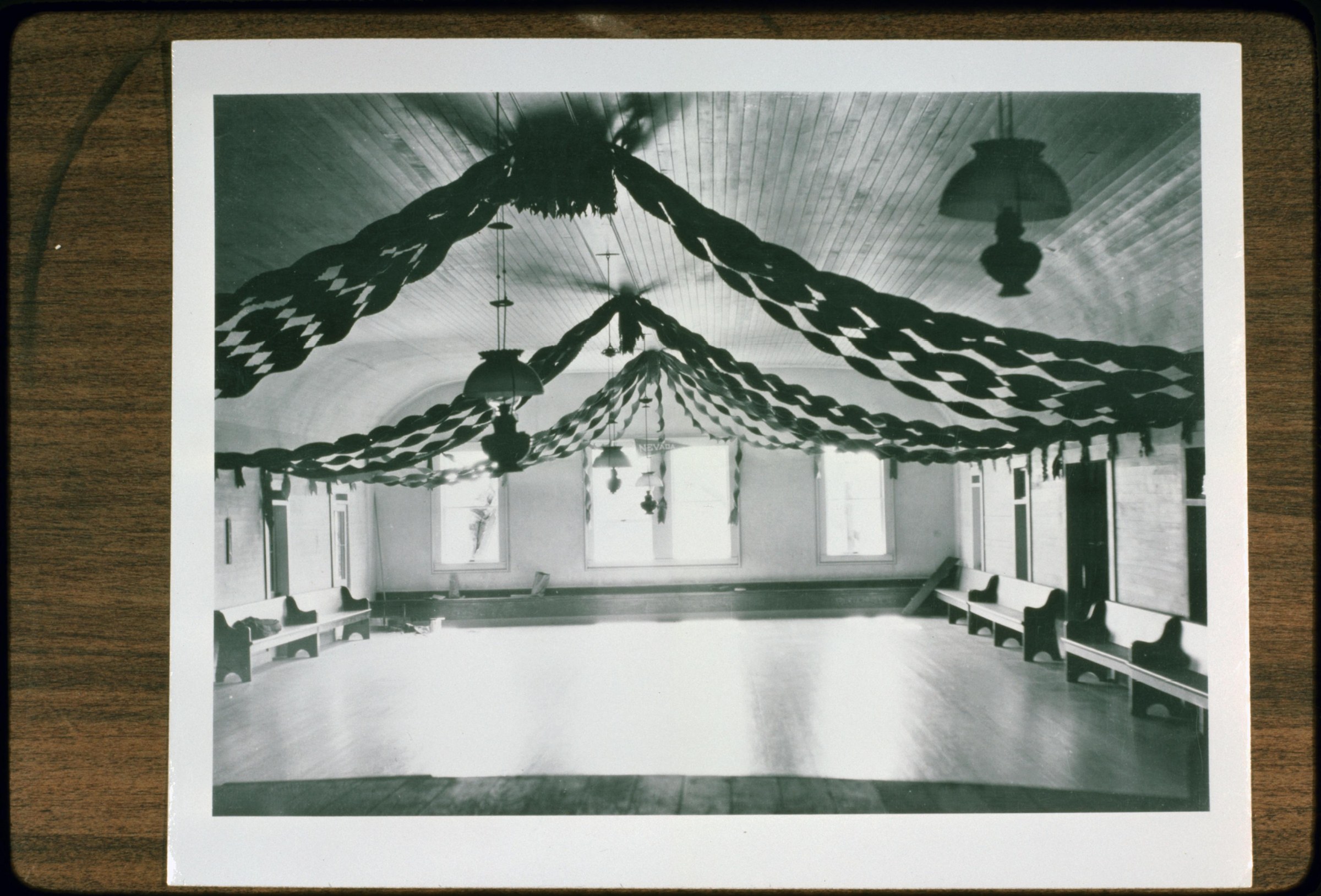
Dance Hall Above Kemler's Store
Unknown artist
- Collection:
- Prints & Photographs
- Source:
- Library of Congress
- Rights:
- Rights vary by item — check the source record before reusing this image. Source record ↗
- Recorded as:
- Library of Congress — no known restrictions (verify per item)
This image is a rare visual record of the physical and social infrastructure supporting everyday American social dance—the actual halls where communities gathered. Most dance history focuses on performers and movement; this photograph instead documents the spaces that made dance possible, revealing the values and resources rural communities invested in creating welcoming, decorated environments for collective movement and celebration.
What you are looking at
A large, bright interior space—a dance hall or gymnasium—is elaborately decorated for what appears to be a holiday celebration, likely Christmas or a formal dance event. The ceiling is draped with long dark fabric swags and garland arranged in radiating points from a central chandelier, creating a tent-like effect. Additional hanging decorations dangle from the apex. The room is lined with tall windows on both sides that flood the space with natural light, and the floor appears to be polished wood suitable for dancing. Simple wooden benches or seating line the perimeter walls. The space is empty of dancers at the moment of the photograph—the viewer sees the prepared hall before or after the event, or between dances. The severity and restraint of the decoration, combined with the simple furnishings, suggests this is a working community space rather than an elite venue.
The dancing
No dancers are visible in this image. The photograph documents the setting and decoration of the space rather than capturing dancers in motion or in specific holds.
The dance depicted
This is a documentary photograph of a dance hall interior, not a depiction of dance in progress. The image records the physical space where social dancing took place, likely in a rural American context given the title's reference to 'Kemler's Store.' The hall's design—with its simple furnishings, abundant windows, and decorated ceiling—is consistent with early-to-mid-twentieth-century rural social dance venues used for community gatherings, square dances, or other folk and social dances. Without dancers present, the specific dance style cannot be identified from movement or costuming.
How it was made
This is a black-and-white photograph on paper, likely a gelatin silver print or similar photographic medium common in the mid-twentieth century. The image shows the characteristic tonality and slight deterioration of age-print photography. The photographer's choice to capture the empty, decorated space emphasizes the architectural and decorative elements rather than human activity, suggesting documentation or archival intent—recording the physical infrastructure of community dance life.
About this work
This photograph documents the interior of a dance hall situated above a store, captured in its decorated state and ready for use. The space itself—its proportions, lighting, finishes, and embellishment—becomes the subject. The image is valuable as evidence of how rural American communities created and maintained spaces for social dancing in the early-to-mid twentieth century. It shows the care taken in decorating temporary venues and the integration of dance space into commercial buildings. The photograph preserves the material culture of folk and social dance life in America, a history often documented only through performance rather than architecture.
How to look at it
Observe the careful geometry of the ceiling decoration—the radiating swags and central focus—which would have framed dancers moving below and created a sense of occasion. Notice the abundant natural light from the windows, which would have made evening decoration and dancing possible without relying solely on artificial light. The empty floor invites imagining the bodies that filled it; the simple benches suggest an audience or resting dancers. The photograph captures intention and readiness rather than action.
The period
By 1979, when this photograph was taken, rural dance halls and community gathering spaces were already declining in many American regions, displaced by automobiles, paved roads, and urban entertainment options. The photograph may document a space that was already historical or closing—part of a broader mid-twentieth-century transformation of American social life away from geographically rooted community venues. The specific location above Kemler's Store suggests a small town or rural crossroads community where the store served as an economic and social anchor.
Where it lives
The photograph is held in the Library of Congress Prints & Photographs collection. It is catalogued as a historical documentary image related to American vernacular architecture and social life.
Questions about this work
Is this a photograph of an actual dance in progress?
No. The hall is empty and decorated, clearly photographed before, after, or between events. The image documents the space itself rather than capturing dancers or dancing.
What kind of dances would have taken place in a space like this?
Rural American community halls of this period hosted social dancing including square dances, contra dances, waltzes, and other folk and ballroom styles. The simple, open floor and modest furnishings are consistent with working-class and agricultural community gatherings.
Why is this building significant?
It exemplifies a now-vanishing infrastructure of American rural social life. Before cars and highways, small towns maintained local gathering spaces for dancing and celebration. The integration of the dance hall above a commercial store shows how closely social life and local commerce were woven together.
What does the decoration tell us?
The elaborate ceiling draping, despite the space's modest appointments, shows that communities took care to create festive, special environments for dancing. The holiday decoration suggests this hall was used for seasonal celebrations and formal community occasions, not just casual social dancing.
More dance artwork





