49 works in this view — arrow keys or swipe to move between them.
Dance in Art
Decorating the Hall the Night Before the Dance
Unknown artist
- Collection:
- Prints & Photographs
- Source:
- Library of Congress
- Rights:
- Rights vary by item — check the source record before reusing this image. Source record ↗
- Recorded as:
- Library of Congress — no known restrictions (verify per item)
This photograph documents the social and material reality of community dance culture: the preparation, the workers, the spaces, the ordinary moments that are the foundation of organized dance but rarely appear in art historical or dance historical records. For historians of grassroots and vernacular dance practice, this kind of everyday documentation is invaluable evidence of how and where dance happens in actual communities.
What you are looking at
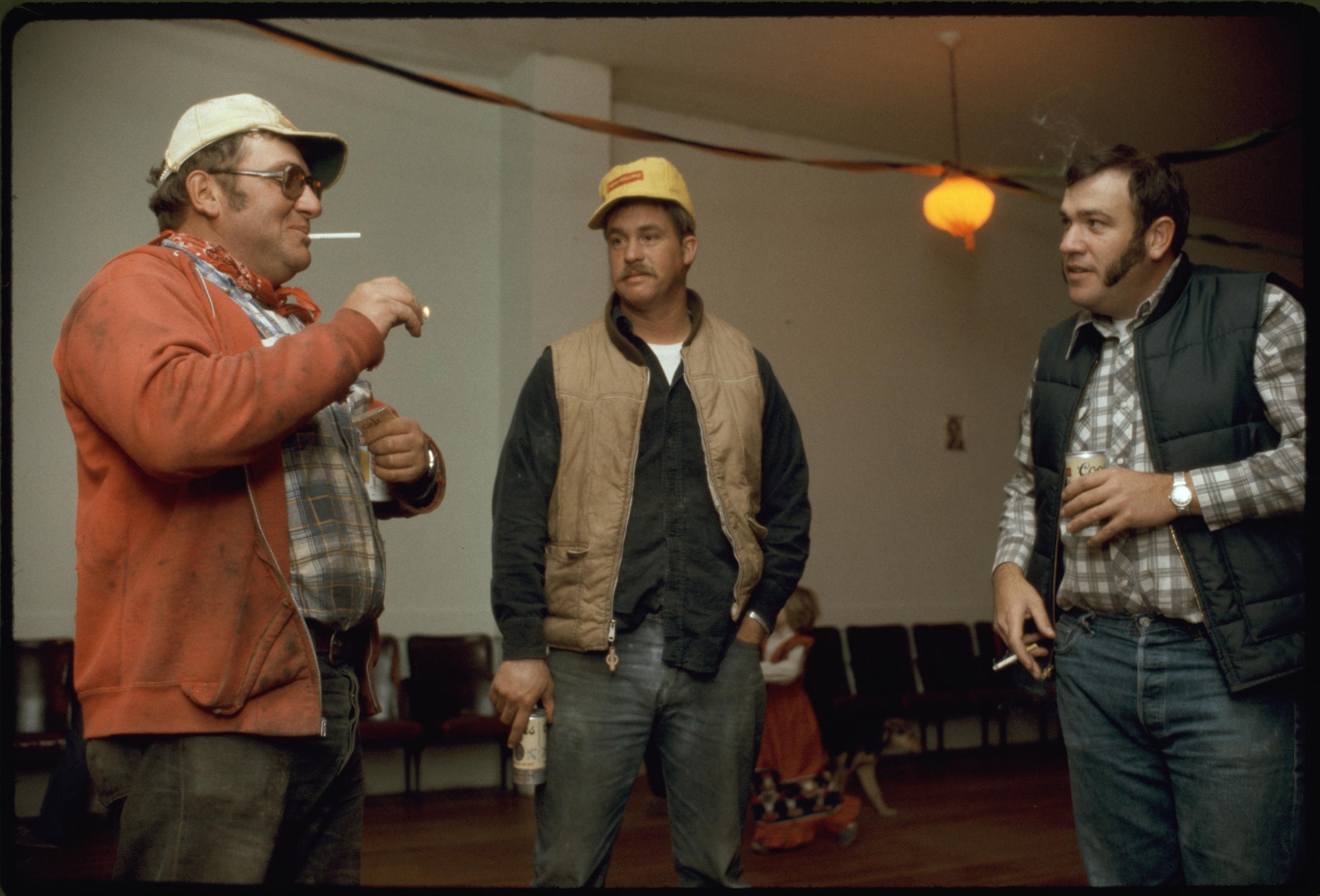
Three men in work clothes stand in the interior of what appears to be a community hall or gymnasium, engaged in conversation or instruction. The setting is institutional and austere: plain walls painted cream and brown, exposed ceiling with a yellow-painted hanging lamp, and what looks like bench seating visible in the background. The man on the left wears an orange-red jacket with a white cap and glasses, a red bandana around his neck, and holds something in his hands—possibly a cigarette. The man in the center wears a tan vest over a dark shirt and a yellow cap. The man on the right wears a dark and light plaid shirt with a dark vest and holds what appears to be a bottle. The photograph is color slide film, documentary in approach, capturing what seems to be a moment of everyday interaction rather than formal performance. The casual stance and interior setting suggest this is taken during a break or informal gathering, not a rehearsal or competition.
The dancing
The three men stand at angles to one another, none in a dance position or frame. Their posture is relaxed and conversational: weight is distributed casually, hands are occupied with cigarettes, bottles, or gestures of speech rather than any dance movement. There is no closed hold, no extension, no rhythm visible in the body. The composition is social and horizontal rather than vertical or dynamic. This is plainly not a depiction of dance movement, but of people occupying a space together.
The dance depicted
The image shows no dance. The title refers to the preparation of a hall *for* a dance, not the dance itself, and the photograph documents the human activity of decoration and social gathering before an event. The three men appear to be workers or organizers preparing the space. The image belongs in a dance archive for its documentary evidence of dance culture and community practice—the social infrastructure that enables dance—rather than for the depiction of movement itself.
How it was made
This is a color photographic slide from 1979, evidently shot in available indoor light with flash or window light, resulting in the visible ceiling fixtures and the warm, slightly flat lighting typical of institutional photography of the period. The slide format suggests it was part of a documentary project, perhaps for archival, journalistic, or community record-keeping purposes. The technical quality and casual framing indicate this is not a posed or professionally lit studio shot, but rather field documentation.
About this work
This 1979 color photograph documents three men in the interior of a community hall, apparently preparing or organizing the space for a dance event. The title *Decorating the Hall the Night Before the Dance* establishes the social and temporal context: this is the work that precedes performance, the community labor that makes dance possible. The image has value not as a depiction of dance movement, but as evidence of the human activity, the spaces, and the ordinary labor that sustain dance as a social practice. It records a moment in the life cycle of a community dance—the infrastructure, the people, the setting—that is often absent from formal dance documentation.
How to look at it
Attend to the setting and the moment: this is a community space in its unlived state, empty except for the workers, lit by institutional fixtures, still in the process of transformation. The photograph captures the threshold moment—not yet decorated, not yet a dance space, but on the way. The informality and candor of the image, the casual dress and conversation, the bottles and cigarettes, document the human reality of this work. Note what is *not* shown: the eventual decoration, the dancers, the performance. This is the prelude.
The period
By 1979, color slide photography was a standard documentary tool for community organizations, local government, and archival institutions in North America. This appears to be part of a systematic record of community life, possibly by a public agency, local history project, or community center. The casual, inclusive approach to documentation—capturing preparation rather than performance—reflects the documentary photography practices and social history interests that gained prominence in the 1970s, when institutions began recording everyday life and ordinary people as worthy subjects for preservation.
Where it lives
The image is held in the Prints & Photographs Collection of the Library of Congress, indicating it is part of a larger documentary project or collection acquired by that institution. The source information suggests it was created as part of community or public documentation, though the specific project, photographer, and context are not recorded in the available catalogue data.
Questions about this work
Why is this in a dance archive if there is no dancing in the picture?
Dance history includes more than performance. This photograph documents the social infrastructure of dance—the spaces, the community work, the preparations that make organized dance possible. For scholars studying vernacular and community dance culture, this kind of evidence of everyday practice is as important as formal performance documentation.
What kind of dance was planned for that evening?
The photograph does not indicate what kind of dance would follow. The informal dress, the community hall setting, and the casual gathering suggest this could have been a social dance—country western, ballroom, swing, or another vernacular form—but the image itself provides no definitive evidence.
Where was this taken and who are these men?
The catalogue record does not identify the location, the photographer, or the individuals pictured. The Library of Congress holds the print as part of its documentary collections, but without further documentation, the specific community and context remain unknown.
More dance artwork





