49 works in this view — arrow keys or swipe to move between them.
Dance in Art
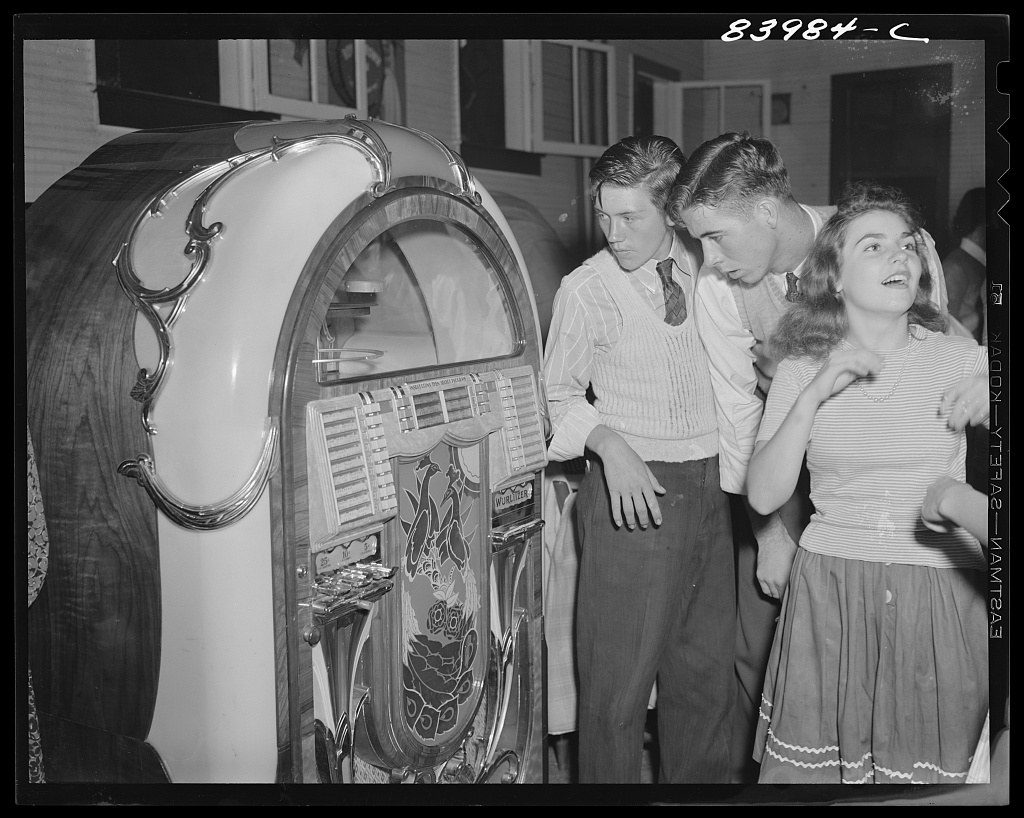
Richwood, West Virginia. Dance hall
Unknown artist
- Collection:
- Prints & Photographs
- Source:
- Library of Congress
- Rights:
- Rights vary by item — check the source record before reusing this image. Source record ↗
- Recorded as:
- Library of Congress — no known restrictions (verify per item)
Jukeboxes transformed American social dance by replacing live musicians with recorded music available on demand, making dancing accessible and affordable in rural areas far from concert halls. This photograph is one of few visual records of that shift, capturing both the machine and the human pleasure it enabled. For dance historians studying vernacular and social dance, it documents the material conditions under which millions of Americans danced in the 1940s.
What you are looking at
A large jukebox dominates the left side of this photograph, its rounded chrome and glass cabinet decorated with ornamental designs visible through the open door. Three young people stand to the right, gazing at the machine with evident interest and pleasure. The man in the center wears a light pinstriped shirt; the woman beside him wears a striped short-sleeved top and a full skirt with decorative trim at the hem. Behind them, a dimly lit interior space suggests a public venue—a dance hall or juke joint—with white painted walls and doorways visible in the soft, overhead lighting. The photograph is black and white, shot indoors with available light that casts subtle shadows and reveals the texture of the industrial or commercial setting.
The dancing
The three figures are posed in a moment of contemplation rather than active dance. The woman's posture is relaxed, her weight on one leg, her gaze fixed on the jukebox with a slight upward tilt of her head suggesting wonder or pleasure. The two men lean in at angles that suggest casual interest rather than formal poses. None are in a dance frame or position; their bodies communicate the informal social interaction of patron-machine engagement rather than dance performance.
The dance depicted
This is not a depiction of dance in progress. Rather, it documents the social setting and the technology that enabled dance—the jukebox as the source of music for informal social dancing in a rural American venue. The photograph captures the moment before or between dances, showing how working-class Americans of the 1940s accessed live music for dancing. The clothing and setting suggest this is a space where jazz, blues, swing, or country music would have been played, and patrons would have danced informally to it.
How it was made
This is a black-and-white photograph, likely taken with a portable camera by a documenter visiting Richwood. The composition and lighting technique—using available indoor light with careful exposure to capture both the bright jukebox and the darker interior—suggest professional or semi-professional photographic practice. The clarity and detail visible in the clothing, the machine's decoration, and the setting indicate this was shot on film stock capable of fine resolution, making it suitable for news or documentary publication.
About this work
This photograph documents a jukebox in a dance hall in Richwood, West Virginia, in 1942, capturing the material culture and social practice of working-class American dancing in the early 1940s. The jukebox—a relatively new technology in rural areas—was the primary means by which ordinary Americans accessed music for dancing in public venues. The image shows three patrons in a moment of leisure and choice, selecting the music that would animate their evening. It is a rare visual record of the technology and venue that made social dancing possible in Depression- and wartime America, before live bands or recorded music became ubiquitous.
The work belongs in a dance archive not as a representation of choreography or technique, but as evidence of how and where dancing happened for ordinary people. The jukebox is the dance floor's twin technology; it made social dancing democratic and continuous, available to anyone who had a coin. This image preserves that moment and that choice.
How to look at it
Attend to the jukebox itself: the ornate decoration, the visible mechanism inside, the glass and chrome that made it both a machine and a piece of furniture worthy of a public space. Notice the casual posture of the three figures and their genuine absorption in the moment of selection—this captures the ordinary pleasure of choosing music. The photographer has chosen to show the technology that enabled dancing rather than the dancing itself, suggesting that understanding dance in this era requires understanding the machines that produced its music.
The artist
The photographer is not recorded. The image bears the Library of Congress archive number 83984-C, suggesting it was part of a systematic documentary project, possibly the Farm Security Administration (FSA) or a similar New Deal-era photography initiative that documented American life and work during the Depression and war years. These projects aimed to create a comprehensive visual record of American communities and conditions.
The period
In 1942, America was at war, and the jukebox was a fixture of working-class leisure and morale. Swing music and blues were dominant genres played on jukeboxes; musicians were being drafted, and live performances were less available in rural areas. The jukebox had become a central technology of American social life, especially in rural dance halls, roadhouses, and taverns. Photographically, the early 1940s saw a shift toward documentary realism and candid capture of everyday life, moving away from posed studio portraiture toward images that showed people in their natural social contexts.
Where it lives
The photograph is held by the Library of Congress Prints & Photographs Online Catalog and comes from what appears to be a mid-20th-century documentary photography collection, likely created as part of a government or journalistic survey of American life. The archival number and the systematic recording of place and date suggest institutional documentation rather than personal or artistic practice.
Questions about this work
What is a jukebox and why does it matter to dance history?
A jukebox is an automatic phonograph that plays recorded music when a coin is inserted and a selection is made. Before the jukebox became widespread in the 1930s–1940s, social dancing in public spaces depended on live musicians or radio broadcast. The jukebox democratized access to music for dancing, making it continuous, affordable, and available on demand—especially in rural areas. For millions of ordinary Americans, the jukebox was how they danced.
Why photograph a jukebox instead of dancers?
This photograph documents the material and social conditions of dance rather than the dance itself. By showing the technology that made dancing possible, the photographer captures something essential: for working-class and rural Americans in the 1940s, dancing was inseparable from the machine that provided music. The image is evidence that dance happened here, enabled by this technology.
What does the clothing tell us?
The woman's full skirt with decorative trim and the men's casual but neat shirts suggest modest means and Sunday-best or evening-out dress. This was the clothing of working people in rural West Virginia in 1942—not formal wear, but cleaned up and chosen for a public occasion. It indicates that dancing was a valued social event, worth dressing for.
Who took this photograph and why?
The photographer is not identified in the record, but the systematic cataloging and the Library of Congress provenance suggest this was part of a mid-20th-century documentary project, possibly the FSA or a similar initiative. These projects aimed to create a comprehensive visual record of American communities and conditions during the Depression and war years.
More dance artwork





