49 works in this view — arrow keys or swipe to move between them.
Dance in Art
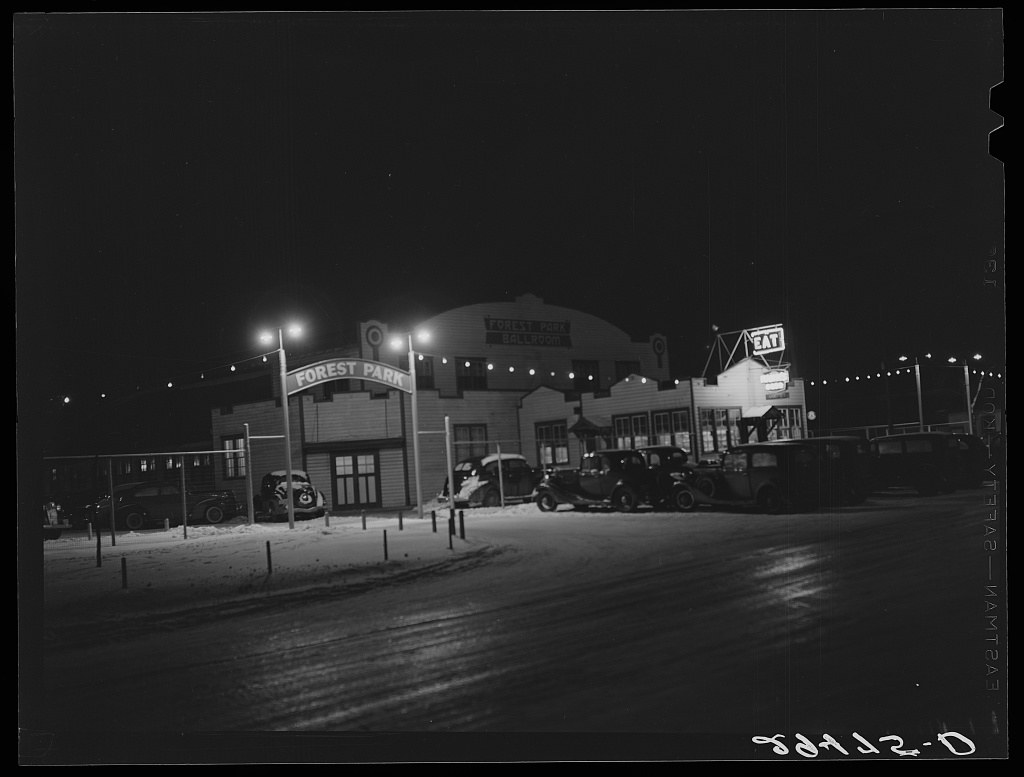
Dance hall, Saturday night. Marshalltown, Iowa
Unknown artist
- Collection:
- Prints & Photographs
- Source:
- Library of Congress
- Rights:
- Rights vary by item — check the source record before reusing this image. Source record ↗
- Recorded as:
- Library of Congress — no known restrictions (verify per item)
For dance historians, this photograph is evidence of the ubiquity and normalcy of public dance halls in small-town America and the investment communities made in them. It shows that dance was not a theatrical or elite activity but a routine Saturday-night social institution, supported by commercial enterprise and automobile culture. The photograph documents a vanished social world.
What you are looking at
A nighttime photograph of the Forest Park dance hall in Marshalltown, Iowa, its facade brilliantly lit by floodlights and strings of small lights strung across the front. The building is a substantial structure with a curved roof and prominent signage. The parking area in front is occupied by several automobiles of 1930s–40s vintage, parked at angles suggesting the casual arrival of patrons. The wet pavement reflects the electric lights, indicating recent rain. The composition captures the building as a destination—a place of public entertainment and social gathering. The surrounding darkness emphasizes the hall's isolation and the intensity of its artificial illumination, a marker of modernity and commercial leisure in rural Iowa.
The dancing
No dancers are visible in this photograph. The image documents the exterior venue rather than the dancing inside. Figures of people may be glimpsed near the entrance or windows, but they are too distant and too small to discern posture, hold, or movement. This is a photograph of the building as a social space, not a record of dance in progress.
The dance depicted
The image does not depict dance itself but rather documents the venue where dance took place. The title explicitly identifies this as a dance hall in operation on a Saturday night—the peak social time. Rural American dance halls of the 1930s–40s hosted vernacular social dancing: country western, swing, blues, and ballroom styles. The photograph testifies to the importance of such spaces in small-town social life, particularly before television made home entertainment dominant. Without interior views, we cannot identify specific dance styles, but the scale and prominence of the hall suggest it hosted mixed-couple dancing of the popular ballroom and swing repertoire.
How it was made
This is a black-and-white photograph, almost certainly taken with a large-format camera and printed as a photographic negative or print. The technical control of the nighttime lighting—the ability to render both the flood-lit building and the dark sky with detail—indicates professional photography, likely using a tripod and calculated exposure. The image is stamped with a Library of Congress accession code visible in the lower right, identifying it as part of a documentary survey. This suggests it was part of a systematic record-making project, not a commercial or artistic photograph intended for exhibition.
About this work
This is a documentary photograph of the Forest Park dance hall in Marshalltown, Iowa, taken in 1940 as part of what appears to be a Works Progress Administration or Library of Congress survey of American public life. It records not the dance itself but the commercial and social infrastructure that enabled vernacular social dancing in rural America. The photograph captures a moment of modernity in a small town: electric light, automobiles, and a dedicated public space for recreation and courtship. It belongs in a gallery about dance because it documents the venues, economics, and social context that made amateur social dance a central leisure activity for ordinary Americans before mid-century.
How to look at it
Study the scale and design of the building itself: its prominent signage, the deliberate placement of lights, the investment in curb appeal. Note the automobiles—their models and arrangement suggest steady foot traffic. Observe the contrast between the bright, artificial illumination of the hall and the surrounding darkness, which makes the building a beacon in the night. The wet pavement suggests the photograph was taken after or during rain, a detail that underscores the importance of the outing: people came to dance regardless of weather. This is a photograph about infrastructure and social desire, not about dance steps.
The artist
The photographer is not recorded. The style, documentation approach, and archival markup indicate this was part of a systematic government survey of American life, possibly undertaken by the Farm Security Administration or a similar New Deal program. Such surveys employed photographers to record everyday American places and practices as historical record.
The period
In the 1930s and 1940s, public dance halls were central to American social life, especially in small towns and rural areas. They provided spaces for unmarried men and women to meet, for couples to court, and for communities to gather. The architecture and lighting of the Forest Park hall—modern, well-lit, designed to attract—reflects the commercialization of leisure during this period. Saturday nights were the peak social time, and dance halls competed for patrons with music, comfort, and reputation. This photograph was made just before television and suburban car culture began to erode the centrality of the town dance hall to American social life.
Where it lives
This photograph is held by the Library of Congress, Prints & Photographs Online Catalog. The accession code visible in the image indicates it was part of a documentary survey, likely a New Deal-era project to record American communities.
Questions about this work
Why is this photograph important if it doesn't show dancers?
It documents the physical and commercial context that made social dancing possible and central to small-town life. The building, lighting, parking, and evident popularity tell us that dance was not an exotic or marginal activity but a routine weekend expectation. For social historians and dance historians, the venue is as important as the movement.
What kinds of dances would have happened inside this hall?
In 1940 in rural Iowa, the mix would have included swing, country western styles, ballroom dances like the waltz and foxtrot, and blues dances. Live bands were standard. The specific repertoire would depend on the hall's management and the musicians hired, but the audience was ordinary working people dancing socially, not performance or competition.
When was this photograph taken and why?
The photograph is dated 1940. It appears to have been taken as part of a government documentary project, possibly the Farm Security Administration or similar New Deal program, to record American life during the Depression and early wartime. Such projects aimed to create a comprehensive visual record of the nation.
More dance artwork





