49 works in this view — arrow keys or swipe to move between them.
Dance in Art
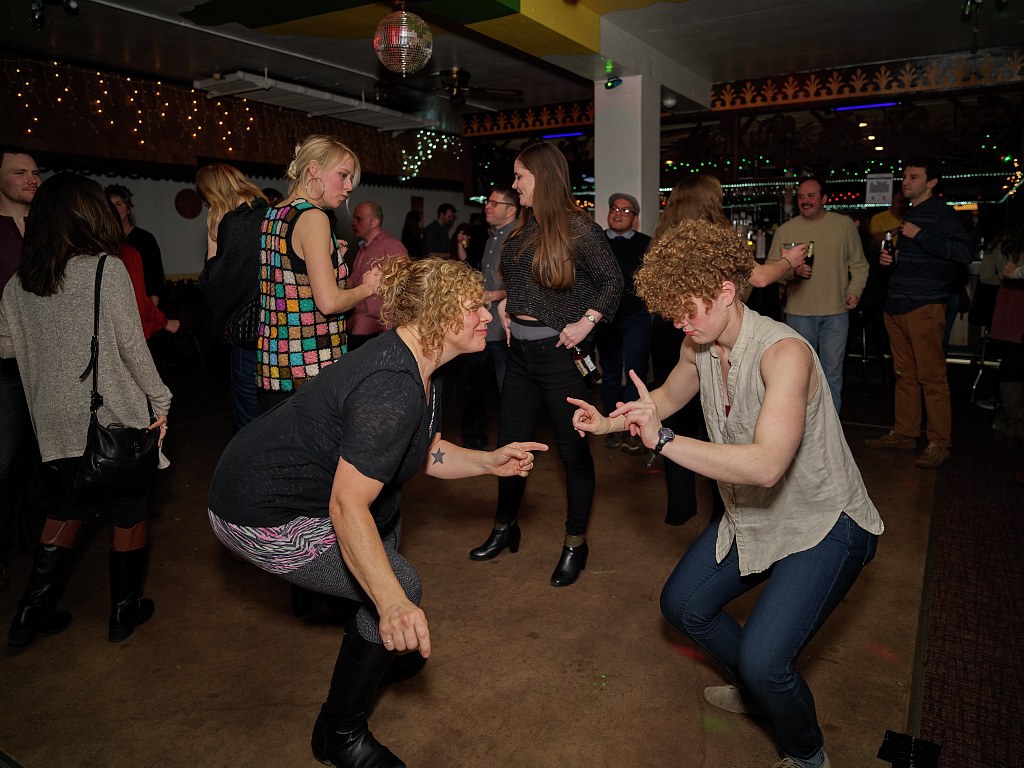
Dancers at the The Lithuanian Hall, also known as Lith Hall, the home of the Lithuanian Hall Association in Baltimore, Maryland
Unknown artist
- Collection:
- Prints & Photographs
- Source:
- Library of Congress
- Rights:
- Rights vary by item — check the source record before reusing this image. Source record ↗
- Recorded as:
- Library of Congress — no known restrictions (verify per item)
This work is evidence of how dance lives in community spaces, particularly in diaspora contexts, as social practice rather than spectacle or art form. It shows the venues, the intergenerational participation, and the non-professional, playful character of community dance that is often absent from formal dance histories and collections.
What you are looking at
A lively social dance scene indoors at what appears to be a community hall, photographed in 2018. The space is decorated for celebration with a disco ball suspended from the ceiling, strings of lights outlining the walls, and decorative patterned trim near the roof. In the foreground, two women with curly reddish hair dance together in a playful, energetic pose—both are bent at the knees in a squat-like stance, arms extended toward each other in a gestural frame, their bodies angled toward one another. One wears a black sleeveless top with striped trim at the waist; the other wears a beige sleeveless vest. Around them, several dozen guests in casual and semi-formal dress mill about, some watching, some conversing. The warm overhead lighting casts a golden tone across the wooden dance floor. The setting and atmosphere suggest a community gathering, reunion, or celebration rather than a formal performance or staged photograph.
The dancing
The two dancers in the center occupy a playful, non-technical pose: both are in a low squat with knees bent, weight distributed evenly, torsos upright, and arms bent at the elbows with hands gesturing toward each other in a friendly, conversational manner. There is no closed hold or formal ballroom frame. Their body language is relaxed and social rather than trained or structured. The surrounding dancers appear to be moving informally or stationary, with no visible coordinated choreography or unified style among the group.
The dance depicted
This appears to be vernacular social dance at a community gathering rather than a trained or choreographed style. The squat-based pose with gestural arm work is consistent with contemporary club or party dance idioms, possibly house or freestyle movement, but the context—a casual community hall gathering—suggests improvised, non-professional social dancing. The playful, low-energy posture and the mixed ages and casual dress of other guests indicate recreational participation rather than performance. Without clearer evidence of a specific named style, it is most accurately identified as contemporary social dancing within a community or diasporic context.
How it was made
This is a color photograph taken in 2018, as indicated by the record. The image shows the characteristics of digital photography: natural color rendition, sharp focus in the foreground with softer detail in the background, and warm artificial lighting from overhead fixtures. The casual, documentary quality suggests this was taken as a record of a community event rather than as fine art photography; it has the immediacy and composition of event documentation or social photography.
About this work
This photograph documents contemporary social dance at the Lithuanian Hall in Baltimore, Maryland, a community venue serving the local Lithuanian diaspora. It captures an informal moment of celebration and social participation, showing how dance functions in community life outside the contexts of performance, instruction, or competitive sport. The image is valuable as ethnographic documentation of how diaspora communities maintain social bonds and cultural practice through informal gathering and movement.
How to look at it
Note the squat-based posture of the two foreground dancers and the gestural, conversational quality of their arm and hand movement—this is characteristic of contemporary freestyle or house-influenced social dance rather than ballroom, Latin, or other codified styles. Observe the relaxed, non-technical quality of the pose and the social context (mixed ages, casual dress, conversational groups nearby), which indicates this is participatory community dance rather than performance. The warm lighting and decorated space signal celebration and intentional gathering.
The period
This photograph was taken in 2018, a moment when diaspora communities in the United States continued to use ethnic social halls as sites of cultural maintenance and intergenerational transmission. The Lithuanian Hall in Baltimore has a documented history as a cultural and social center. The image reflects early 21st-century casual documentation practices and the prevalence of digital photography in recording community life.
Where it lives
This photograph is held in the Prints & Photographs collection at the Library of Congress and is documented as being from the Lithuanian Hall Association in Baltimore, Maryland, a community institution serving the local Lithuanian diaspora.
Questions about this work
What is the Lithuanian Hall and why does it matter?
The Lithuanian Hall is a community center in Baltimore that has served the Lithuanian-American diaspora as a social and cultural venue for generations. Ethnic social halls like this one are crucial sites where immigrant and diaspora communities maintain cultural practice, transmit traditions across generations, and build social bonds through events like dances, celebrations, and gatherings.
What dance style is shown in this photograph?
The dancers are engaged in informal, contemporary social dance rather than a named or codified style. The squat-based posture and gestural arm work are consistent with freestyle or house-influenced movement. This is vernacular social dancing—the everyday dance of community celebration rather than performance or instruction.
Why photograph a community dance rather than a professional performance?
Community dance is an important subject for documentation because it shows how dance functions in real life outside concert halls and competitions. Photographs like this one provide evidence of how diaspora communities use dance and celebration to maintain cultural identity, build intergenerational relationships, and sustain community bonds.
More dance artwork





