49 works in this view — arrow keys or swipe to move between them.
Dance in Art
The Brownies' Dancing School
Unknown artist
- Collection:
- Prints & Photographs
- Source:
- Library of Congress
- Rights:
- Rights vary by item — check the source record before reusing this image. Source record ↗
- Recorded as:
- Library of Congress — no known restrictions (verify per item)
This work documents the cultural currency of dance imagery in late-Victorian illustration and children's literature, showing how dance—even imaginary, supernatural dance—was understood as a core marker of liveliness, play, and magical transformation. It is evidence of how dance functioned symbolically in the visual culture of the period, separate from any codified dance practice.
What you are looking at
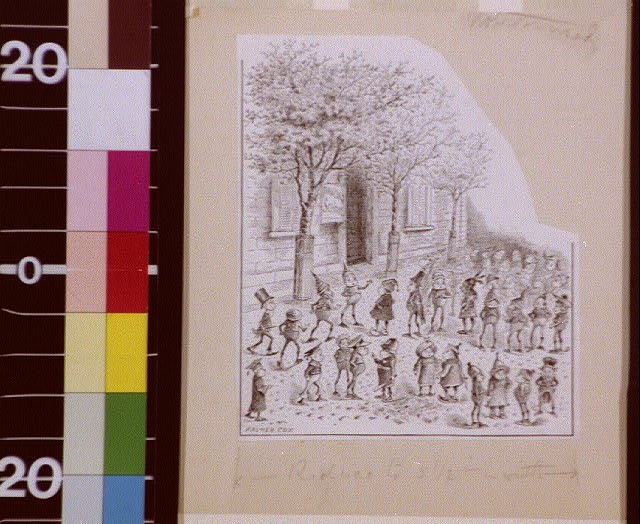
A crowded outdoor gathering under bare-branched trees, rendered in fine pen-and-ink with careful cross-hatching for depth and shadow. Dozens of small figures, apparently children, occupy a paved or open ground before a building with tall arched windows and doors. The composition is structured around a architectural backdrop—possibly a courtyard or institutional space—with the crowd distributed unevenly across the foreground. The rendering is delicate and precise, with considerable attention to individual postures and the variety of poses among the assembled group. The bare trees and open air suggest spring or autumn. The title "The Brownies' Dancing School" and the density of small figures suggest this depicts a fanciful or allegorical scene rather than documentary reportage, though the architectural setting is rendered with real spatial specificity.
The dancing
The figures are minute and numerous, making individual posture difficult to assess, but the engraver has clearly differentiated their attitudes: some appear to have arms raised or extended, others stand in conversation or observation, and a few seem to be in motion or grouped as if dancing. The scale (dozens of figures, each only a few millimetres tall) and the lack of partnering or ballroom hold suggests informal, playful movement rather than codified dance. No clear evidence of pointe shoes, tutus, or formal ballroom costume; the figures appear to wear simple dress consistent with the period and scale of the work.
The dance depicted
The title references the Brownies of Celtic folklore—mischievous supernatural creatures—and this appears to be a whimsical or allegorical illustration rather than a record of actual dance practice. Without clearer detail or an identified artist and publication context, the specific dance cannot be determined. The gathering resembles a children's play-dance or festival scene in the manner of late-Victorian illustration. The composition and title suggest this may be from a children's story, fairy tale illustration, or whimsical periodical publication of the 1900s era.
How it was made
This is a fine engraving or etching, executed with meticulous pen-and-ink linework and cross-hatching to create tonal modulation and atmospheric depth. The technique is characteristic of commercial book or periodical illustration of the 1890s–1910s. The precision of the line and the architectural rendering suggest professional production, probably for mass reproduction in print. The method allowed for wide circulation through photomechanical reproduction in books and magazines aimed at middle-class family audiences.
About this work
This is a whimsical engraved illustration titled "The Brownies' Dancing School," dated around 1900, depicting an imaginary gathering of Brownies (folkloric mischievous creatures) in an architectural setting. The work belongs to the tradition of late-Victorian illustrated fantasy and children's literature, using careful engraving technique to render both spatial architecture and numerous small animated figures. It sits at the intersection of dance imagery and literary illustration—documenting not actual dance practice but the cultural fantasy of supernatural revelry, a common motif in the period's illustrated folklore and children's books.
How to look at it
Look first at the composition: the artist has arranged the crowd asymmetrically, with density varying across the ground to create spatial recession and visual rhythm. Notice how individual figures are differentiated despite their miniature scale—varied stance and gesture suggest choreographed liveliness without literal narrative. The bare trees and architectural frame establish plausibility even for an impossible scene. The cross-hatching creates a soft, atmospheric quality appropriate to a fairy-tale setting rather than the hard clarity of documentary reportage.
The period
Around 1900, illustrated stories of folklore, fairy tales, and anthropomorphised creatures were extremely popular in British and American publishing. The "Brownie" as a figure appeared in Kate Greenaway's work and in children's periodicals of the period. The engraving technique and the subject matter place this firmly in the commercial illustrated press aimed at educated, middle-class families. Simultaneously, theatrical ballet and music-hall entertainment were booming, and dance imagery was pervasive in popular illustration. This work belongs to the lighter, more fantastical end of that spectrum.
Where it lives
Held in the Prints & Photographs collection of the Library of Congress. The catalogue record provides title, approximate date, and medium type but no artist attribution, publication source, or other contextual information. This is characteristic of the Library's holdings of commercial book and periodical illustrations from the period, many of which remain inadequately catalogued.
Questions about this work
What are Brownies and why are they dancing?
Brownies are creatures from Celtic and Germanic folklore, imagined as small, mischievous supernatural beings who perform household labour or revelry by night. In Victorian illustrated literature, they were popular subjects for whimsical, magical scenes. A "dancing school" for Brownies is an invention of the artist or the source publication—a fanciful conceit to render folkloric magic as visible animation.
Who is the artist?
The catalogue record does not identify the artist. Without additional information about the source publication or provenance, the maker cannot be determined from the image alone. The style and technique are consistent with professional commercial engraving of the 1890s–1910s.
Is this a real dance?
No. This is an allegorical or fantastical illustration, not a record of an actual dance or dance practice. It depicts an imaginary gathering of folkloric creatures in a playful, lively scene. The dance-like activity shown is part of the fantasy, not documentation of human dance.
What publication did this come from?
The source publication is not recorded. The style and subject matter suggest it may have been an illustration from a children's book, fairy tale collection, or periodical aimed at family audiences in the period around 1900.
More dance artwork





