49 works in this view — arrow keys or swipe to move between them.
Dance in Art
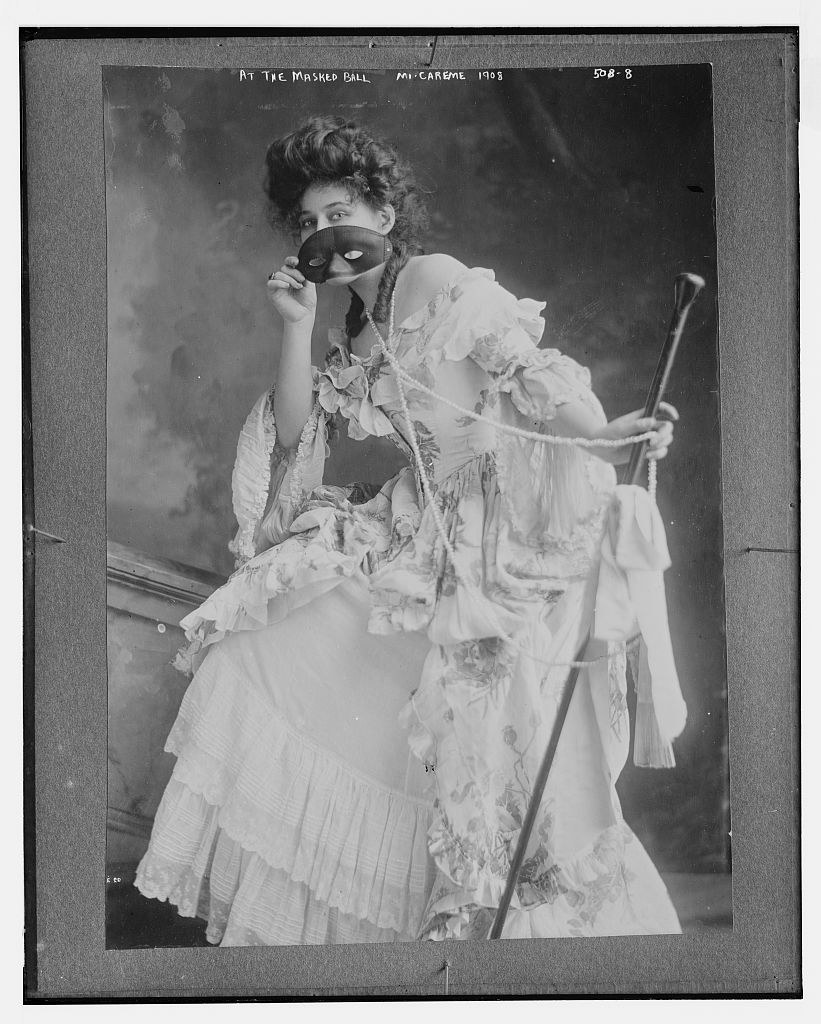
Masquerade Ball-Mi-Careme
Unknown artist
- Collection:
- Prints & Photographs
- Source:
- Library of Congress
- Rights:
- Rights vary by item — check the source record before reusing this image. Source record ↗
- Recorded as:
- Library of Congress — no known restrictions (verify per item)
The photograph reveals the elaborate material and aesthetic context of early 1900s ballroom culture: the cost, complexity, and visual spectacle of costume and presentation that were central to how women performed femininity and status in social dance. For historians of dance, dress, and gender, it shows the visual grammar of the masquerade ball and the theatrical staging that turned social dance into costume performance.
What you are looking at
A woman in elaborate Edwardian-era costume holds a black eye mask to her face with one hand while striking a theatrical pose. She wears a white muslin gown with voluminous puffed sleeves, deep lace or ruffle trim at the bodice and multiple tiers of ruffled flounces at the skirt hem. A long rope of beads or pearls drapes diagonally across her torso. In her other hand she holds what appears to be a theatrical baton or pointer. Her hair is elaborately styled in the Gibson Girl fashion of the period. The photograph is shot against a plain studio backdrop with soft, diffused lighting typical of early 1900s portraiture. The masquerade mask and theatrical props suggest this is a costume portrait rather than a dance documentation—the woman poses for the camera rather than executing movement.
The dancing
A single figure occupies the frame in a standing, three-quarter pose. Her weight shifts slightly to one side, creating an S-curve silhouette characteristic of Edwardian posture. One arm is raised to hold the mask near her face at an angle that plays to the camera; the other extends to the side holding a prop. Her body is still and composed rather than captured in motion, suggesting this is portraiture rather than action documentation. The overall frame is one of display and invitation to look rather than the dynamic capture of dance in progress.
The dance depicted
The image does not depict dance in motion. Rather, it is a costume portrait of someone dressed for a masquerade ball—likely a Mardi Gras or carnival-themed social event (Mi-Carême, the mid-Lenten carnival celebration). The theatrical baton and mask are props of a masquerade costume, not evidence of a specific dance form. The elaborate white gown and beaded accessories were the formal dress worn to such balls by women of the leisure class, and the styling suggests the photograph documents costume and fashion rather than choreography or technique. The pose and lighting are those of early 1900s studio portraiture.
How it was made
This is a black-and-white photographic print, likely gelatin silver or similar process, mounted on a card stock backing with an archive label. The soft, even lighting and carefully composed pose are characteristic of early 1900s studio portrait work, where subjects were positioned and directed rather than captured candid. The photograph's technical quality—sharp focus, controlled exposure, formal cropping—suggests professional studio work, and the date label (1908) and collection notation confirm its status as an archival photograph rather than a casual snapshot. This technique allowed wide circulation and reproduction, making it suitable for press, theatrical archives, or collector albums of the period.
About this work
This is a studio portrait photograph from 1908 documenting the costume and styling worn to a masquerade ball or carnival celebration, specifically a Mi-Carême (mid-Lenten carnival) event. The subject is a woman of evident social standing, posed to display her fashionable gown, elaborate jewelry, and theatrical accessories. While the image belongs in a dance archive because masquerade balls were central social dances of the Edwardian era and because the costume and setting reveal what women wore to dance, it does not itself depict dance movement or technique. Instead, it documents the material culture, fashion, and social ritual surrounding ballroom dance in the early 1900s—the dress, the props, the theatrical styling that framed women's participation in these events.
How to look at it
Attend to the costume rather than movement: the architectural complexity of the gown, the weight of the jewelry, the construction of the hair. Note that this is a static portrait pose, not a captured moment of dance. The mask is held rather than worn, a theatrical gesture for the camera. The baton is a prop of masquerade theatricality rather than a dance implement. This is a photograph about display—how a woman of the era presented herself to be seen at a formal social event.
The period
Masquerade balls and carnival celebrations were fixtures of urban social life in the early 1900s, particularly in cities with strong French cultural influence such as New Orleans. The Mi-Carême tradition—a mid-Lenten carnival celebration—was a moment when social hierarchies could be theatrically inverted through costume and mask. The Edwardian era saw an explosion of consumer fashion and a newly visible culture of leisure among the middle and upper classes. Studio portraiture had become an accessible and fashionable way to document oneself in costume, and theatrical or fancy-dress photography was a popular genre. The Gibson Girl silhouette visible in this woman's styling was the dominant beauty ideal of the period.
Where it lives
The photograph is held in the Prints & Photographs collection of the Library of Congress. The archive label indicates it was catalogued as a theatrical or costume study, likely preserved as part of documentation of American social life and performance culture in the early 1900s.
Questions about this work
Is this a photograph of someone actually dancing?
No. This is a studio portrait taken before or after the event, with the subject posed in costume for the camera. The static posture, carefully arranged props, and studio lighting are all characteristic of portraiture rather than action photography. Early 1900s photographic technology could capture dance in motion, but this image was not intended to.
What is a Mi-Carême masquerade ball?
Mi-Carême (mid-Lenten carnival) was a carnival celebration held in the middle of Lent, traditionally in French and Creole communities. Masquerade balls during this season featured elaborate costumes, masks, and theatrical performances. They were major social events where dance, particularly ballroom dances like quadrilles and waltzes, was central to the evening.
What does the costume tell us about ballroom dance of this era?
The elaborate gown, with its trained skirt, full sleeves, and tight corseting, would have constrained movement significantly. The weight of the beads and the complexity of the hair styling were part of the performance. This shows that Edwardian ballroom dance was as much about display and presentation as movement—women's bodies were dressed to be looked at while moving through formal, controlled patterns.
More dance artwork





