49 works in this view — arrow keys or swipe to move between them.
Dance in Art
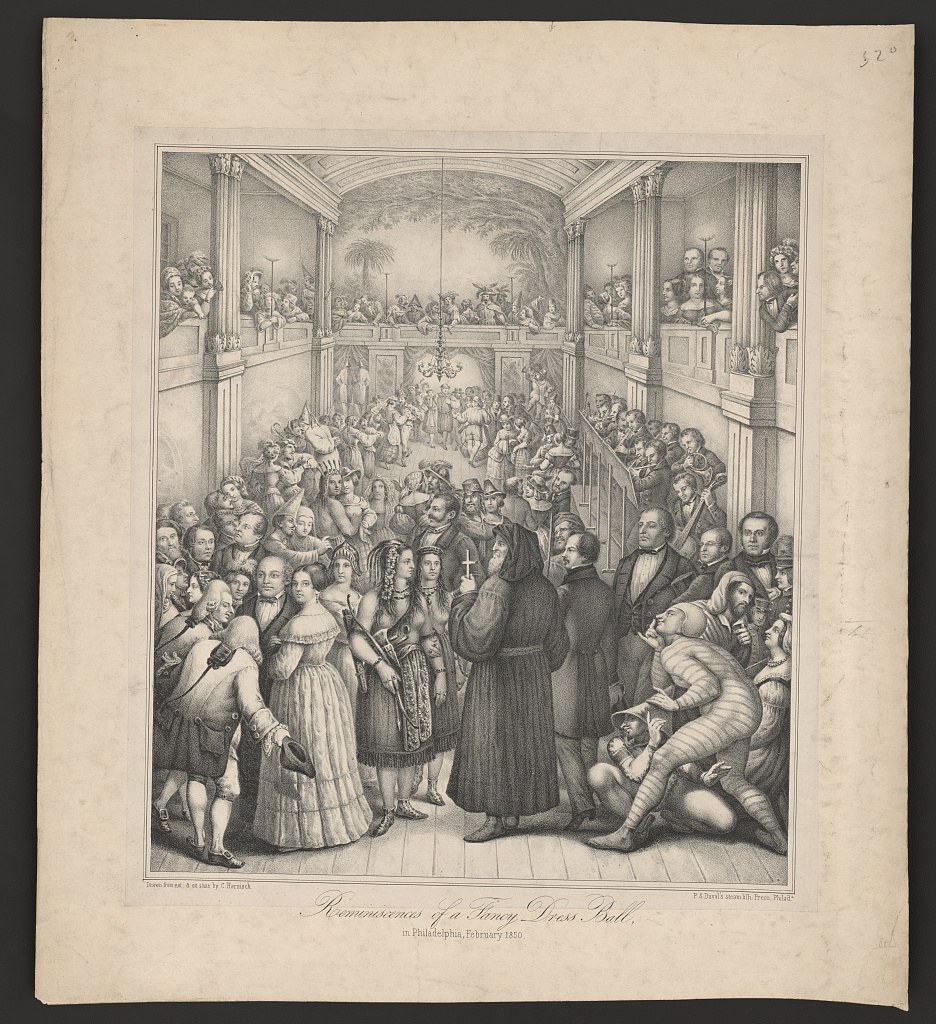
Reminiscences of a fancy dress ball, in Philadelphia, February 1850
Unknown artist
- Collection:
- Prints & Photographs
- Source:
- Library of Congress
- Rights:
- Rights vary by item — check the source record before reusing this image. Source record ↗
- Recorded as:
- Library of Congress — no known restrictions (verify per item)
For historians of ballroom culture and nineteenth-century American social life, this is a rare contemporary visual account of an actual society ball. It documents the scale of these events, the investment in elaborate costume, and the architecture that housed them. For dancers and choreographers, it reveals how the ballroom as institution shaped elite social practice, and how the individual dance was subordinated to the larger spectacle of costume, gathering, and display.
What you are looking at
A grand indoor ball unfolds in a classical columned hall with a barrel-vaulted ceiling. The space is densely packed with figures in elaborate 1850s dress—women in wide skirts, many with exposed shoulders, men in dark coats and formal attire. The composition draws the eye upward: the main floor teems with dancers and socialites, while two tiers of galleries above are crowded with spectators looking down. A chandelier hangs from the vault. Palm fronds visible through tall windows suggest an exotic or greenhouse setting. The engraver has rendered the scene with fine attention to the crush of fabric, the arrangement of bodies, and the social stratification visible in the vertical arrangement of spectators.
The dancing
The figures are upright and stationary rather than caught in movement. Most stand facing outward or to the sides, displaying their costumes to the viewer rather than actively dancing. The women's enormous skirts dominate the visual field, constructed with the hoops and layers characteristic of mid-nineteenth-century formal wear. A few figures are recognizable as dancers in motion—notably a figure in the foreground right in what appears to be a contorted or acrobatic pose—but most of the crowd appears to be promenading, talking, or observing rather than actively engaged in synchronized dance. The overall effect is more social gathering than kinetic performance.
The dance depicted
The title indicates this depicts a fancy dress ball—a formal costume event where attendees wore theatrical or elaborate dress. The scene records the social event itself rather than any specific formal dance style. The crush of fashionably dressed figures, the presence of musicians (hinted by the attention to details), and the tiered viewing suggest a ballroom occasion where quadrilles, waltzes, or other fashionable dances of the 1850s would have been performed, though the engraving captures the pageantry and assembly more than the dance proper. The one figure in exaggerated pose at right may suggest the presence of special performers or entertainment alongside the ballroom dances.
How it was made
This is a wood engraving or steel engraving, recognizable from the fine parallel hatching, the precise linear rendering, and the overall tonal range achieved through closely spaced lines. The technique allowed for fine detail in costume and architectural setting, and for the circulation of multiple impressions, making this a form of popular visual reportage. The image was likely created shortly after the event itself for distribution in periodicals or as a commemorative print. The engraver's signature and source attribution appear at the bottom, indicating professional commercial production.
About this work
This is a society print documenting a fashionable ball held in Philadelphia in February 1850. Rather than capturing a single dance in progress, it records the event as spectacle: the crush of guests in their finest dress, the architectural grandeur of the venue, and the social hierarchy made visible by the arrangement of viewers at multiple levels. It belongs in a dance gallery not because it depicts dance technique, but because it shows how ballroom events functioned as the primary social vehicle for dance in American urban elite culture at mid-century. The image is a historical record of where and how people danced, and under what circumstances.
How to look at it
Approach this as a social document rather than a dance image. Notice the vertical arrangement: the hierarchy of viewing positions, with the elite on the main floor and the curious or less prominent in the galleries. Observe the obsessive rendering of fabrics and silhouettes—the artist is interested in costume as the primary visual subject. Look for the few moments of actual movement or gesture amid the static crowd. The scene represents the ball as a moment of public display where dance was one component of a larger social performance.
The artist
The work is credited to artist(s) unnamed in the record. The signature and publication information at the bottom (partially visible) would identify the engraver or publishing house. The print is from the Library of Congress Prints & Photographs collection, suggesting it was a commercial or journalistic production for wide distribution.
The period
In the 1850s, the ball was at the apex of American upper-class social life. The decade saw the full flowering of the Romantic aesthetic in dress—the enormous crinoline skirt, exposed shoulders, elaborate trimmings—and the waltz and quadrille dominated fashionable dancing. Philadelphia was a major cultural center, and society balls were occasions of intense public interest, often documented and distributed as prints. This event, in the depth of winter, in a city known for its cultural pretensions, would have been widely reported.
Where it lives
The work is held in the Prints & Photographs Online Catalog of the Library of Congress. It is a wood or steel engraving of a type that would have been distributed as a commercial print, likely published within weeks of the event.
Dance in this work
Questions about this work
What dances were actually performed at this ball?
The print does not show active dancing, so we cannot know from the image alone. In 1850 Philadelphia, a formal ball would have featured the quadrille and the waltz as the principal dances, likely with some cotillions and country dances. These were not improvised but followed strict forms, and the ball would have had a program.
Why is one figure in that strange twisted pose at the right?
That figure appears to be a professional acrobat or performer, suggesting that fancy dress balls of the period often included entertainment beyond ballroom dancing—contortionists, trained performers, or novelty acts meant to astonish the guests.
Is this a specific, named ball, or a generic depiction?
The title indicates this depicts an actual event held in Philadelphia in February 1850. The Library of Congress record does not provide the name of the host or further identifying details, but the specificity of date and place suggests it was a notable occasion thought worth recording and circulating.
How many people are shown here?
The engraver has rendered roughly 150–200 figures across the three levels of the space, though precise counting is difficult due to density and the overlap of forms. The print conveys an impression of crowding and spectacle rather than serving as a census.
More dance artwork





