49 works in this view — arrow keys or swipe to move between them.
Dance in Art
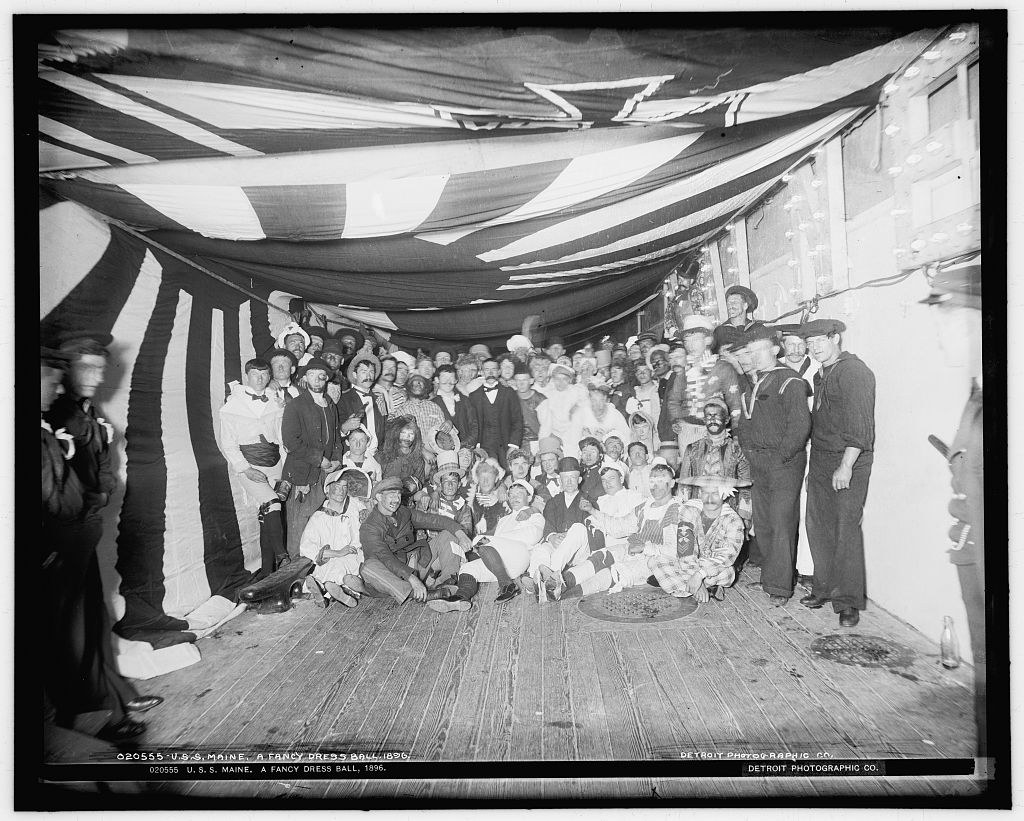
U.S.S. Maine, a fancy dress ball
Unknown artist
- Collection:
- Prints & Photographs
- Source:
- Library of Congress
- Rights:
- Rights vary by item — check the source record before reusing this image. Source record ↗
- Recorded as:
- Library of Congress — no known restrictions (verify per item)
For historians of social dance and naval culture, this photograph is valuable precisely because it does not show dancing: it documents the formal apparatus, scale, and social structure of a Gilded Age ball before the choreography began. It reveals who danced together, how these events were organized spatially, and how the ship's interior was transformed for civilian entertainment during peacetime.
What you are looking at
A large gathering fills what appears to be the interior of a ship or maritime vessel, suggested by the wooden plank flooring and the draped fabric overhead creating a tent-like ceiling decorated with striped patterns. The space is crowded with approximately 80–100 people of mixed ages, including adults and children, arranged in loose clusters throughout the frame. The attendees wear formal 1890s dress: men in dark suits, bowler hats, and formal coats; women in long skirts, white blouses, and elaborate hats typical of the era. The photograph captures a moment of social gathering rather than active dancing—some figures stand in conversation, others are seated on the floor in the foreground, and the overall atmosphere is one of a formal social event or celebration. The lighting is bright and even, characteristic of flash photography of the period, which flattens the scene and emphasizes the density of the crowd and the formal nature of their dress.
The dancing
The figures are predominantly static or in posed positions rather than mid-movement. Those seated in the foreground sit upright in dignified postures appropriate to formal dress. Standing figures maintain vertical, composed stances with arms at their sides or held naturally. There is no evidence of active partnering, closed holds, or the dynamic weight shifts and arm extensions characteristic of dance in motion. The arrangement suggests a formal assembly or reception rather than a choreographed gathering.
The dance depicted
While the title promises a 'fancy dress ball,' the photograph does not capture active dancing. A ball in 1896 would have featured waltzes, quadrilles, polkas, or other social dances of the Gilded Age, and the formal dress and naval context are consistent with such an event. However, this image documents the social gathering itself—the assembly, dress, and ceremony—rather than the moment of dance. It is possible the photograph was taken before dancing began, during an intermission, or was intended to document the attendees and occasion rather than the choreography.
How it was made
This is a black-and-white photograph, likely taken with flash given the even, bright lighting and the absence of shadows typical of natural light photography. The image shows signs of age and possible print degradation. The photographic medium allowed documentary capture of a large group in interior conditions that would have been difficult with other media of the period; it provides evidence of actual dress, spatial arrangement, and the social composition of a naval entertainment. The photograph was produced by the Detroit Photographic Company, a major publisher of photographic prints in the 1890s–1900s.
About this work
This photograph documents a fancy dress ball held aboard the U.S.S. Maine in 1896, capturing a formal social gathering of approximately 80–100 attendees in period dress within the ship's interior. Rather than a moment of active dancing, it records the assembly itself—the ceremony, costume, and social composition of a Gilded Age naval entertainment. The image serves as documentary evidence of how such events were staged, who attended them, and what formal dress and comportment were expected.
How to look at it
Observe the formal arrangement of the crowd: note how the attendees maintain dignity and composure despite the cramped space, and how dress functions as a marker of social status and occasion. The photograph does not show movement or action, but rather the preparation and assembly—the moment before dancing. Look closely at the variation in dress among the attendees, which suggests a mix of officers, crew families, and invited guests. The draped fabric overhead and the wooden interior establish the specific maritime setting.
The artist
The photograph was taken by the Detroit Photographic Company, a major American publisher of photographic prints founded in the 1880s. The company specialized in documentary and commemorative photography, distributing images widely through the Library of Congress collections and commercial networks. The company's practice was to document significant events, public gatherings, and notable occasions.
The period
In 1896, the U.S.S. Maine was an active naval vessel, and formal balls aboard warships were common social occasions that mixed naval officers, civilians, and dignitaries. The Gilded Age saw elaborate public ceremonies and entertainments as expressions of national pride and social status. Fancy dress balls—events in which attendees wore costume or formal dress—were fashionable in both civilian and military contexts. The photograph reflects the formality and scale of such events, as well as the gender segregation and hierarchical arrangement typical of the era's social gatherings.
Where it lives
This photograph is held by the Library of Congress, Prints & Photographs Online Catalog, as part of the Detroit Photographic Company collection. It is catalogued as a documentary photograph of a naval social event.
Dance in this work
Questions about this work
Is anyone actually dancing in this photograph?
No. The photograph captures the gathering and assembly for the ball, not the dancing itself. Most attendees are either standing in conversation or seated. This was a common approach to documentary photography of the era—to photograph the event as a social occasion and formal gathering rather than to capture the kinetic moment of dance.
What kind of dances would have been performed at a ball on a warship in 1896?
The repertoire would have included waltzes (especially Viennese waltzes), quadrilles, polkas, lancers, and possibly cotillions. These were the standard social dances of the Gilded Age ballroom. The formal dress visible in the photograph is consistent with such dances, which required partners, large floor space, and elaborate etiquette.
Why is it called a 'fancy dress ball' if the dress looks standard for the period?
In the 1890s, 'fancy dress' could refer to formal or elaborate dress generally, or to costume worn for specific occasions—not necessarily to costumes or disguises. The term emphasized that this was a formal, dressed-up occasion rather than everyday wear. The specific naval and patriotic context may have added ceremonial significance to the dress code.
What can we learn about dance from a photograph that doesn't show dancing?
The scale, gender composition, age range, and spatial arrangement reveal how social dances were organized and who participated. The formal dress confirms the genres of dance expected (ballroom, formal partnered dances). The maritime setting shows how dance was integrated into naval ceremonies and public relations. Historical photographs of events rather than action often provide context that performance images do not.
More dance artwork





