49 works in this view — arrow keys or swipe to move between them.
Dance in Art
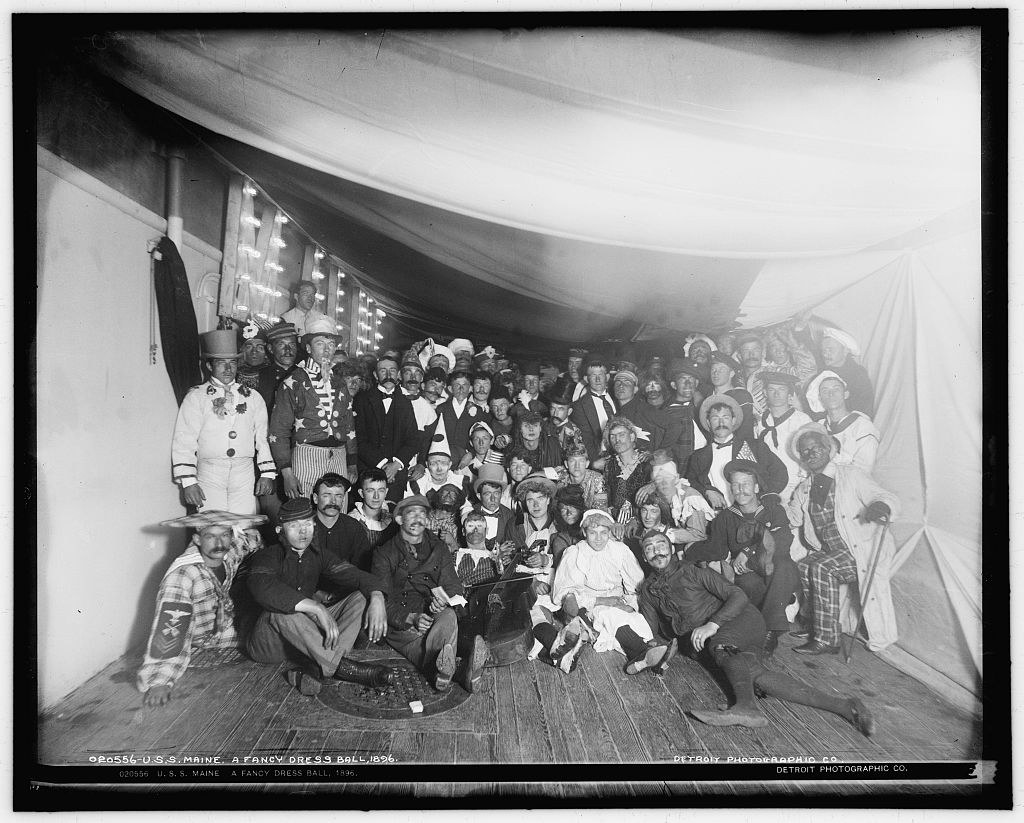
U.S.S. Maine, a fancy dress ball
Unknown artist
- Collection:
- Prints & Photographs
- Source:
- Library of Congress
- Rights:
- Rights vary by item — check the source record before reusing this image. Source record ↗
- Recorded as:
- Library of Congress — no known restrictions (verify per item)
This image documents a pivotal context for dance in late-19th-century America: the integration of theatrical costume, social dancing, and amateur performance in military and institutional life. It shows how formal entertainment and dance culture permeated even the most constrained environments, and how costume and spectacle could create spaces of play within rigid hierarchies. For historians of American social dance and naval culture, it is a rare documentary photograph of an actual event rather than a staged studio image.
What you are looking at
A large group photograph taken aboard the U.S.S. Maine, showing approximately 50–60 people packed into what appears to be a ship's interior space, lit by natural light from above. The photograph captures a fancy dress ball in progress, with participants in elaborate costume: military dress uniforms with ornate decorations, elaborate hats (including what appear to be turbans, bonnets, and feathered headgear), striped trousers, and formal civilian dress. The composition is crowded and informal by modern standards, with figures arranged in loose clusters rather than formal rows. Some people stand, others crouch or sit on the wooden deck. The canvas or sail visible at the back and sides suggests this was shot under temporary coverings or rigging. The lighting is diffuse and somewhat soft, characteristic of interior shipboard photography of the 1890s. The scene captures the festive but constrained energy of shipboard entertainment—formal in costume but intimate in scale and arrangement.
The dancing
Most figures are stationary or in conversational posture rather than in active dance movement. Several men and women stand in loose social groupings; a few appear to be in mock-formal stances. No clear partnering or coupled dance hold is evident. The postures are upright and formal rather than dynamic. No footwork or active choreography is visible; this appears to be a moment of pause, gathering, or social promenade rather than active dancing.
The dance depicted
This is a fancy dress ball—a social event combining costume display with dancing, but the photograph captures the assembly and social moment rather than choreographed dance in motion. Fancy dress balls were popular among naval and military officers in the late 19th century as opportunities for formality, spectacle, and theatre within the constraints of shipboard life. The costumes suggest players taking on theatrical roles, historical characters, and exoticised personas. No specific dance form is being actively performed at the moment of exposure; the image documents the social ritual of dressing, gathering, and preparing for the evening's entertainment rather than the execution of a particular dance style.
How it was made
This is a black-and-white photograph, likely taken with natural light supplemented by shipboard illumination. The image shows the softness and even exposure characteristic of mid-1890s photographic practice, though the interior setting has challenged the photographer—the upper portions of the frame are slightly overexposed. The photograph was made on glass plate or early film stock and appears to be a documentary record, not a posed studio portrait. Its archival origin in the Library of Congress Prints & Photographs collection suggests it was created either as an official naval record or as press documentation of a significant shipboard event.
About this work
This is a photographic record of a fancy dress ball held aboard the U.S.S. Maine in 1896, a form of social entertainment common in naval life and in upper-class society of the Gilded Age. The photograph documents not choreographed dance but the social spectacle of costume, gathering, and formality that framed such events. It is valuable as evidence of how dance and theatre were integrated into military life, and of the role of costume and role-play in creating entertainment under strict spatial and social constraints.
Fancy dress balls allowed participants—particularly officers—to assume alternative identities, to stage historical tableaux, and to introduce elements of theatre and carnival into otherwise hierarchical institutional settings. The photograph captures the amateur theatricality of the event, the cosmopolitan aspirations of the participants (visible in the exoticised costumes), and the all-male or heavily male-skewed composition typical of military gatherings of the period.
How to look at it
Look closely at the costumes rather than at dancing movement—notice the range of characters attempted: military dress uniforms heavily decorated with braid and medals, turbans suggesting Oriental themes, feathered bonnets, and striped trousers evoking various historical periods and fictional roles. Note how the photographer has positioned the camera to include the entire assembled group, creating a document of a moment of gathering rather than of action. Observe the mix of formality (the stiff poses, the elaborate dress) with the informality of shipboard constraint (the crowding, the uneven spacing, figures crouching on the deck). The photograph documents a threshold moment—before or between dances, the moment of display rather than performance.
The period
The U.S.S. Maine fancy dress ball took place during the height of American naval expansion and the Gilded Age's enthusiasm for military pageantry and formal entertainment. Fancy dress balls were fashionable among both civilian society and military officers; they combined elements of historical costume, theatrical performance, and social dancing. The 1890s saw a strong revival of interest in historical and exotic costume as a form of entertainment and social display. The formal militarism visible in the uniforms and the exoticised costumes reflect the era's imperial confidence and its appetite for theatrical representations of 'the East' and of historical periods. Such events served both as morale-building activities and as opportunities for officers to perform status and refinement.
Where it lives
The photograph is held by the Library of Congress Prints & Photographs Online Catalog. It was created as documentary record of a U.S. Navy shipboard event and is cataloged as a historical photograph of military life and social entertainment.
Dance in this work
Questions about this work
Was this an actual dance, or just a costume party?
This was a fancy dress ball—an event that combined both. Participants wore elaborate costumes and attended a formal evening of entertainment that included dancing, but this particular photograph captures the social gathering and costume display rather than an active dance moment. Fancy dress balls were theatrical social events where the costumes and roles were as important as the dancing itself.
Why are there so many men and so few women in the photograph?
This was a U.S. Navy event aboard a warship, where the crew and officer corps were almost entirely male. Women would have been admitted as guests for special events, but the bulk of the attendees would necessarily be naval personnel. Military balls and shipboard entertainments of this period were heavily male-dominated events.
What is the significance of the exotic costumes?
The turbans, ornate military dress, and historical costumes reflect the Gilded Age appetite for theatrical exoticism and for role-playing. Fancy dress balls allowed participants to assume characters from history, fiction, and imagined 'exotic' cultures. This mixing of styles also reflects the era's imperial confidence and its fascination with military spectacle.
More dance artwork





