49 works in this view — arrow keys or swipe to move between them.
Dance in Art
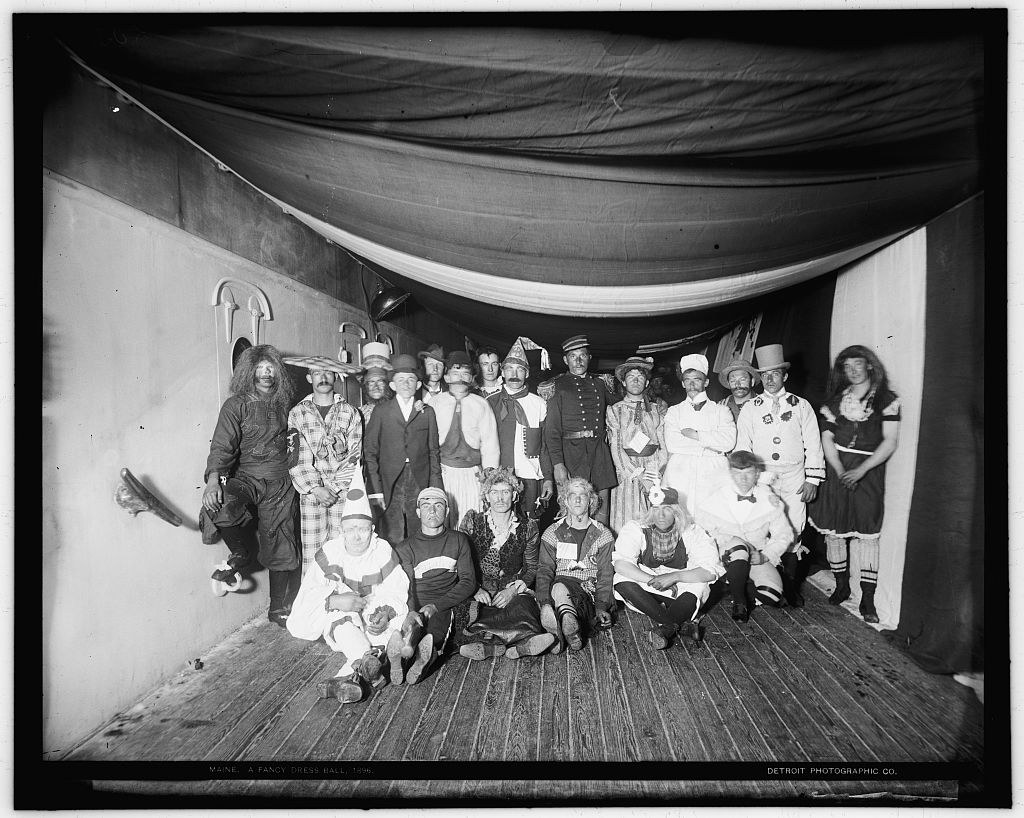
U.S.S. Maine, a fancy dress ball
Unknown artist
- Collection:
- Prints & Photographs
- Source:
- Library of Congress
- Rights:
- Rights vary by item — check the source record before reusing this image. Source record ↗
- Recorded as:
- Library of Congress — no known restrictions (verify per item)
This photograph provides rare documentary evidence of how naval officers and personnel actually dressed for and participated in theatrical social events in the 1890s, revealing the intersection of military culture, fancy dress tradition, and ballroom entertainment. For historians of social dance, costume, and naval history, it offers specific detail about the aesthetics and scale of a fancy dress ball at a moment when such events were central to genteel social life. The image also documents diversity in costume choices—from military drag to historical pastiche to comic grotesque—showing how participants negotiated gender, rank, and character through costume in a formal military setting.
What you are looking at
A large group photograph of people in costume poses inside what appears to be a ship's interior or cargo hold, indicated by the wooden plank flooring and curved dark fabric draped overhead like a canopy or sail. The space is industrial and bare, with white-painted walls visible. The photograph is dated to 1896 and documents a fancy dress ball held aboard the U.S.S. Maine. The assembled group numbers approximately twenty-five people, arranged in two loose rows—some standing, some seated on the floor in front. The costumes are varied and theatrical: several figures wear complete suits of armor or military dress; others sport colonial or historical clothing; one figure on the far left appears to be in drag or feminine costume with a long skirt; multiple men wear top hats, bowlers, and period dress suggesting late 18th or 19th-century styles. The overall composition suggests this is a documentary record of a naval social event rather than a staged theatrical performance, with the photographer capturing the group formally posed for the camera.
The dancing
The figures stand and sit in relatively static poses arranged for the photograph, not captured mid-movement. Their posture is formal and frontal, typical of group photography conventions of the 1890s. There is no visible dance hold or frame; the bodies are separate rather than partnered. The costumes suggest various character roles—soldiers, historical figures, perhaps comic or grotesque characters in the elaborate fancy-dress tradition—but the photograph freezes them in a group assembly moment rather than capturing active dancing.
The dance depicted
This is not a dance scene but a documentary photograph of participants in a fancy dress ball. A fancy dress ball was a social event where attendees wore elaborate costumes and masks, typically featuring dancing, but this photograph documents the assembly or formal group portrait moment rather than the dance itself. The event was held aboard the U.S.S. Maine, a United States Navy battleship, suggesting this was an officers' or naval personnel social gathering. The costumes and the theatrical nature of the assembly indicate the fancy dress tradition of late-Victorian upper-class entertainment, which included cotillion, quadrille, and other ballroom dances, but the photograph captures the pre-dance or post-dance formal moment rather than choreography in motion.
How it was made
This is a black-and-white photograph, from its tone and quality clearly a silver gelatin or albumen print typical of 1890s naval and institutional documentation. The photograph was taken by the Detroit Photographic Company, as credited in the lower right of the print. The lighting is relatively even and artificial, suggesting studio or indoor shipboard conditions with careful setup. The photographic medium allowed for precise documentary recording of costume detail and group composition, making this valuable as a historical record of period dress and naval social customs. The image quality and composition suggest this was a professional commission to document a significant naval social event.
About this work
This photograph documents a fancy dress ball held aboard the U.S.S. Maine in 1896, capturing approximately twenty-five participants in elaborate theatrical costumes posed formally for the camera in what appears to be a ship's interior. The scene records the fancy dress tradition of the late-Victorian era, when elaborate masquerade and costumed balls were fashionable entertainment among upper-class and military society. While fancy dress balls were occasions for dancing—including cotillion, quadrille, and other ballroom forms—this photograph arrests the moment of formal assembly rather than capturing the dance in motion. The image is a valuable document of period costume, naval social life, and the theatrical entertainment culture of the 1890s. It belongs in a gallery of dance in art as evidence of the social contexts and costume traditions that framed ballroom dancing in this era, even though it does not depict active dancing.
How to look at it
Examine the costume details carefully: the armor, historical uniforms, drag costumes, and period wigs reveal how participants understood character and role-play in fancy dress tradition. Note the mix of formal naval dress uniforms (some figures appear to be in actual uniform) and theatrical costume, suggesting a boundary between martial identity and playful performance. The formal frontal poses and group arrangement are typical of 1890s documentary photography, designed to record the event clearly rather than capture action or movement. Look at the space itself—the industrial interior, the draped dark fabric overhead, the bare walls—which situates this entertainment within the actual material conditions of a naval vessel rather than a decorated ballroom.
The artist
The photograph is credited to the Detroit Photographic Company, a major American photographic publisher and studio active from the 1890s through the early 20th century. The company was known for high-quality documentary and commercial photography, including institutional commissions such as this naval social event. The company's work is held in major American collections and represents the professional photographic documentation practices of the period.
The period
In the 1890s, the fancy dress ball was a fashionable form of theatrical social entertainment, particularly among the wealthy and military establishments. The tradition had deep roots in 18th-century masquerade culture but evolved in the Victorian era into elaborate costume pageants where participants adopted historical, mythological, or comic personae. The U.S. Navy, particularly its officer corps, maintained strong traditions of formal social entertaining, and the U.S.S. Maine was one of the most prominent American battleships of the era (launched 1890), making its social events noteworthy. The photograph was taken just two years before the ship's destruction in 1898, which precipitated the Spanish-American War. In the context of American ballroom dance, the 1890s were a period of transition: the waltz and Viennese forms remained dominant, but the cotillion and quadrille—participatory group dances—were central to formal social events and would have been featured at such a ball.
Where it lives
The photograph is held in the Prints & Photographs collection of the Library of Congress and was created by the Detroit Photographic Company. It is credited as "U.S.S. Maine, a fancy dress ball, 1896" and represents the kind of institutional and commercial documentary photography that such companies produced for naval and military clients.
Dance in this work
Questions about this work
Was this actually a dance performance?
No. This photograph documents a fancy dress ball, a social event where dancing occurred, but it captures the formal group portrait moment rather than active dancing. Fancy dress balls were theatrical costume parties where attendees wore elaborate dress and participated in ballroom dances like the cotillion and quadrille, but this image freezes the assembly or conclusion rather than the dance itself.
What was a fancy dress ball?
A fancy dress ball was a fashionable social event, particularly among the wealthy and military in the Victorian era, where guests wore elaborate theatrical costumes representing historical figures, mythological characters, or comic personas. These events combined costume pageantry with ballroom dancing and were opportunities for social display and role-play. The tradition descended from 18th-century masquerade culture but evolved into more elaborate theatrical form by the 1890s.
Who were these people?
The photograph does not identify individual participants, but given that it was taken aboard the U.S.S. Maine, they were likely naval officers and personnel of the U.S. Navy. The U.S.S. Maine was a front-line battleship, and its officers were prominent figures in American military society. The mix of elaborate theatrical costumes with some actual naval uniforms suggests a blend of military personnel and possibly their families or civilian guests.
What does this tell us about ballroom dancing in the 1890s?
This image shows that fancy dress balls were significant social occasions for ballroom dancing, and that costume and theatrical performance were integral to how upper-class and military society experienced dance. The elaborate costumes and the formal documentation of the event indicate that such balls were considered important enough to commission professional photography, revealing the cultural prominence of ballroom dancing and costumed entertainment in this period.
More dance artwork





