49 works in this view — arrow keys or swipe to move between them.
Dance in Art
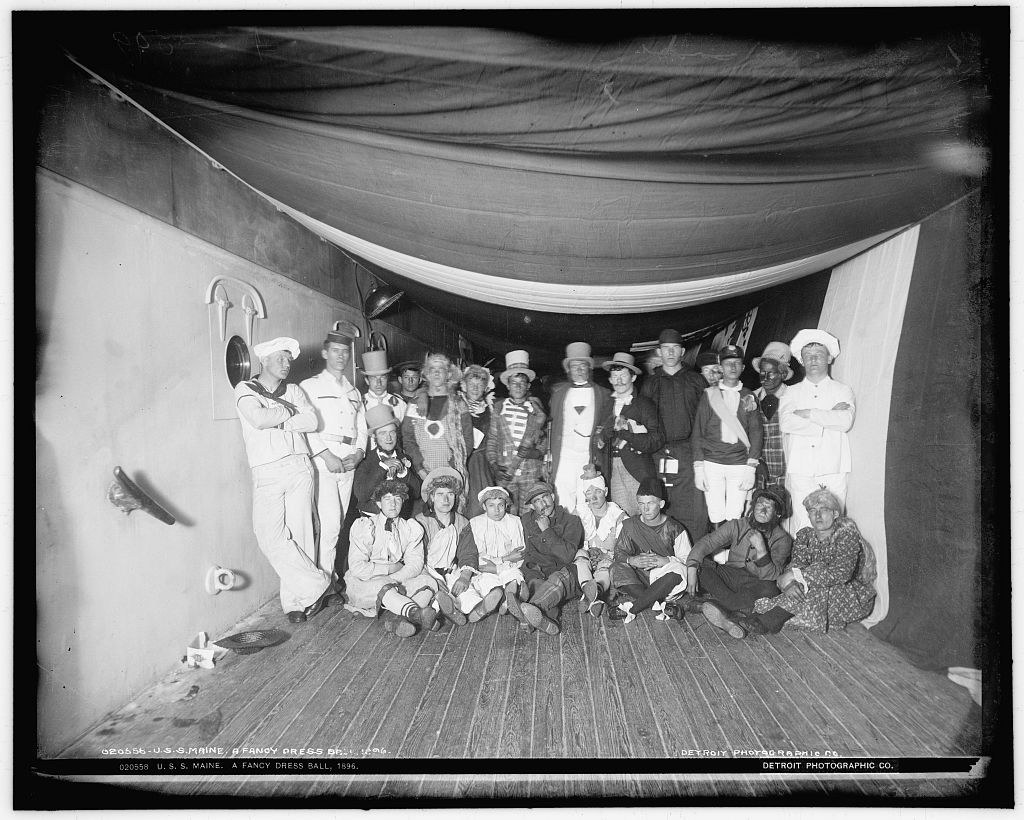
U.S.S. Maine, a fancy dress ball
Unknown artist
- Collection:
- Prints & Photographs
- Source:
- Library of Congress
- Rights:
- Rights vary by item — check the source record before reusing this image. Source record ↗
- Recorded as:
- Library of Congress — no known restrictions (verify per item)
For historians of American social life and naval culture, this photograph is primary evidence of how formal entertainments were staged and who participated. For dance historians, it shows the costume, social composition, and shipboard setting of late-nineteenth-century American ball culture, even though no actual dancing is captured. The image demonstrates that elaborate costume balls were serious social institutions aboard major naval vessels, worthy of professional documentation.
What you are looking at
A large group portrait taken inside what appears to be the hold or cargo space of a ship, with dramatic fabric draping overhead creating a tent-like ceiling. The photograph captures approximately thirty people arranged in two loose rows—some standing, some seated on the wooden deck—all wearing elaborate fancy dress costumes. The standing figures include sailors in white uniforms, figures in theatrical or masquerade attire including striped garments, top hats, and various character costumes. The seated figures in front wear similarly varied dress, some in light-colored suits and hats, others in darker garments. The lighting is theatrical, with strong illumination from what appears to be a single source, casting shadows and creating dramatic contrast against the light wooden walls. The overall composition suggests a formal gathering or costume ball held in an improvised or unconventional venue—the ship's interior lending an intimate, enclosed quality despite the large group.
The dancing
The figures stand and sit in relaxed, informal poses typical of group portraiture rather than active dance. Most weight is neutral; there is no visible weight transfer, extension, or dynamic tension in the body. Arms hang at sides or rest on laps; there are no closed holds, no frame, no clear leading and following. The arrangement is social and documentary rather than choreographic. This is a gathering of people in costume, not a moment of dance in progress.
The dance depicted
No active dance is visible in this photograph. This is a fancy dress ball—a costumed social gathering aboard a ship—but the image captures a posed assembly moment rather than dancing itself. The title and setting confirm this is a ballroom event, and the costumes suggest that dancing likely occurred or would occur, but the photograph freezes a stationary group portrait. The formal attire and theatrical costumes indicate this was an entertainment event among naval personnel or guests, but the image provides no evidence of specific dance styles, holds, or movement vocabulary.
How it was made
This is a black-and-white photograph, likely taken with flash photography given the sharp focus and theatrical lighting across the group. The print shows clear geometric composition and even illumination typical of early-twentieth-century documentary or press photography. The image appears to be a gelatin silver print from the Detroit Photographic Company, as noted in the credit. The technique allowed the photographer to document the entire scene and all participants in a single exposure, making it suitable for publication or archival record of the event. The quality and professional framing suggest this was commissioned documentation.
About this work
This is a photographic record of a fancy dress ball held aboard the U.S.S. Maine in 1896, a social entertainment event during the era of the American naval buildup. The photograph preserves evidence of how officers and guests dressed, socialized, and staged elaborate entertainments aboard naval vessels during the Gilded Age. While not an image of dance in motion, it documents the setting, scale, and social context of naval ball culture—a significant context for understanding American social dance and military entertainment of the period.
How to look at it
Attend to the composition: the photographer has arranged the group to fill the frame, using the ship's interior and the dramatic fabric overhead to create visual interest and a sense of occasion. Notice the variety of costumes and the mix of formal naval dress with theatrical or character costumes—this tells you something about how the event mixed military identity with playful disguise. Look at the posture and arrangement: this is a formal portrait, not action photography. The moment chosen is social and commemorative, not a frozen instant of movement.
The artist
The photograph is credited to the Detroit Photographic Company, a major American commercial and documentary photography studio active from the 1880s through the early twentieth century. The company was known for producing high-quality documentary, architectural, and social photography. The professional framing and execution are consistent with their style. The specific photographer is not recorded.
The period
In 1896, the U.S.S. Maine was a cutting-edge battleship, and naval social life was highly formal and elaborate. The Gilded Age saw an expansion of American naval power and a corresponding investment in naval pageantry and social display. Fancy dress balls aboard major ships were significant social events, attended by officers, their families, guests, and dignitaries. These events blended military hierarchy with theatrical entertainment and demonstrated the cosmopolitan ambitions of the American naval establishment. The photograph dates to a moment just before the Spanish-American War, which would alter the ship's historical significance.
Where it lives
This photograph is held in the Prints & Photographs collection at the Library of Congress. It is credited to the Detroit Photographic Company and carries the accession number 626558. The image is part of the Library's broader collection of American social and military documentation from the late nineteenth and early twentieth centuries.
Questions about this work
What is a fancy dress ball?
A fancy dress ball is a formal social event at which guests wear elaborate costumes, masks, or theatrical attire. These were popular among the wealthy and military elite in the nineteenth century and served as occasions for entertainment, socializing, and display. Costume balls often included dancing, but the main event was the social gathering and the performance of elaborate dress itself.
Was the U.S.S. Maine significant?
Yes. The U.S.S. Maine was a U.S. Navy battleship that was at the center of American foreign policy in 1898. The ship was destroyed in Havana harbor in February 1898, an event that helped trigger the Spanish-American War. This photograph was taken two years before that incident.
Does this image show people dancing?
No. This is a posed group portrait taken at a fancy dress ball, but it captures a stationary moment—a gathering or assembly—rather than active dancing. The photograph documents the event and the participants, but not the dance itself.
Why would a fancy dress ball be held on a ship?
Naval vessels were centers of military and social life, and elaborate entertainment aboard ship was a way to demonstrate prestige, host dignitaries, and build morale among officers and crew. The ship's interior, with its formal spaces and symbolic resonance, made it an impressive venue for social display.
More dance artwork





