49 works in this view — arrow keys or swipe to move between them.
Dance in Art
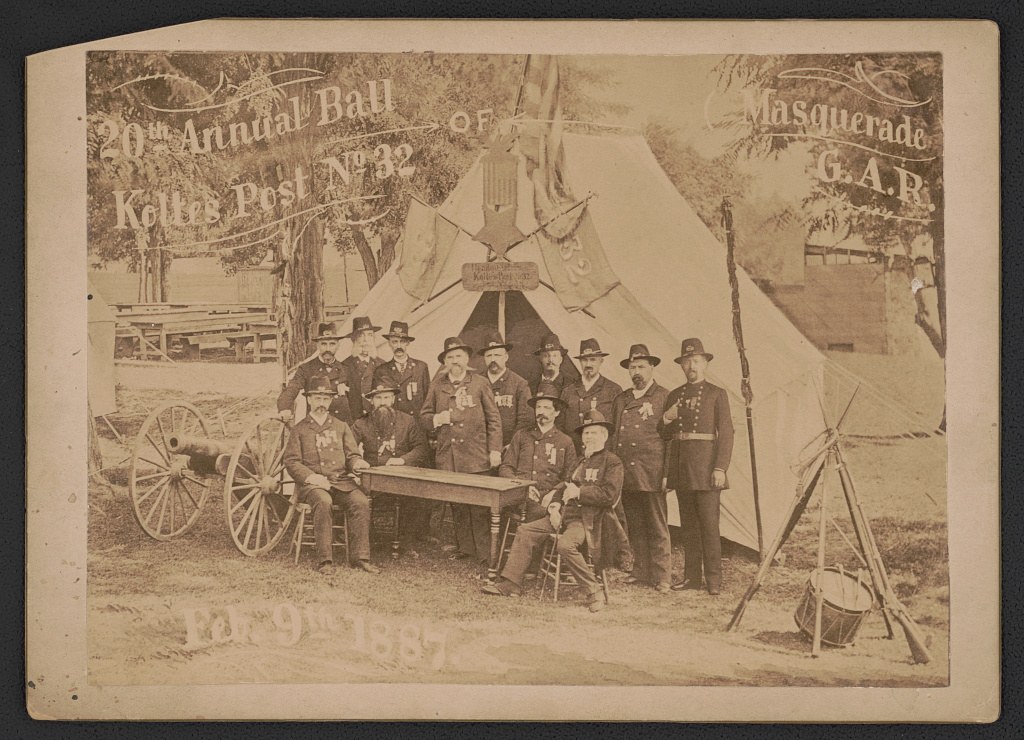
20th annual ball masquerade of Koltes Post No. 32 G.A.R., Feb. 9th, 1887
Unknown artist
- Collection:
- Prints & Photographs
- Source:
- Library of Congress
- Rights:
- Rights vary by item — check the source record before reusing this image. Source record ↗
- Recorded as:
- Library of Congress — no known restrictions (verify per item)
This photograph is valuable evidence of how American Civil War veterans marked their fellowship and community in the decades after the war. The masquerade ball format—a common social dance tradition of the era—was appropriated by the G.A.R. as a vehicle for commemorative gathering, but what survives in the photograph is the ceremonial, formal moment rather than the social dance itself. It shows how dance traditions were embedded in nineteenth-century veteran and community life, even when the photograph itself documents ceremony rather than movement.
What you are looking at
A formal photograph captures the 20th annual masquerade ball of Koltes Post No. 32 of the Grand Army of the Republic, taken on February 9, 1887. The scene is set outdoors beneath large canvas tents, with bare trees visible in the background suggesting a winter encampment or fairground. A long wooden table dominates the center, around which stand and sit approximately twenty uniformed men wearing dark military-style jackets with medals and insignia. Many wear bowler hats or military caps. The figures are arranged in a formal group portrait formation—some standing in rows behind, others seated at the table. To the left, a wagon wheel and what appears to be military equipment or supplies are visible. The photograph is sepia-toned and shows the wear of age, with some areas faded or obscured. The composition emphasizes the formal, commemorative nature of the gathering rather than capturing movement or dance itself.
The dancing
The figures are positioned in a stiff, formal arrangement typical of nineteenth-century group portraiture. Most stand at attention or sit upright, facing the camera directly rather than engaging with one another. No embraces, hand-holds, or partnered positioning is evident. The bodies are static and the photograph appears to have been taken during a pause or assembly rather than mid-movement. The uniformed dress and military bearing suggest a structured, hierarchical gathering rather than an informal social dance.
The dance depicted
Despite the title's reference to a "masquerade ball," this photograph does not depict dancing. It is a formal commemorative portrait of the assembled members and guests of a G.A.R. post's annual ball—a social event associated with the veterans' organization. The image shows the attendees posed for the camera rather than in the act of dancing. No dance floor, musicians, or movement is visible. The "masquerade" element may have been decorative or may have referred to costume elements not clearly legible in the photograph, but no active dance performance is recorded here.
How it was made
This is a photograph, likely an albumen print or gelatin silver print on paper, a standard documentary medium of the 1880s. The sepia tone and surface wear are consistent with albumen printing of the period. The technical limitations of the era—longer exposure times and less sensitive plates—would have made capturing movement nearly impossible, which explains why the photographer composed a formal group portrait instead. This suggests the image was intended as an official record of the event and its attendees rather than a celebration of the dance itself, and was probably distributed as a souvenir to members.
About this work
This is a documentary photograph of a Grand Army of the Republic post's annual social gathering, not a dance image per se. The G.A.R. was the largest organization of Union Civil War veterans, and their annual balls were important social and commemorative events that brought communities together. While the occasion was billed as a "masquerade ball," the photograph captures the formal assembly and group portrait moment rather than any actual dancing. It documents the social and organizational life of the post and preserves the faces and uniforms of its members.
How to look at it
The photograph is valuable as a historical record of costume, insignia, and the composition of a Civil War veterans' organization circa 1887, rather than for its documentation of dance. Viewers should attend to the details of military dress, the range of ages visible in the group, the physical arrangement that suggests rank or position within the post, and the outdoor setting with its tent and equipment. The photograph is a still life of a social occasion rather than a captured moment of movement.
The period
The G.A.R. reached its peak membership and organizational influence in the 1880s. Annual balls and civic events were central to the organization's public presence and served as fundraisers, recruitment opportunities, and occasions for veterans to maintain solidarity. The masquerade ball was a fashionable social form in late nineteenth-century America, borrowed from European traditions; by the 1880s it was a common format for civic and fraternal organizations. The photograph's formal composition reflects the documentary impulse of the period to record and preserve such gatherings as historical evidence.
Where it lives
The print is held in the Prints & Photographs collection of the Library of Congress. It is catalogued as a documentary photograph of a specific historical event, dated February 9, 1887, and likely created and distributed as an official record or souvenir of the occasion.
Questions about this work
Is this photograph showing an actual masquerade dance?
No. The image shows a formal group portrait taken at or around the time of a G.A.R. post's masquerade ball, but it does not depict dancing. It is a commemorative assembly photograph, probably taken before, after, or during a break in the festivities. The technical limitations of 1880s photography—long exposure times—would have made it nearly impossible to capture movement.
What was the Grand Army of the Republic?
The G.A.R. was the largest and most influential organization of Union Army veterans in the nineteenth century, founded in 1866. Local posts like Koltes Post No. 32 held civic events, fundraisers, and commemorative gatherings to maintain veteran solidarity and shape public memory of the Civil War. Annual balls were among their most prestigious social events.
Why is this in a dance image archive if no dance is shown?
The photograph documents a social occasion explicitly named as a masquerade ball, a format rooted in dance tradition. It is evidence of how dance traditions and dance-related social forms were central to community and organizational life in the nineteenth century, even when the photograph itself preserves ceremony rather than movement.
More dance artwork





