49 works in this view — arrow keys or swipe to move between them.
Dance in Art
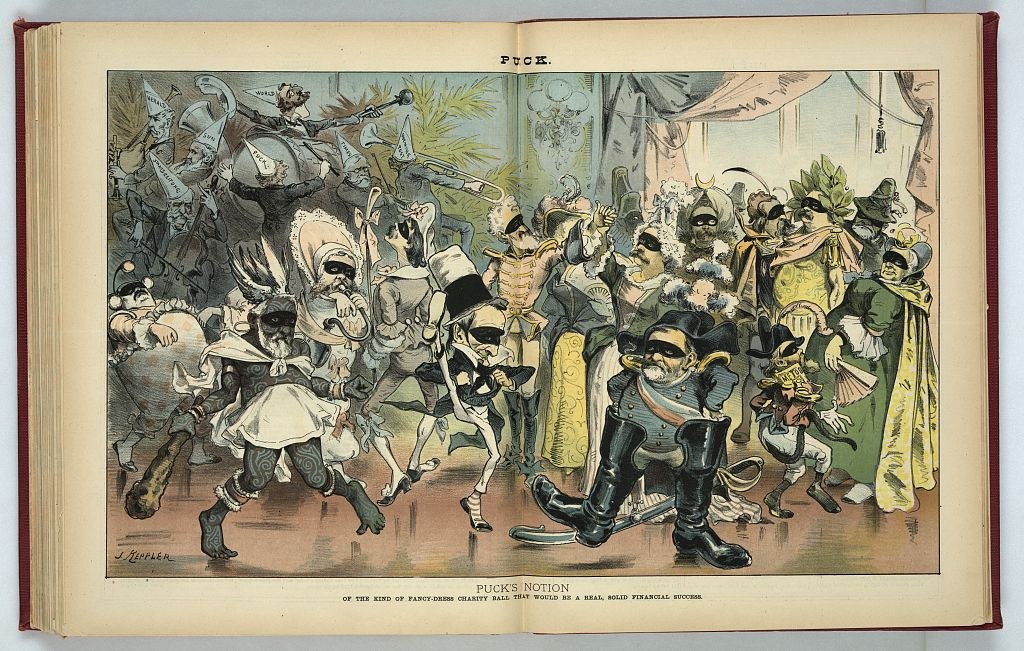
Puck's notion of the kind of fancy-dress charity ball that would be a real, solid financial success
Unknown artist
- Collection:
- Prints & Photographs
- Source:
- Library of Congress
- Rights:
- Rights vary by item — check the source record before reusing this image. Source record ↗
- Recorded as:
- Library of Congress — no known restrictions (verify per item)
This image documents not how ballroom dance was actually performed in the 1880s, but how the ballroom as a social institution was perceived and satirized in popular culture. It reveals the anxieties and comedic possibilities surrounding formal dance in Gilded Age America, and shows how visual satire could use the body, movement, and costume to critique social structures. For dance historians, it is valuable evidence of how ballroom culture was being questioned and ridiculed even as it flourished.
What you are looking at
A crowded ballroom scene rendered in colored engraving, dominated by satirical caricature and social comedy. The composition is densely packed with figures in formal evening dress—men in tailcoats and top hats, women in elaborate gowns—engaged in various states of dancing, flirtation, and social chaos. The left side shows energetic dancers in motion; the center and right present a more chaotic crush of bodies. The setting appears to be a grand interior, suggested by architectural elements and drapery at the top. The atmosphere is one of exaggerated merriment and disorder: dancers collide, lose their balance, strike absurd poses. The artist has used a full palette of watercolor wash—greens, browns, flesh tones, golds—to enliven the black-line engraving, creating a lively visual din that matches the social tumult being depicted.
The dancing
The dancers show no unified technique or formal hold. Bodies are twisted, off-balance, and contorted in ways that contradict ballroom propriety: figures lurch, stumble, and embrace with exaggerated intimacy. Several dancers are depicted mid-collision or mid-fall. The women's postures are particularly exaggerated—skirts flare outward, arms fling wide, heads tilt back in theatrical abandon. No closed or standard frame is visible; instead, the artist emphasizes the breakdown of decorum and the loss of control. The density and disorder of the crowd suggests social stratification and chaos rather than the ordered ritual of ballroom dancing.
The dance depicted
This is not a depiction of actual ballroom dance technique but a satirical commentary on the ballroom itself and the social pretensions surrounding formal charity events. The image title promises a 'fancy-dress charity ball' and the subtitle cynically notes that this chaos would constitute a 'real, solid financial success'—the implication being that disorder, excess, and questionable propriety are what actually draw crowds and donations. The 'dancing' here is crude, unschooled, and deliberately unflattering: it is not waltz, quadrille, or any specific historical-period style, but rather a mockery of ballroom culture as a whole. The figures may attempt ballroom movement, but the artist has distorted and exaggerated every gesture to ridicule both the dancers and the institution.
How it was made
This is a hand-colored engraving or possibly a hand-colored lithograph from Puck magazine. The base image was produced by engraving or lithographic printing; the color was then applied by hand or in a limited chromolithographic pass, allowing for the vivid but somewhat informal palette visible here. This technique was standard for Puck, a weekly humor and satire magazine founded in 1876 and widely distributed in the United States. The combination of fine line work with loose watercolor wash allowed the artist to render social detail precisely while maintaining the expressionistic energy of the composition. As a printed satirical illustration, this work was made for mass circulation and public consumption.
About this work
Puck's Notion of the Kind of Fancy-Dress Charity Ball That Would Be a Real, Solid Financial Success is a satirical engraving from the American humor magazine Puck, dated to 1885. It depicts a ballroom in deliberate chaos—dancers colliding, lurching, and embracing with exaggerated abandon—as a commentary on the social spectacle and financial incentives of late 19th-century charity fundraisers. The artist uses the language of ballroom dance and formal evening wear as the vehicle for social satire, mocking both the pretensions of the ballroom and the questionable motives of those who might attend such an event. As a work from Puck, it belongs to a tradition of American satirical printmaking that used dance, dress, and social ritual as windows onto contemporary manners and hypocrisy.
How to look at it
Attend to the composition's deliberate disorganization. Unlike a straightforward ballroom scene, which would show ordered couples in formal hold and synchronized movement, this image fractures and multiplies the action: no two figures occupy the same space or perform the same gesture. The artist has frozen not a single moment of ballroom dance but a succession of comic collisions and exaggerations. Notice too the costume: the men's tailcoats and top hats are rendered in meticulous detail, as are the women's elaborate gowns, but the bodies beneath them are twisted, off-balance, and undignified. The contrast between formal evening dress and anarchic movement is the entire point of the satire. The watercolor wash adds to the sense of exuberance and disorder—color spills and mingles rather than sitting in neat, controlled zones.
The artist
The image is attributed to Puck magazine, but the individual artist is not recorded. Puck (1876–1918) was a weekly satirical magazine edited by Joseph Keppler and later by his sons, and it employed a roster of skilled caricaturists and engravers who produced topical commentary on American society, politics, and manners. The magazine was known for its technical sophistication in color printing and its sharp social observation. The artist here was skilled in rendering crowds, costume detail, and exaggerated expression—all essential to the magazine's brand of humor.
The period
In 1885, the ballroom was at the height of its cultural prestige in America; the waltz, polka, and quadrille were the dances of elite social life. At the same time, the Gilded Age was a period of intense scrutiny of manners, pretension, and the gap between public decorum and private behavior. Charity balls were becoming increasingly prominent as instruments of upper-class philanthropy and social display. Puck and its competitors (Judge, Life) used caricature and satire to expose hypocrisy and social excess. This image participates in that tradition by suggesting that the real draw of a charity ball is not noble giving but social disorder and spectacle—the very opposite of the discipline and formality that ballroom dance was supposed to embody.
Where it lives
The work is held in the Library of Congress Prints & Photographs collection, as indicated by the source attribution 'loc'. It is a page from a bound volume of Puck, or a separated and mounted print from such a volume. As a mass-produced satirical engraving from a weekly magazine, it was originally created for distribution to thousands of subscribers and newsstand readers.
Dance in this work
Questions about this work
Is this actually showing how people danced at 1880s charity balls?
No. This is satire, not documentary. The artist has deliberately exaggerated and distorted ballroom movement to ridicule both the dancers and the event. An actual 1880s ballroom would have shown more formal, restrained movement and proper holds—precisely what this image rejects in favor of chaos and collision.
What magazine is this from?
Puck, an American weekly satire magazine founded in 1876 by Joseph Keppler. Puck was known for its sophisticated color printing and its sharp, detailed caricatures of American society. It was one of the most widely circulated humor magazines of the Gilded Age.
Why would a charity ball be portrayed as chaotic and disorderly?
The caption's irony suggests that financial success—the real goal—depends on spectacle, excess, and social sensation rather than genuine charitable impulse or decorous behavior. The image mocks both the pretensions of charity fundraising and the public's appetite for social disorder dressed up as formal occasion.
How was this image made and distributed?
It was created as an engraving or lithograph and then hand-colored or produced in limited chromolithography. It appeared as a full-page or multi-page illustration in Puck magazine and was seen by tens of thousands of readers each week. The technique allowed for fine detail and vivid color, making it an ideal vehicle for satirical commentary on contemporary life.
More dance artwork





