49 works in this view — arrow keys or swipe to move between them.
Dance in Art
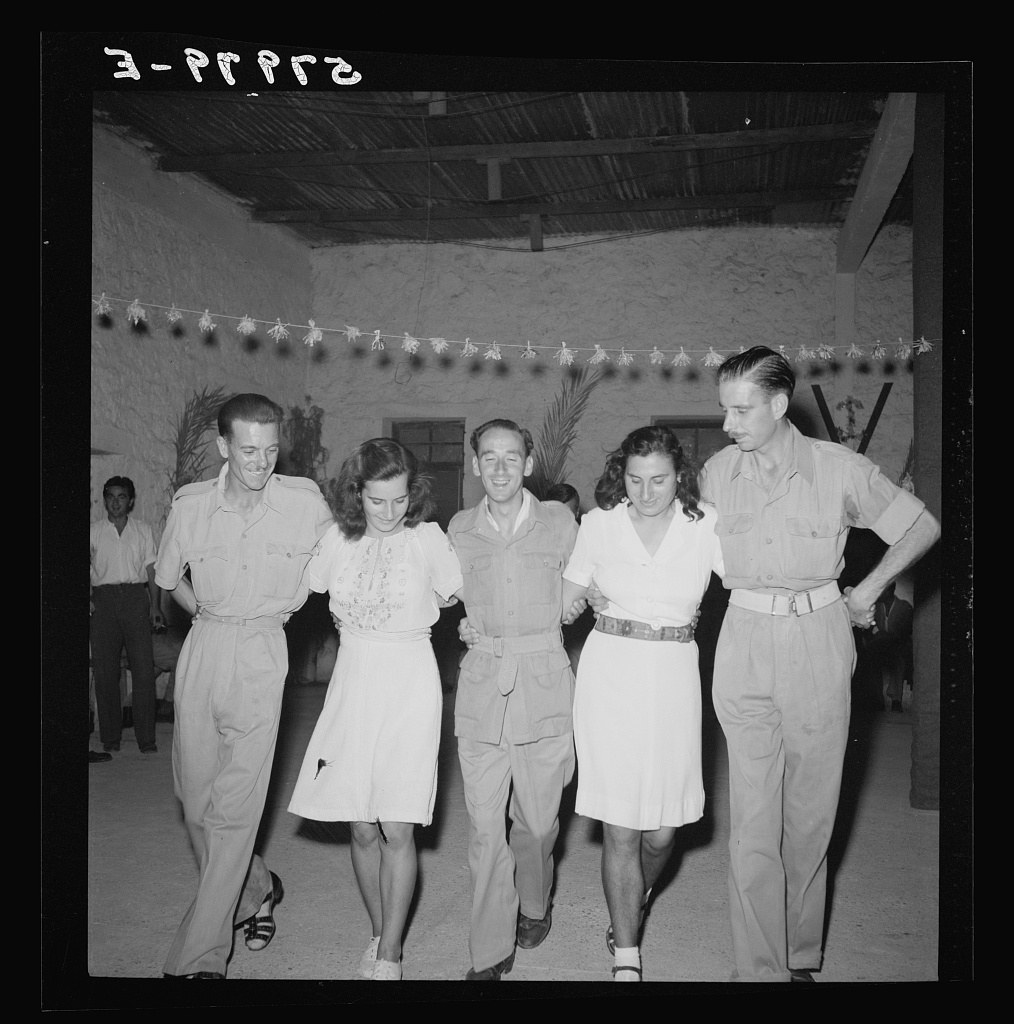
El Shatt, the United Nations Relief and Rehabilitation Administration's refugee camp for Yugoslavs
Unknown artist
- Collection:
- Prints & Photographs
- Source:
- Library of Congress
- Rights:
- Rights vary by item — check the source record before reusing this image. Source record ↗
- Recorded as:
- Library of Congress — no known restrictions (verify per item)
The photograph is significant as evidence of how displaced communities maintained cultural and social life under severe constraints. The presence of decoration and the formal arrangement for a photograph suggests that even in a refugee camp, people organized gatherings and marked occasions—practices essential to maintaining dignity and community bonds during displacement.
What you are looking at
Five people stand in a line across the center of a large, bare interior space, their bodies turned slightly toward the camera in a relaxed formation. The room is a simple, whitewashed shed or hangar with a corrugated metal roof visible above and palm fronds visible in the background—suggesting a warm climate and makeshift shelter. A decorative garland or chain of small ornaments hangs along the wall behind them at roughly chest height. The three men wear light-colored work shirts or military-style uniforms with belts; the two women wear simple white dresses. The lighting is even and institutional, characteristic of documentary photography. The composition is frontal and presentational rather than capturing movement—the figures are arranged for the camera rather than absorbed in dance.
The dancing
All five figures stand upright with neutral posture, shoulders back, feet planted firmly on the sandy floor. There is no visible hold between them—they stand as individuals in proximity rather than as partners or ensemble members. Their arms hang at their sides or rest casually on hips. The arrangement suggests a formal line-up or photograph rather than an active dance position. No weight shift, turnout, or technical positioning is evident.
The dance depicted
This photograph does not appear to depict active dance. The figures are arranged for a formal documentary photograph, posed and static. The setting—identified as the UNRRA (United Nations Relief and Rehabilitation Administration) refugee camp at El Shatt—suggests this is a social or community gathering of displaced persons, possibly a celebration or cultural event. The garland decoration and the informal gathering suggest festive intent, but the actual moment captured shows poses for the camera rather than dancing in motion.
How it was made
This is a black-and-white photograph, likely taken with flash or bright documentary lighting that casts minimal shadow and renders detail evenly across the frame. The technical execution is clear and straightforward—the work of a documentary photographer recording conditions or activities in the camp rather than a fine-art photographer composing a scene. The print quality and archival nature indicate this was part of a systematic documentation project, likely by an official agency photographer.
About this work
This is a documentary photograph from the El Shatt refugee camp in 1944, a UNRRA facility for displaced Yugoslavs during the Second World War. The image shows five camp residents posed in front of a decorated interior, apparently at a social gathering or festive event. While the setting and decoration suggest dance or celebration was part of camp life, the photograph itself captures a static moment: people arranged for the camera rather than moving. The work belongs to a visual record of refugee life and community resilience during wartime displacement.
How to look at it
Observe the deliberate arrangement and the frontal pose: this is a photograph *of* people in a camp, not *by* them or *with* them as collaborators. Notice the decoration on the wall behind them—evidence of effort to create festive space in an austere setting. The neutral expressions and static stance indicate the subjects understood they were being recorded for external documentation. The sandy floor and metal roof tell you more about conditions than the poses do.
The artist
The photograph is uncredited in the archive record. It was produced as part of the official UNRRA documentation of camp conditions and activities, likely by a staff or contract photographer assigned to record the camp's operations and the lives of its residents. Such documentation typically served both administrative and publicity purposes.
The period
The El Shatt camp operated during the Second World War and immediately after, serving as a holding facility for Yugoslav displaced persons awaiting repatriation. Refugee camps of this period were documented extensively by international relief agencies to demonstrate their operations and to record the experiences of displaced populations. Camp photography served dual purposes: bureaucratic record-keeping and humanitarian narrative. The simple, ordered composition reflects documentary photography conventions of the 1940s—clear, informative, focused on human subjects in their environments.
Where it lives
The photograph is held in the Prints & Photographs Online Catalog of the Library of Congress and was sourced from the Library of Congress collections. It is part of the documentary record of UNRRA operations and is cataloged as evidence of camp life and administration during the refugee crisis of 1944.
Questions about this work
Is this a dance photograph?
No. While the setting and decoration suggest a festive gathering or celebration, the photograph captures a static pose for the camera rather than dance in motion. The subjects are arranged and facing the photographer, not moving or engaged with each other in choreographed movement.
What was El Shatt?
El Shatt was a refugee camp operated by the United Nations Relief and Rehabilitation Administration (UNRRA) to house Yugoslav displaced persons during and after the Second World War. It was located in Egypt and served as a holding and administrative facility while residents awaited repatriation or resettlement.
Who are the people in this photograph?
They are camp residents—Yugoslav refugees—posed for an official documentary photograph. They are not named in the archive record. The photograph was taken as part of UNRRA's systematic documentation of camp operations and resident life.
What does the garland on the wall indicate?
The decoration suggests that camp residents created festive occasions and maintained social and cultural practices despite their displacement and the constraints of camp life. Such decorations would have been made from available materials and represent an effort to mark celebrations and maintain community bonds.
More dance artwork





