49 works in this view — arrow keys or swipe to move between them.
Dance in Art
El Shatt, the United Nations Relief and Rehabilitation Administration's refugee camp for Yugoslavs
Unknown artist
- Collection:
- Prints & Photographs
- Source:
- Library of Congress
- Rights:
- Rights vary by item — check the source record before reusing this image. Source record ↗
- Recorded as:
- Library of Congress — no known restrictions (verify per item)
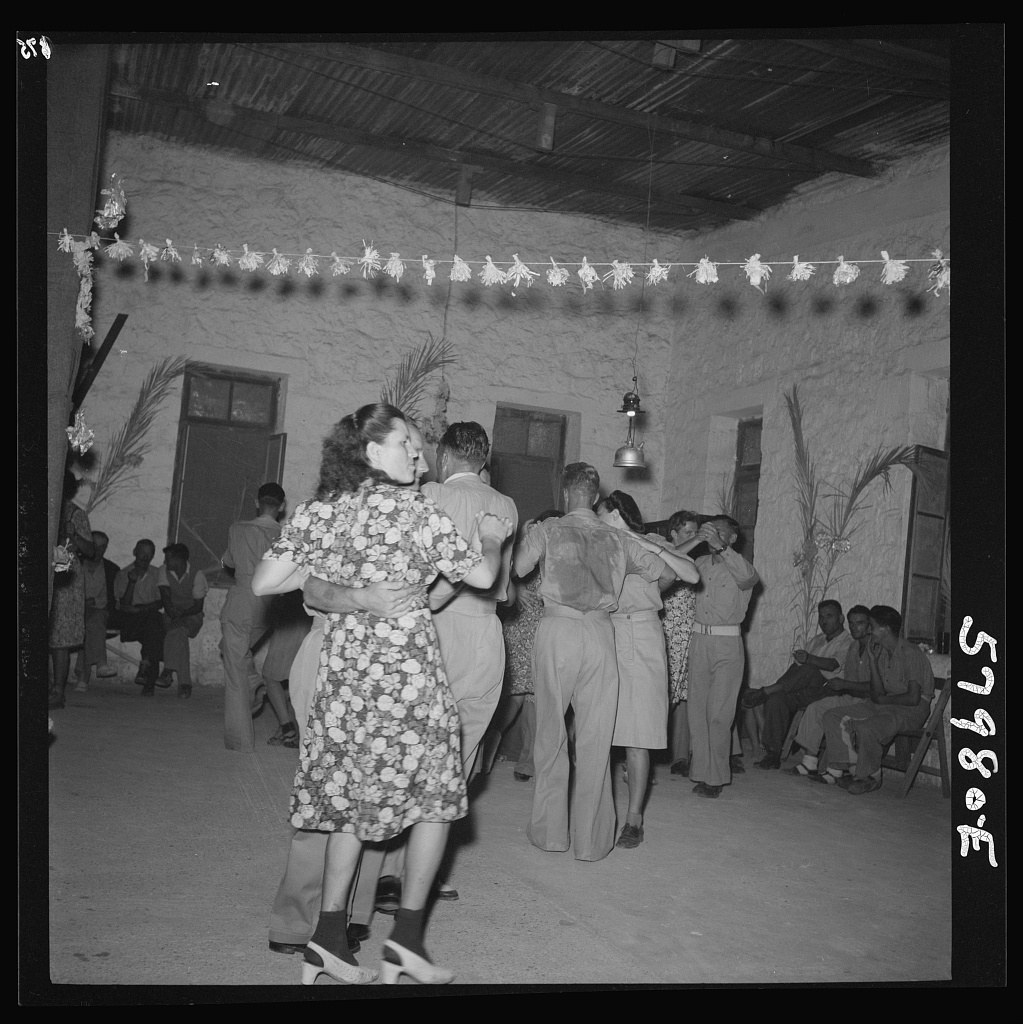
This image is rare evidence that social dance continued in the camps, challenging any narrative of refugee camps as purely sites of deprivation. It shows Yugoslav refugees—whose homelands had been torn apart by invasion and occupation—choosing to dance together, suggesting both cultural continuity and a form of agency and normalcy-seeking within extreme constraint. For dance historians, it documents the folk ballroom practices of Yugoslav communities and the role of dance in diaspora and survival.
What you are looking at
A large indoor space—a warehouse or institutional hall with exposed corrugated metal roof and supporting columns—fills with a mixed crowd of Yugoslav refugees. In the foreground, couples dance together; in the middle ground, onlookers sit and stand, watching. The central couple visible in sharp focus show a woman in a floral print dress with her arm around a man's shoulder, dancing in close embrace. Decorations hang from a rope strung across the ceiling: cutout paper shapes (possibly snowflakes or stars) suggesting a festive occasion. A hanging lantern provides overhead light. The photograph's grain and contrast are consistent with wartime or immediate postwar documentary photography. Children and adults populate the edges of the frame, some seated on chairs, others standing in small groups. The mood is one of community gathering and modest celebration within constrained circumstances.
The dancing
The central couple dances in a closed, upright hold with the woman's right arm across the man's back and his arm around her waist—a frame consistent with Central and Eastern European folk or social ballroom dance. Their posture is upright and compact rather than extended. A second couple is visible behind them in similar embrace. The dancers' weight appears to be on their feet in a grounded, walking rhythm rather than lifted or suspended. The dress of the male dancer is plain trousers and a light shirt; the woman wears a simple floral dress without the formal attire of staged performance.
The dance depicted
This appears to be a social ballroom or folk couple dance of the type common in Yugoslav communities—possibly a waltz, foxtrot, or regional variant such as a polka or folk-derived turn. The frame and hold suggest Central European dance conventions of the mid-twentieth century rather than Latin or modern forms. The setting identifies this as a community gathering rather than performance, meaning the dance was functional and participatory. No musician is visible, though the organized space and festive decoration suggest music was provided. The identity of specific dancers and their backgrounds cannot be established from the image alone.
How it was made
This is a black-and-white photograph, likely taken with a 35mm press or documentary camera typical of the 1940s. The grainy quality, contrast, and composition suggest professional documentary photography rather than casual snapshot work. The Library of Congress Prints & Photographs collection includes extensive wartime and postwar documentation, and this image's technical qualities and subject matter align with the visual record created by official photographers and journalists during the displaced persons crisis. The photograph's perspective—taken from within the hall at a slight distance—allows the full scene to register while maintaining focus on the dancing figures.
About this work
This is a documentary photograph of a dance gathering in El Shatt, a United Nations Relief and Rehabilitation Administration (UNRRA) camp for Yugoslav refugees, taken in 1944. The image captures a moment of cultural continuity and community resilience: displaced persons maintaining traditional social dance practices within a displaced persons camp. The photograph is one of the historical record of the European refugee crisis and the lived experience of those in institutional care; it is also evidence of dance as a form of psychological and social sustenance during displacement. The work belongs in a dance history collection because it documents how communities under duress preserve and practice dance as an act of cultural identity and collective self-care.
How to look at it
Observe the deliberately maintained distance between the dancers' bodies despite the close frame—this is a formal, patterned dance rather than an embrace of intimacy. Notice the spectators' posture and attention: they are neither passive nor voyeuristic, but part of a shared social occasion. The decoration overhead signals that even in a refugee camp, aesthetic and festive effort was made. The photograph captures not a moment of virtuosity but of normalcy and continuity: this is how people danced, this is how communities held themselves together.
The artist
The photographer is not recorded. The image is part of the Library of Congress Prints & Photographs Online Catalog, likely acquired from UNRRA records or postwar documentary archives. It is consistent with the work of official war photographers and relief organization documentarians who created the visual record of the displaced persons camps in the aftermath of World War II.
The period
This photograph was taken in 1944, while World War II was still ongoing in Europe and the Yugoslav territories were under Axis occupation or partisan control. The UNRRA camp system was established to receive and care for civilians displaced by the war. By 1944, dance was already recognized by relief workers and the Red Cross as valuable for morale and mental health. The photograph captures a moment when social institutions—including dance—were being reconstructed within the camps, and when cultural practices served as both memory of home and assertion of continued identity. In European dance history, 1944 was still the era of ballroom and folk dance as dominant social forms; theatrical modernism and street dance had not yet displaced traditional couple dance from community life.
Where it lives
The image is held in the Library of Congress Prints & Photographs Online Catalog. It is part of the historical documentation of the UNRRA camp system and the displaced persons crisis of World War II. The original photograph appears to be an archival black-and-white print or negative.
Dance in this work
Questions about this work
What was El Shatt?
El Shatt was a refugee camp established by the United Nations Relief and Rehabilitation Administration (UNRRA) in Egypt during and after World War II to house Yugoslav civilians displaced by the war. The camp provided shelter, food, and basic services to thousands of refugees waiting for resettlement or repatriation.
Why would people dance in a refugee camp?
Dance served crucial psychological and social functions: it maintained cultural identity, provided recreation and momentary escape from difficult conditions, reinforced community bonds, and asserted normalcy and agency. Relief workers recognized that cultural and recreational activities were essential to mental health and morale.
What kind of dance is this?
The frame and hold suggest a Central or Eastern European ballroom or folk couple dance, most likely a waltz, foxtrot, polka, or regional variant common in Yugoslavia. The specific style cannot be identified with certainty from the photograph alone, but the upright frame and closed position are consistent with traditional Yugoslav social dance.
Who is the photographer?
The photographer is not identified in the archival record. The image is likely part of the official documentary record created by UNRRA photographers or war photographers working with relief organizations.
More dance artwork





