49 works in this view — arrow keys or swipe to move between them.
Dance in Art
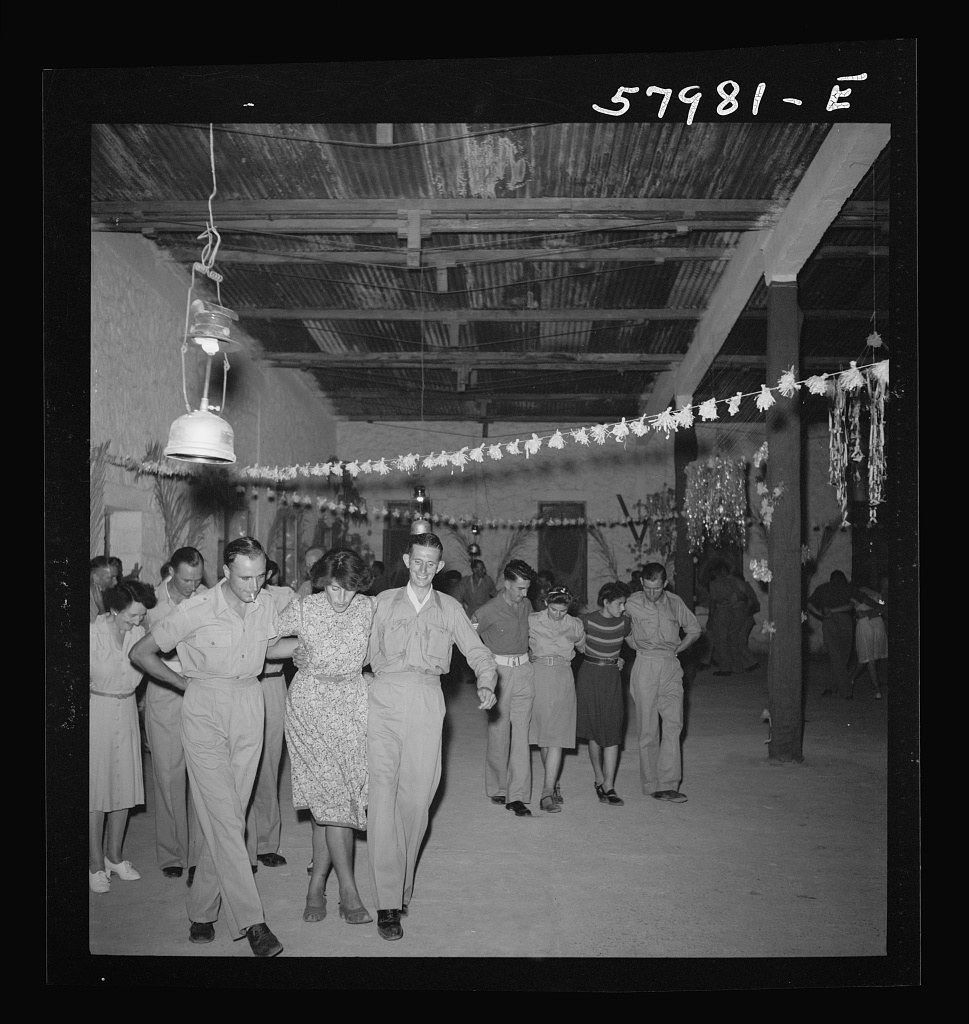
El Shatt, the United Nations Relief and Rehabilitation Administration's refugee camp for Yugoslavs
Unknown artist
- Collection:
- Prints & Photographs
- Source:
- Library of Congress
- Rights:
- Rights vary by item — check the source record before reusing this image. Source record ↗
- Recorded as:
- Library of Congress — no known restrictions (verify per item)
This photograph is essential evidence that dance survived and persisted in refugee camps—that even under conditions of displacement and internment, communities found space to gather and dance together. It shows dance functioning as social glue and cultural continuity rather than as art for display. The image also documents the specific experience of Yugoslav refugees during WWII, a community history that is underrepresented in visual culture.
What you are looking at
A large group of people dance together in what appears to be a communal shelter or warehouse space with a corrugated metal roof and exposed wooden beam structure. The setting is brightly lit by a hanging lamp suspended from the ceiling. Paper decorations—strings of cut-out figures or snowflakes—hang in festoons across the roof beams, suggesting a celebration or holiday gathering. The floor is bare concrete or packed earth. Approximately fifteen to twenty figures are visible, arranged in loose clusters across the space: some in the foreground dance in pairs or small groups, while others cluster in the background. The dancers wear simple, practical clothing—light-colored work shirts and trousers for the men, simple print dresses and work clothes for the women and children. The overall mood is one of collective, informal celebration rather than formal performance.
The dancing
The dancers move in a relaxed, social formation rather than a choreographed line. Several couples hold hands or maintain light contact at shoulder and waist as they move across the floor. The bodies are upright and the movements appear to flow from side to side and in circular patterns. The frame suggests social, partnered dancing of the folk or traditional European ballroom type, with an emphasis on communal participation rather than technical precision. No pointe shoes, competitive frame, or formal ballet technique is evident.
The dance depicted
This appears to document social or folk dancing at a refugee camp gathering. The informality of the setting, the mixed group composition (adults and children), the casual dress, and the decorative effort suggest a community celebration—possibly a holiday, festival, or morale-building event. The style of partnering and movement is consistent with Central or Eastern European social or folk dance, which aligns with the catalogue identification of this as a Yugoslav refugee camp. The dancers appear to be performing traditional couple or group dances, though the specific regional style cannot be determined from the photograph alone. This is documentary photography capturing lived social practice rather than staged performance.
How it was made
This is a black-and-white photograph, likely taken with flash or bright portable lighting given the even exposure and sharp detail despite the interior setting. The image quality and photographic style are consistent with documentary photography from the 1940s, suggesting it was shot with a portable press or news camera. The photograph was probably created as part of institutional documentation of refugee camp conditions by the UNRRA (United Nations Relief and Rehabilitation Administration), which maintained extensive photographic records of its operations. The medium allowed rapid, direct documentation of daily life and morale-building activities without the formal staging required by earlier photographic or illustrative methods.
About this work
This is a documentary photograph of Yugoslav refugees dancing at El Shatt, a UNRRA refugee camp, in 1944. It captures a moment of social celebration and cultural continuity amid displacement, showing a community gathered to dance together in a temporary shelter. The image preserves evidence of how refugees maintained traditional social practices and communal identity through dance during wartime internment. The photograph belongs in a gallery about dance because it documents the social, emotional, and cultural function of dance in extreme circumstances—not as performance art but as an assertion of community, tradition, and human resilience. It is a rare visual record of how ordinary people used dance to sustain themselves and each other during the Second World War.
How to look at it
Look first at the composition: the photographer chose to capture the full scale of the gathering, showing the temporary architecture and the number of people involved, rather than isolating individual dancers. Notice how the decorations (the cut-out paper garlands) signal that this is a marked occasion, not routine activity—the refugees invested effort in making the space festive. Observe the body language: the dancers are relaxed and social rather than performing; many are smiling or concentrating on their partners. The lighting, probably harsh and artificial, is characteristic of press photography of the period and gives the scene an immediate, urgent quality—this is real life being documented, not art being created.
The artist
The photograph is uncredited in the catalogue record, but it was almost certainly taken by a UNRRA photographer or field documentarian. The UNRRA maintained a large photographic archive as part of its official record-keeping, and field photographers documented camp conditions, services, and social activities to report on operations to international bodies and donors. The photograph reflects the documentary conventions of wartime institutional photography—matter-of-fact recording of conditions and activities without aesthetic elaboration.
The period
This photograph dates to 1944, in the final year of the Second World War in Europe. Millions of people were displaced from their homes by the conflict; the UNRRA (established in 1943) coordinated international relief efforts for civilians caught in the war zone and for those liberated from occupied territories. El Shatt was a transit camp in Egypt used to house Yugoslav and other European refugees awaiting repatriation or relocation. In this period, dance was often mobilised as a tool for maintaining morale and preserving cultural identity in camps, DP (Displaced Persons) centers, and other sites of mass congregation. The photograph captures a moment when the certainty of eventual return or resettlement made community gatherings feel possible and meaningful.
Where it lives
This photograph is held in the Prints & Photographs Online Catalog (LOC), part of the Library of Congress collections. It comes from what is almost certainly the UNRRA photographic archive, a massive institutional collection documenting wartime relief operations. The catalogue record identifies it only by camp name and year, which is typical of archival documentary photography, where individual images are understood as part of a larger systematic record rather than as singular artworks.
Dance in this work
Questions about this work
Was this a professional performance or just everyday social dancing?
This was a social gathering, not a staged performance. The casual dress, mixed ages, informal grouping, and the effort to decorate the space all indicate that the refugees gathered to dance together as a community, probably to mark a holiday or celebration. There is no stage, no audience standing apart, and no formal choreography—the dancers are participating, not performing for an external viewer.
What specific dance or tradition is being performed?
The photograph does not provide enough detail to identify a specific regional dance or style. The partnered, circular movement and the casual grouping suggest Central or Eastern European social or folk dancing, which fits with the Yugoslav refugee population. Individual dancers may have been dancing styles specific to their regions of origin, but the photograph captures only the general social activity.
Where was El Shatt and why were Yugoslav refugees there?
El Shatt was a transit camp near Cairo, Egypt, operated by the UNRRA. Yugoslav and other European refugees were placed there during and after World War II, awaiting repatriation to their home countries or relocation. The camp served as a holding facility while international organisations worked to process and resettle displaced persons.
What do the paper decorations mean?
The strings of cut-out figures or snowflake-like shapes hung across the roof beams indicate that the refugees decorated the space for a special occasion—likely a holiday celebration or festival. This investment of effort in making the temporary shelter festive demonstrates both the desire to create beauty and normalcy in difficult circumstances and the psychological importance of marking time and community through celebration.
More dance artwork





