49 works in this view — arrow keys or swipe to move between them.
Dance in Art
Wiedost [i.e. Wiedoeft]
Unknown artist
- Collection:
- Prints & Photographs
- Source:
- Library of Congress
- Rights:
- Rights vary by item — check the source record before reusing this image. Source record ↗
- Recorded as:
- Library of Congress — no known restrictions (verify per item)
Though not a dance image itself, this photograph documents the early jazz era when musical innovation and choreographic development were inseparable. For a dance historian, it provides context for understanding who the musicians were that accompanied dancers of the period and how jazz musicians worked and presented themselves.
What you are looking at
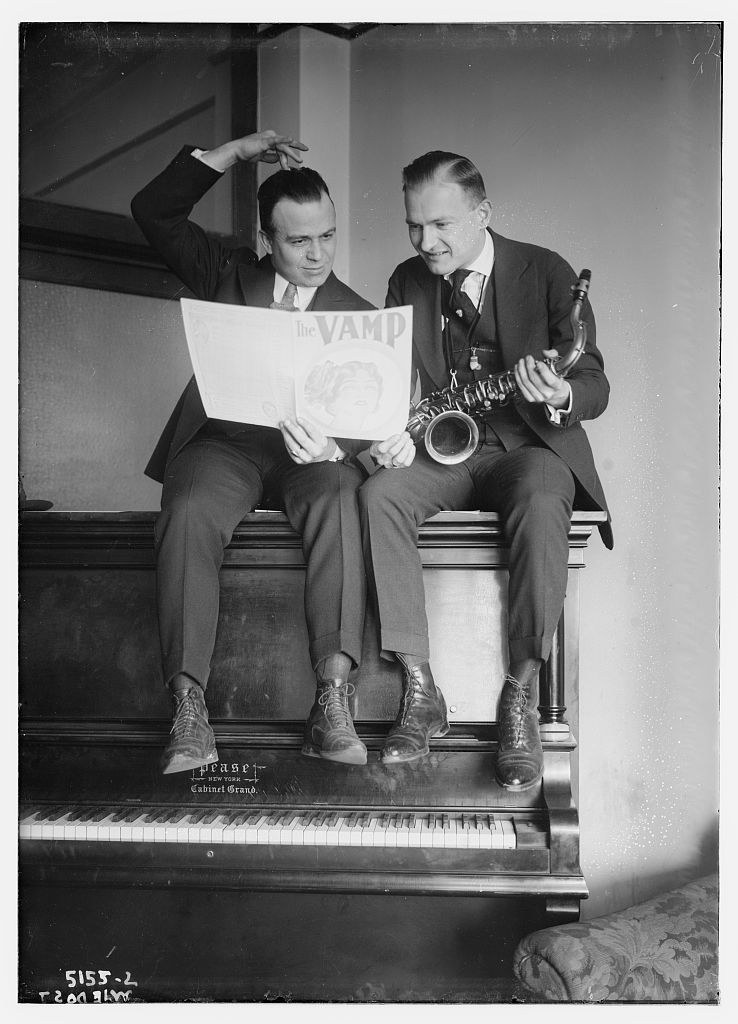
Two men in business suits sit atop a grand piano, their legs dangling casually over the keyboard. The man on the left holds a sheet of paper bearing what appears to be a logo or emblem marked "VAMP," tilting his head back in an attitude of pleasure or contemplation. The man on the right holds a saxophone across his lap. The setting is a studio or performance space with a plain wall and what appears to be a column or architectural element behind them. The composition suggests a moment of creative collaboration or musical camaraderie, captured in a black and white photograph with the intimate documentary quality of 1910s studio photography.
The dancing
Both figures are seated on the piano bench in relaxed postures, their body language suggesting ease and informality rather than performance tension. Their legs extend downward, pointing loosely toward the keys below. The left figure's raised arm and tilted head convey a moment of satisfaction or amusement, while the right figure's grip on the saxophone is assured and proprietary. There is no choreographed hold or frame; these are musicians at rest, not dancers in motion.
The dance depicted
This is not a depiction of dance. The image shows two musicians—a pianist and saxophonist, identifiable by the instruments and the piano setting. The catalogue identification 'Wiedost [i.e. Wiedoeft]' likely refers to Rudy Wiedoeft, a prominent saxophonist of the 1910s-1920s, which would date this to the jazz era. The casual studio pose and the presence of sheet music suggest this is a behind-the-scenes moment in the creation or promotion of jazz music, not a choreographed or performed dance.
How it was made
This is a black and white photograph, likely a gelatin silver print from the 1910s era, identifiable by its tonal range, grain structure, and the wear patterns visible on the negative. The photographic medium allowed documentary capture of the musicians in an informal, unguarded moment—a function that engraving or painting could not serve as readily. The image bears an archive stamp indicating its holding in the Library of Congress Prints & Photographs collection, confirming its status as an original photographic negative rather than a reproduction.
About this work
This photograph documents two musicians collaborating in a studio setting, most likely Rudy Wiedoeft (right), a pioneering jazz saxophonist, and an unnamed pianist during the early jazz era. The image captures a moment of creative leisure rather than performance, showing the informal camaraderie between two instrumentalists. Though it belongs to a collection concerned with dance in art, the photograph does not depict dance; it is a musical collaboration piece from an era when jazz and dance were closely intertwined culturally, even when photographed separately.
How to look at it
Attend to the informality of the pose: these are not performers striking attitudes for the camera, but colleagues at ease in a studio. The sheet marked 'VAMP' is the key detail—a vamp is a repeated musical phrase, suggesting the men are pausing mid-rehearsal or mid-composition. The casual placement of the saxophone and the relaxed sprawl across the piano convey the improvisational, workaday reality of early jazz music-making, removed from the glamour of performance.
The artist
The photographer is not credited in the catalogue record. The image comes from the Library of Congress collection, suggesting it may have been a commercial studio portrait or publicity photograph, possibly made by a staff photographer or a professional music photographer of the period. The quality and composition suggest professional rather than amateur work.
The period
This photograph dates to approximately 1915, during the explosive emergence of jazz from New Orleans into mainstream American culture. While jazz dance and jazz music developed in tandem during this period, musicians and dancers inhabited overlapping but distinct professional worlds. The studio setting and the formal business suits suggest this was promotional material for musicians seeking to establish jazz as a legitimate entertainment form during a period when the music was still controversial.
Where it lives
The photograph is held by the Library of Congress Prints & Photographs Online Catalog (loc.gov/pictures), where it is catalogued under the identifier BAIN LC-B2- 3465-1. It appears to have been part of the Bain News Service collection, a major commercial news photography archive of the early 20th century.
Questions about this work
Why is this in a dance collection if it's not a dance photograph?
This photograph has been catalogued within the Gallery of Dance in Art, but it does not depict dance. It may have been misclassified, or it may be included for contextual value—showing the musicians and instruments that accompanied dance during the early jazz era. The saxophone and the 'VAMP' sheet music connect it tangentially to the dance world of 1915.
Who is Wiedoeft?
Rudy Wiedoeft (1893–1940) was an American saxophonist and composer who pioneered the tenor saxophone in early jazz. He was one of the most celebrated musicians of the 1910s and 1920s, known for his virtuosity and recordings that helped establish the saxophone as a lead instrument in jazz.
What is a vamp in music?
A vamp is a short, repeated musical phrase or riff, typically played while waiting for a soloist to enter or to fill time during a performance. In this photograph, the sheet marked 'VAMP' suggests the musicians were either rehearsing or performing a repeating musical passage.
More dance artwork





