49 works in this view — arrow keys or swipe to move between them.
Dance in Art
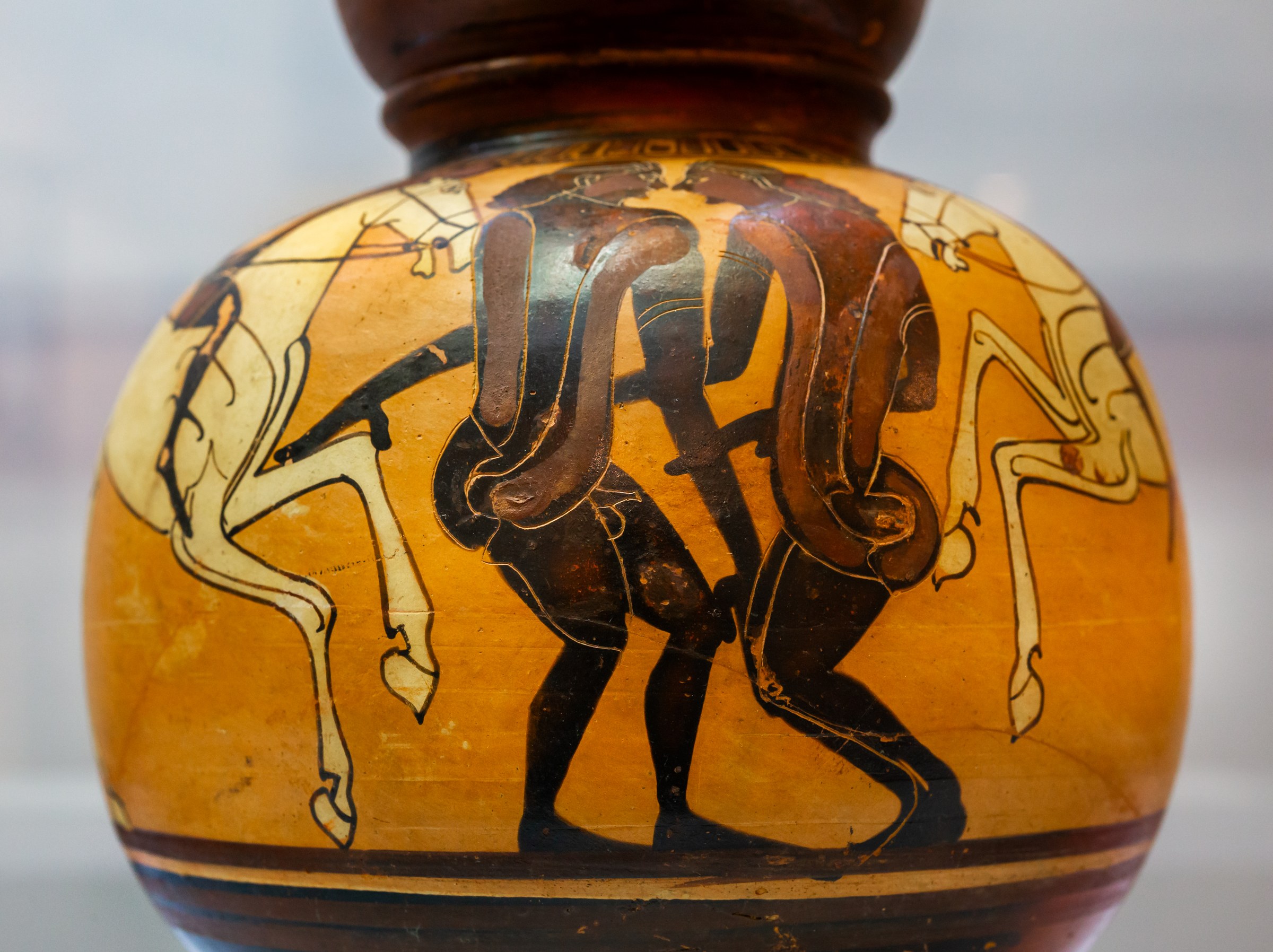
Late corinthian globular oinochoe - CVPAP extra - padded dancers between horsemen - München AS coll Schneider - 05
ArchaiOptix
- Source:
- Wikimedia Commons
- Rights:
- Reusable with conditions: credit the creator; share any adaptation under the same license. Source record ↗
- Recorded as:
- cc by-sa 4.0
The image is rare direct evidence of Greek komastic dance, capturing not just a moment but a whole performance tradition in visual form. The padded costume became the standard dress of comic theatre, making this vessel an ancestor document for the history of comedy itself. For dance historians, it demonstrates that ancient Greek comedy had a physical, embodied language—one based on absurdity, transgression, and exaggerated bodily display—that persisted across centuries and genres.
What you are looking at
A Late Corinthian oinochoe (wine jug) shows a procession of four figures arranged in a freeze around the globular body. Two padded dancers dominate the center, their bodies rendered in the black-figure technique against the warm orange-red clay slip. Both dancers are nude except for thick padding that wraps their torsos, hips, and thighs—the characteristic costume of Greek komasts (revelers). Their bodies are bent forward at the waist in an exaggerated posture, legs splayed, as though caught mid-movement in a satirical or comic dance. Flanking them on either side are two young horsemen in short chitons (tunics), shown in profile, each leading or standing beside a horse. Above the horses, two eagles are depicted in flight. A decorative vine pattern frames the scene at top and bottom, typical of Corinthian pottery. The composition is tightly organized and symmetrical, with the padded dancers as visual anchors and the horsemen as framing elements.
The dancing
The two central figures are unmistakably dancers, identifiable by their grotesquely padded bodies and forward-flexed posture. Both wear thick padding around the abdomen, buttocks, and thighs, creating a phallic silhouette—a costume device used in comic drama and komos (reveling processions). Their legs are wide apart, knees slightly bent, suggesting a low center of gravity and an exaggerated, ungainly gait rather than the upright carriage of athletic or noble movement. The stance conveys comedy: the body shape is absurd, the posture undignified. The flanking horsemen provide context but are not themselves dancing; they represent another social register—youth, nobility, or civic authority—set against the licensed mockery of the komasts.
The dance depicted
This depicts komoi, the organized reveling processions of ancient Greece, in which costumed men danced, sang, and performed satirical and often obscene movements as part of festival celebration or dramatic performance. The padded costume is the visual signature of this tradition, worn in both street processions and in theatrical contexts (particularly in Old Comedy). The exaggerated posture—forward-bent, legs splayed—captures the character of komos movement: comedic, uninhibited, lower-body-focused. The inclusion of the horsemen suggests a formal procession or a scene from a drama in which different social or character types are juxtaposed. This is not a depiction of a refined or sacred dance but of a licensed, sanctioned performance of bodily transgression.
How it was made
This is a black-figure decorated pottery vessel, the dominant ceramic technique in Corinth during the Late Archaic period (ca. 550–540 BCE). The figures are painted in glossy black pigment on the natural orange-red clay body. Details—anatomical features, the vine scroll borders—are incised through the black layer to reveal the clay beneath. Black-figure technique was labor-intensive and required skilled hand-painting; such decorated vessels were valuable prestige items, used for serving wine at symposia or displayed in wealthy households. The technique's crisp lines and high contrast allowed for precise narrative detail, making it ideal for the codification of costume and character types like the padded komastes.
About this work
This is a decorated wine-serving vessel from Late Archaic Corinth (ca. 550–540 BCE), among the most prestigious pottery-producing centers of its era. The vessel's decoration documents an important Greek social practice: the komos, a reveling procession in which costumed performers enacted transgressive, comic movement. The padded dancers depicted here represent a character type and performance mode so recognizable to contemporary viewers that they needed no label. The juxtaposition of the komasts with the horsemen suggests a procession scene or dramatic tableau, possibly from a comedy or civic festival. The vessel itself would have held wine served at a symposium (elite drinking party), creating a self-referential context: the image of revelers decorates an object used in an actual occasion of elite conviviality.
This work matters because it is direct evidence of Greek dance as both social practice and visual convention. The padded komos costume appears frequently in later Athenian black-figure and red-figure pottery, and will eventually become the costume of Old Comedy (the plays of Aristophanes). Here, at an earlier date and in Corinth, we see the costume and movement type already codified as recognizable and repeatable—evidence that komos was not spontaneous but structured, with conventional gestures and a standardized visual identity.
How to look at it
Focus on the posture of the two central dancers: the extreme forward flexion of the torso, the splayed legs, the broad silhouette created by padding. This is not a naturalistic stance but a codified one—a visual shorthand for comic transgression. Compare the dancers to the horsemen flanking them: notice how upright, dignified, and idealized the horsemen are in contrast. The juxtaposition tells you that the komos represents a licensed inversion of normal decorum. The dense patterning of the incised vine scroll above and below anchors the scene in ornamental tradition, reminding you that this narrative image is also part of a decorated object. The warm terracotta ground against the glossy black figures creates strong contrast and would have caught light during use and display.
The artist
The vessel is unattributed, as was common for Corinthian pottery of the period. It was made in a major workshop center that supplied decorated wares across the Mediterranean. The artist was a skilled craftsperson trained in the black-figure technique, capable of precise narrative composition and the differentiation of character types through costume and posture. The work reflects the conventions of a pottery tradition in which narrative, character, and social commentary were expressed through the careful selection and arrangement of stock types.
The period
Late Corinthian I (ca. 550–540 BCE) is the final phase of Corinthian pottery's dominance before Athenian red-figure wares took over the market. Corinth was a major maritime and commercial power, and its pottery was exported widely. In this period, Greek city-states were developing the institutions and practices of democracy and dramatic performance. The komos as depicted here is part of the larger ecology of Greek festival culture, in which organized, ritualized performance was central to civic and religious life. Black-figure technique reached its technical and compositional peak in this era before the red-figure technique (introduced in Athens around 530 BCE) allowed for greater flexibility in pose and anatomical rendering.
Where it lives
The vessel is housed in the Staatliche Antikensammlungen, Munich, in the Eva-Maria and Berthold Schneider collection, a private holding assembled and catalogued in the 2025 publication by Pfisterer-Haas and Bentz. It is part of a broader scholarly effort to document and study Corinthian pottery collections outside major state museums.
Questions about this work
What is the padded costume on the dancers?
The padding represents the costume of Greek komasts—revelers who performed in organized processions and later in comedic theatre. The padding emphasizes the torso, hips, and thighs, often with a phallic outline, and was used for comic effect. This costume became standard in Old Comedy (5th century BCE) and is recognizable in many Greek vase paintings.
Is this from a play or a real procession?
Probably both. Komoi were real social practices—licensed reveling processions at festivals—but by the 6th century BCE they were also being incorporated into dramatic performance. The image may document either, or conflate them; the boundary between street ritual and staged performance was not always clear in ancient Greece.
Why are horsemen shown with the dancers?
The juxtaposition likely represents a procession scene in which different social types—nobles on horseback and comic performers on foot—are arranged in a formal order. This could reflect either civic festival protocol or a dramatic scene from a comedy or satyr play.
What was this object used for?
The oinochoe was a wine-serving jug used at Greek symposia (elite drinking parties). The decorated vessel held wine and would have been displayed on a table or sideboard. The image of revelers thus created a playful context for the actual occasion: wine and celebration.
More dance artwork





