49 works in this view — arrow keys or swipe to move between them.
Dance in Art
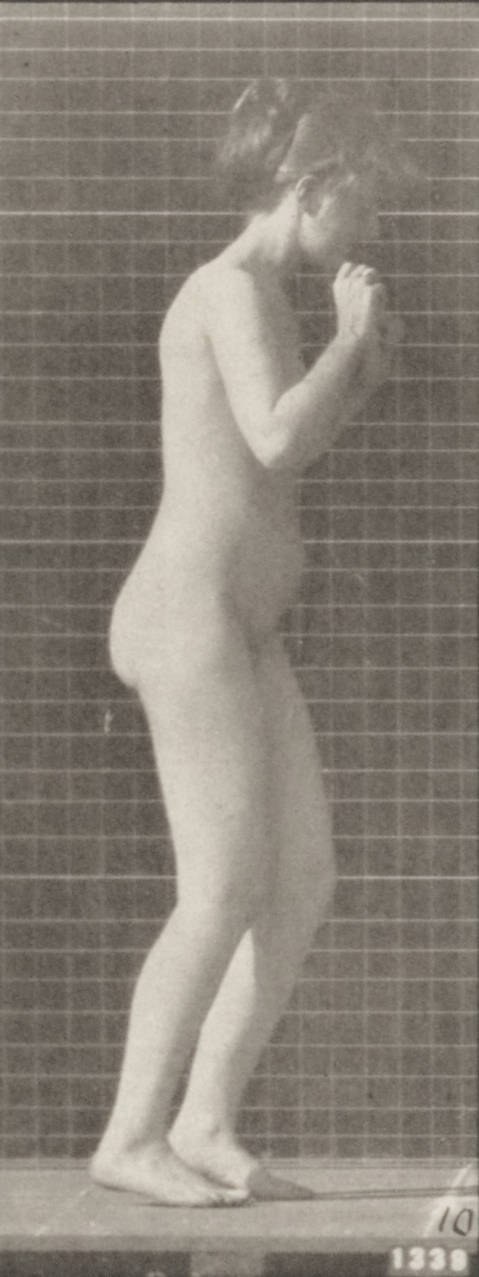
Nude woman dancing a waltz (rbm-QP301M8-1887-195a~10)
Muybridge, Eadweard, 1830-1904
- Source:
- Wikimedia Commons
- Rights:
- Public domain — free to use, share and adapt.
- Recorded as:
- public_domain
Muybridge's *Animal Locomotion* was among the first scientific instruments capable of breaking continuous movement into discrete frames, influencing both artistic practice and the development of cinema. For dancers and historians, this plate documents how the dancing body was being analyzed, measured, and dissected in the late 19th century—not as aesthetic performance, but as biomechanical system.
What you are looking at
A single nude female figure stands in profile against a gridded background, captured in a moment of upright, extended posture. The body is fully frontal to the viewer's right side, with the left arm raised and bent at the elbow near the head, and the right arm positioned across the torso at waist height. The figure stands on both feet with weight evenly distributed, the body elongated and the musculature clearly defined. The gridded background is typical of motion studies, suggesting a controlled studio environment with reference markers for precise measurement and analysis. The photograph is rendered in grayscale with soft, even lighting that reveals anatomical detail.
The dancing
A single standing female figure in profile, with the body held in an upright, extended vertical alignment. The left arm is raised, bent, and positioned near the head; the right arm is lower, held near the center of the body. The stance is grounded and stable, with the weight distributed evenly across both feet. There is no partner or group interaction visible. The posture suggests a moment of poised, composed movement rather than dynamic action or rapid motion.
The dance depicted
The work is titled as depicting a waltz, but the static, frontal-facing pose does not correspond to the characteristic holds, frames, or movement signatures of waltz dancing in any period. A waltz requires a closed hold with a partner (or at minimum a clear frame for partnered movement), continuous rotational momentum, and a three-beat timing pattern reflected in the body's trajectory through space. This figure is isolated, symmetrical, and held in a moment of stillness. The pose may represent an artistic or anatomical study of a dancer's body, or a moment extracted from movement for analytical purposes, rather than a faithful representation of waltz as it was performed.
How it was made
This is a photogravure, a reproductive photographic print from the *Animal Locomotion* series. The gridded background and numbered reference plate are characteristic of Muybridge's systematic motion-analysis methodology. Photogravure allowed for the high-quality printing and wide circulation of photographs, making these studies accessible to artists, scientists, and educators. The medium's capacity for capturing precise anatomical detail and the sequence format enabled new ways of analyzing human movement in art and medicine.
About this work
This plate is one of several hundred in Eadweard Muybridge's *Animal Locomotion* (1887), a monumental photographic project documenting human and animal movement in sequential frames. The series was published under the auspices of the University of Pennsylvania and represented one of the first systematic, scientific approaches to recording motion. Although titled "Dancing a waltz," the image shows a single standing figure rather than the partnered movement the title suggests, indicating either a moment extracted from a larger sequence, an anatomical study of a dancer's pose, or a discrepancy between the plate's caption and its content. The work sits at the intersection of art, anatomy, and early motion photography, and has become foundational to the history of both dance documentation and cinema.
How to look at it
Observe the stillness and frontality of the pose: this is not a moment of dynamic waltz motion, but rather a held position. Notice the gridded background, which is not a design choice but a scientific reference system—each square allows measurement of spatial displacement and anatomical proportion. The numbering visible in the lower corner identifies this as plate 195 in a systematic archive of movement. Look for what the pose reveals about the dancer's training and body type, and consider whether this figure was captured mid-sequence (and if so, which moment in the waltz) or posed deliberately for anatomical study.
The artist
Eadweard Muybridge (1830–1904) was a British photographer and motion-analysis pioneer whose sequential photographic studies revolutionized the understanding of human and animal locomotion. Using a battery of synchronized cameras, he captured movement frame-by-frame and published his findings in *Animal Locomotion* (1887), which contained 781 collotype plates. His work influenced artists including Thomas Eakins and Edgar Degas, and was instrumental in the development of motion pictures. The *Animal Locomotion* project was funded by the University of Pennsylvania and represented one of the largest and most systematic photographic undertakings of the era.
The period
The 1880s saw a convergence of scientific inquiry into human movement and new artistic interest in capturing motion. Photography was being used to settle aesthetic and anatomical questions—notably, Muybridge's earlier *The Horse in Motion* (1877) had already challenged artistic conventions about galloping horses. The waltz was the dominant social and theatrical dance of the period, performed in both ballroom and concert contexts, yet Muybridge's project approached movement from a biomechanical rather than aesthetic perspective. This image belongs to a moment when dance was being systematically documented as a physical phenomenon, parallel to growing interest in dance as theatrical spectacle and social ritual.
Where it lives
This is a photogravure plate from *Animal Locomotion: An Electro-Photographic Investigation of Consecutive Phases of Animal Movements*, published in 1887 by the Photo-Gravure Company in Philadelphia under the auspices of the University of Pennsylvania. The series is now held in the USC Digital Library. It is one of approximately 20,000 individual photographs organized into 781 collotype plates, making it part of one of the largest and most ambitious motion-documentation projects of the 19th century.
Questions about this work
Is this a photograph or a drawing?
This is a photogravure, a reproductive print made from a photograph. Muybridge used a battery of synchronized cameras to capture movement frame-by-frame; the image was then engraved and printed to allow mass production and wide distribution. The gridded background and reference markers were part of the original photographic setup, not added in printing.
Why is there only one person if this is supposed to be a waltz?
The image may represent a single frame extracted from a larger sequence showing both partners, or it may be an anatomical study of the dancer's body in isolation. The title 'Dancing a waltz' may not accurately reflect the plate's content, or the waltz may have been reconceived for Muybridge's analytical method. The discrepancy between title and image is a question worth asking.
How is this used in dance history?
*Animal Locomotion* is studied for what it reveals about late-19th-century attitudes toward the dancing body as a measurable, scientific object. It influenced artistic practice (notably among painters) and was foundational to cinema. For dance historians, it documents biomechanical analysis, anatomical ideals, and the increasing medicalization of movement in the period.
More dance artwork





