49 works in this view — arrow keys or swipe to move between them.
Dance in Art
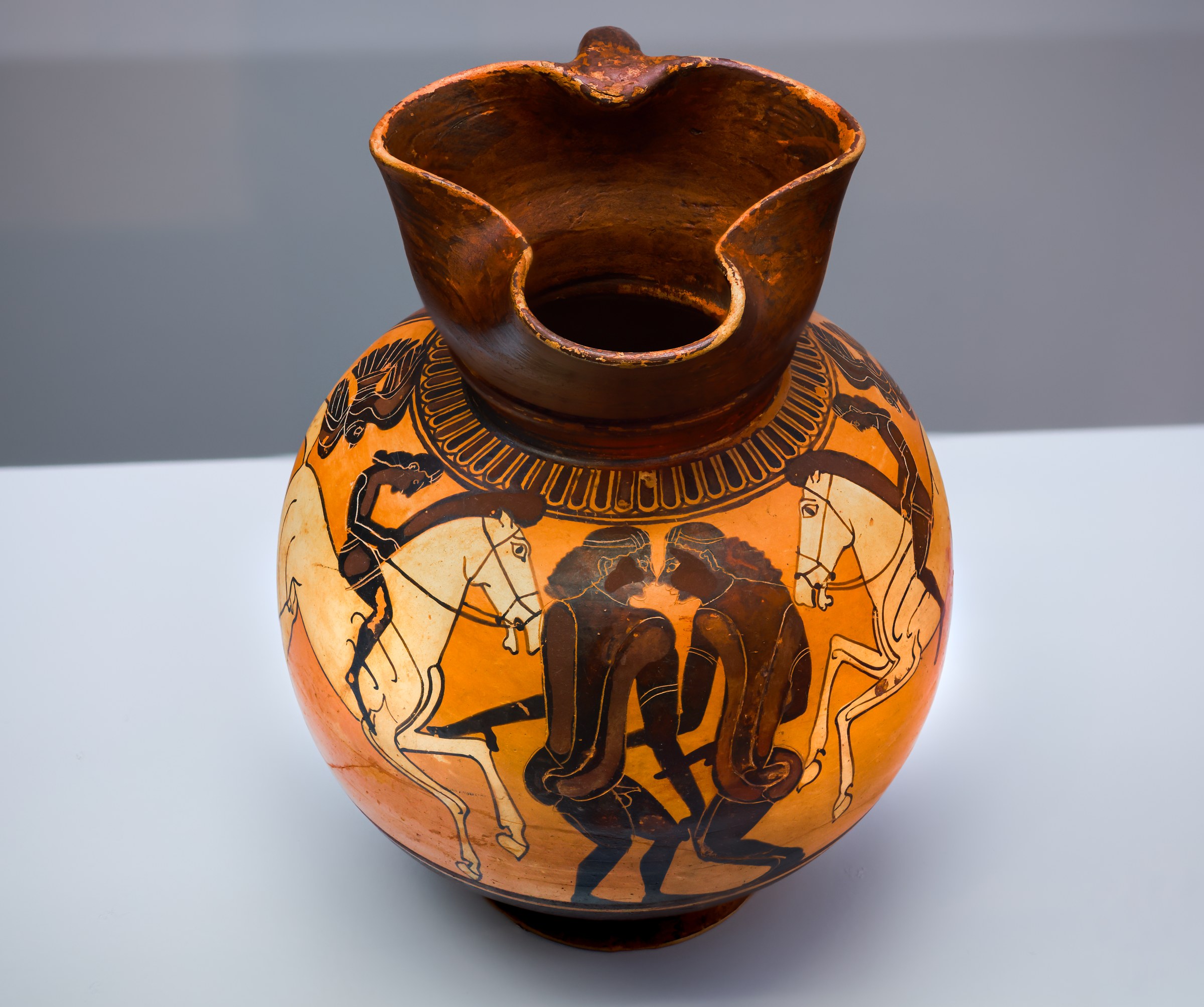
Late corinthian globular oinochoe - CVPAP extra - padded dancers between horsemen - München AS coll Schneider - 02
ArchaiOptix
- Source:
- Wikimedia Commons
- Rights:
- Reusable with conditions: credit the creator; share any adaptation under the same license. Source record ↗
- Recorded as:
- cc by-sa 4.0
This vase is one of the few surviving visual records of komast performance in ancient Greece, a form of entertainment that left no written choreographic or movement description. The padded costume and exaggerated postures shown here are among the clearest evidence we have for how these performers looked and moved, and how their comic physicality was understood and valued in Greek society.
What you are looking at
A globular clay pitcher with a trefoil (three-lobed) mouth displays a lively frieze of figures against the warm orange-red slip characteristic of Late Corinthian pottery. The principal scene shows two padded dancers—their bodies thickened with protective costume—positioned centrally and flanking a pair of young horsemen dressed in short chitons. The dancers adopt exaggerated postures with bent knees and splayed limbs, their padding creating comic, almost grotesque silhouettes. The horsemen, rendered in the fine black-figure technique, wear neat short garments and are mounted on horses shown in profile. Two eagles with spread wings fly behind the horses, their bodies rendered in silhouette. A decorative band of geometric and linear patterns runs around the shoulder of the vessel, creating a formal frame for the narrative scene below. The composition is rhythmic and symmetrical, with the dancers' energetic poses contrasting sharply against the more controlled stance of the mounted riders.
The dancing
The two padded dancers display the exaggerated, low-centre-of-gravity posture typical of komast performers: wide-planted legs, bent knees, and torsos tilted forward. Their padding—shown as a thickened silhouette—gives them a bulbous appearance, emphasizing the costume rather than the body beneath. The horsemen stand more upright, their bodies rendered with cleaner lines and lighter fill, suggesting they belong to a different social category. The dancers' arms appear extended or gesturing outward, capturing a moment of active movement, while the riders maintain a more static, formal presentation. The spatial arrangement—dancers flanking riders—creates a visual dialogue between two forms of performance or social performance.
The dance depicted
These are komasts, the padded comic dancers of ancient Greek symposium culture, depicted here in the company of horsemen, likely nobles or wealthy youths. Komasts performed at drinking parties and festivals, their exaggerated physicality and grotesque costuming marking them as entertainment performers of lower status. The padding visible on their bodies was functional—it protected and shaped the performer while creating a comic, almost phallic silhouette. This vase captures the komasts mid-performance, their bodies captured in dynamic, splayed postures. The inclusion of young horsemen suggests a scene of mixed entertainment or a procession, placing the dancers within a broader social and ceremonial context. The image documents not formal choreography but the conventions of improvised, comic physical performance.
How it was made
This is a ceramic vessel made from local Corinthian clay, decorated in the black-figure technique—figures and details rendered in a durable black gloss against the natural orange-red of the clay slip. The technique was labour-intensive: the artist incised details into the black glaze with a fine point, creating the linear patterns on the horses, the geometric border, and facial features. The firing process transformed the glaze to a permanent black. This method allowed for fine detail and precise line-work, as visible in the decorated band and the careful rendering of the horsemen's garments. The trefoil mouth required skilled hand-forming. Such vases were functional drinking vessels used in the symposium—the very context in which komasts performed—making this both a record of dance and an artifact of the social event it depicts.
About this work
This Late Corinthian oinochoe (pitcher) preserves a vivid record of komast performance in early classical Greece. Komasts were padded comic dancers who performed at symposia and public festivals, and this vase captures two of them mid-gesture, their exaggerated, low-slung postures and grotesque silhouettes marked by protective padding. The scene places the dancers alongside mounted young men, possibly nobles, creating a visual record of how different performers occupied the same festive space. The black-figure technique allows the artist to render fine detail—the geometric border, the horses' bridles, the dancers' bulging forms—with precision. As a functional drinking vessel, this pitcher carried its own performance context: it would have been used to serve wine at the very kind of gathering where komasts danced, making it both document and participant in the cultural practice it depicts.
How to look at it
Attend first to the padded dancers' posture: the wide-planted legs and bent knees place their centre of gravity low and forward, a stance wholly unlike the upright carriage of the horsemen. Notice how the artist has rendered padding as an all-over thickening of the silhouette, creating an almost abstract bulbousness that reads as costume rather than body. The incised details—the horsemen's bridles, the geometric patterns on the shoulder—show the precision of black-figure work, which required drawing by subtraction, scratching lines into glaze. The spatial arrangement—dancers flanking riders—invites interpretation: are the dancers escorts? entertainment? a formal procession? The artist does not narrate a single moment so much as present a type scene, a visual formula for 'komasts with horsemen,' which may reference a specific ceremony or simply a memorable juxtaposition of social ranks.
The artist
The painter is unattributed, as is typical for the vast majority of Corinthian pottery. The work is assigned to the Late Corinthian I period on stylistic grounds—the confident use of black-figure technique, the proportions of the vessel, and the decorative vocabulary. Corinthian potters were highly skilled craftspeople whose workshops produced vessels for both local use and export throughout the Mediterranean. While individual artists' names survive only occasionally in Greek pottery, this work demonstrates the sophisticated visual culture of Corinth in the mid-sixth century BCE, where narrative scenes on domestic vessels were a vehicle for recording social life, performance, and elite identity.
The period
In the mid-sixth century BCE, the symposium—the all-male drinking party—was a central institution of elite Greek culture, and performance was integral to the evening's entertainment. Komasts, whose name derives from komos (revel or procession), occupied a particular social niche: they were professional or semi-professional entertainers, their low social status marked by their grotesque padding and comic behaviour. At the same time, the Late Archaic period saw the rapid development of the black-figure pottery technique and the emergence of narrative painting on functional vessels. Images of performance, procession, and social gathering became common on drinking vessels, making them visual records of the culture that used them. The appearance of komasts on vases becomes more frequent in the sixth century, suggesting either a growth in the practice or an increase in its cultural prestige sufficient to merit depiction by elite potters.
Where it lives
This vase is held in the Eva-Maria and Berthold Schneider Collection, now part of the Staatliche Antikensammlungen in Munich. The Schneider collection is a significant private assembly of Greek pottery, and this work is catalogued in the collection study by Susanne Pfisterer-Haas and Martin Bentz (2025).
Questions about this work
What was a komast?
A komast was a performer, usually of lower social status, who danced at symposia (drinking parties) and public festivals in ancient Greece. They wore distinctive padded costumes that exaggerated the body's contours, and their performance was comic and improvisational rather than formally choreographed. The padding served both protective and aesthetic purposes, creating the grotesque silhouette visible on this vase.
Why is the padding visible on their bodies?
The padding was part of the komast costume, probably made from cloth stuffed with material to create exaggeration. It was functional—it protected the performer during vigorous movement—and visual: the bulging outline was part of the comic effect. On this vase, the artist has rendered the padding as an all-over thickening of the silhouette in black glaze.
What is the black-figure technique?
Black-figure is a pottery decoration method where figures and details are rendered in a durable black gloss against the natural orange-red of the clay. The artist draws by incising lines into the dried glaze with a fine tool, creating details like facial features, patterns, and bridles. When fired, the glaze becomes a permanent black, allowing for very fine linear detail.
Who were the horsemen, and what do they have to do with the dancers?
The horsemen are likely young nobles or elite men, identifiable by their short chitons and mounted status. Their inclusion alongside komasts suggests the vase records a scene of mixed social performance or procession. The juxtaposition may reflect actual symposium entertainment or ceremonial contexts where different performers and social ranks were visible in the same event.
More dance artwork





