49 works in this view — arrow keys or swipe to move between them.
Dance in Art
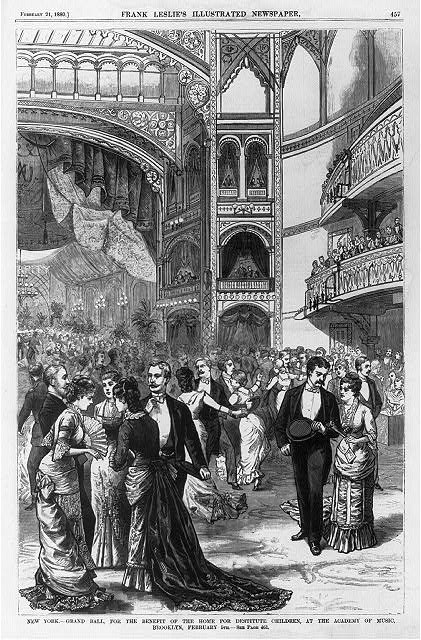
New York - Grand ball, for the benefit of the Home for Destitute Children, at the Academy of Music, Brooklyn, Feb. 5th.
Unknown artist
- Collection:
- Prints & Photographs
- Source:
- Library of Congress
- Rights:
- Rights vary by item — check the source record before reusing this image. Source record ↗
- Recorded as:
- Library of Congress — no known restrictions (verify per item)
This image is rare evidence of what an actual Gilded Age ballroom event looked like in scale, costume, and spatial organization—information rarely preserved in historical photography or preserved in contemporary description alone. For dance historians, it documents the venue, the formality, the proportion of spectators to dancers, and the costume silhouette that framed the movement of the period. The engraving also reveals the role of illustrated newspapers in circulating knowledge of high-society events to a broader readership, making social dance and formal evening dress a topic of public visual culture.
What you are looking at
This engraving depicts a grand ball held at the Academy of Music in Brooklyn on February 5th, 1880, in benefit of the Home for Destitute Children. The scene is composed around a soaring central atrium with multiple tiers of ornate balconies stacked vertically, their wrought-iron railings catching the light. The architecture frames the action dramatically: a dense throng of formally dressed guests occupies the floor of the hall, while additional spectators crowd the upper galleries. The foreground shows elegantly dressed couples and individuals—men in black tailcoats and white tie, women in elaborate gowns with long trains and corseted silhouettes—mingling and moving across the polished floor. The architectural theatricality dominates the composition: the soaring height, the visual repetition of arches and balconies, and the interplay of light and shadow create an atmosphere of refined spectacle. The engraver has concentrated detail on the costuming and the architectural setting rather than freezing a specific choreographed moment, instead capturing the social circulation and choreography of arrival and encounter that the evening entailed.
The dancing
The dancers and attendees are distributed across the floor and galleries in a social formation rather than a unified ensemble. In the foreground, several couples and individuals stand or move in conversation rather than in active dance hold. A woman in an elaborate dark gown with a long train is the dominant figure in the lower left, her posture upright and her train extending behind her—a static display of fabric and form typical of Gilded Age formal evening dress. Men stand at ease or with hands gesturing in conversation. There is no evidence of closed ballroom frame, lifted frame, or active footwork in the freeze-frame moment; the image captures social promenade and standing conversation rather than partnered dance in action.
The dance depicted
This is a social ball—a formal evening event structured around ballroom dancing and social circulation rather than a theatrical dance performance. The setting and context indicate American Gilded Age ballroom practice, circa 1880, where galas of this scale would have featured orchestral music and multiple dances: waltzes, polkas, quadrilles, and galops. However, the engraving does not freeze a specific choreographed moment or dance step; instead, it captures the event as a social spectacle—the gathering, the display of dress, the architectural frame. The composition prioritizes the social and architectural experience of the ball over the documentation of dance steps or hold, which may reflect either the engraver's priorities or the nature of the commission as a commemoration of the event rather than a dance manual.
How it was made
This is a wood engraving or steel engraving, recognizable from the fine parallel hatching lines used to build tone and shadow, the precise linear work defining the architecture and costume detail, and the tonal range achievable through density of line. The technique allowed for wide circulation as a newspaper or magazine illustration—the catalogue identifies it as from Frank Leslie's Illustrated Newspaper. The engraving process was ideal for contemporary documentation in periodicals: it could be reproduced at scale, distributed rapidly, and combined with letterpress text. The composition and the level of architectural and costume detail suggest this was a significant social event deemed worthy of illustrated reporting in a major publication.
About this work
This is a journalistic engraving of a Gilded Age charity ball, published in Frank Leslie's Illustrated Newspaper in 1880. It captures a moment in the social history of American ballroom culture—specifically, the formal evening entertainment that was both social occasion and public spectacle. The work functions as historical documentation of costume, architecture, and the social choreography of urban high society, rather than as a technical study of dance steps or technique. It belongs in a dance history context because ballroom events of this scale and formality—public galas with orchestral music, multiple dances, and hundreds of attendees—were central to how ballroom dance was practiced, displayed, and understood in the Gilded Age. The engraver's choice to capture the assembled crowd and the architectural frame rather than a single partnered couple reflects the period's understanding of the ball as a total social environment, not just a collection of individual dances.
How to look at it
Pay attention to the architectural framing: the engraver has made the soaring central atrium and the tiered balconies the dominant visual element, suggesting that the scale and spectacle of the venue itself was part of the evening's experience. Observe the distribution of figures—dense in the foreground, but also present in the galleries above—which conveys both participation and spectatorship. Notice the rendering of dress: the women's elaborate skirts and trains, the men's formal tailcoats, and the precision with which fabric texture is suggested through engraved line. Look for the absence of frozen choreography or active step: no couple is captured mid-turn or in a vivid arabesque. Instead, figures stand, converse, and circulate. This is a moment of social choreography—arrival, encounter, display—rather than dance technique.
The period
The 1880 date places this in the height of the American Gilded Age, when urban charity balls were major public events combining fundraising, social display, and ballroom dancing. The Academy of Music in Brooklyn was among the leading venues for such events. At this period, the dominant ballroom dances were the waltz (in its slower, more controlled American form), the polka, the galop, and the quadrille—all of which were typically danced in formally costumed, mixed-gender couples or sets. Women's fashion was characterized by the corseted silhouette, elaborate skirts with trains, and ornamental detail visible in this engraving. Socially, these events were highly stratified: attendees were drawn from the merchant and professional classes, with admission or ticket purchase required. The choice to illustrate such an event in a major periodical reflected the cultural significance of ballroom society and the appetite of middle-class newspaper readers for detailed visual reporting of elite social life.
Where it lives
This engraving is held in the Prints & Photographs Online Catalog of the Library of Congress. It was published in Frank Leslie's Illustrated Newspaper, a weekly illustrated periodical based in New York that reported on social, cultural, and political events through detailed wood and steel engravings. The publication date of February 21, 1880 (the issue date in the catalogue record) is consistent with coverage of events from the preceding week.
Dance in this work
Questions about this work
Was this a dance performance or a social event?
This was a formal social ball—a public evening event combining fundraising for a charitable organization with ballroom dancing and social gathering. Unlike a theatrical dance performance, attendees came to participate in multiple dances, socialize, and display their dress. Dancing occurred, but the event was structured around social circulation and courtship convention rather than choreography staged for an audience.
What dances would have been performed at a ball like this in 1880?
The standard ballroom dances of the period were the waltz (in its slower, more controlled American form), the polka, the galop, and the quadrille. These were typically danced in mixed-gender couples or, in the case of the quadrille, in mixed-gender sets of four. The evening would have been structured as a program of multiple dances, with breaks for refreshment and socializing.
Why is the architecture so prominent in this engraving?
The Academy of Music was a prestigious venue, and the soaring central atrium with its ornate balconies was a significant architectural feature that enhanced the grandeur of the event. The engraver prioritized the setting as part of what made the evening spectacular and worthy of illustration in a major newspaper. The scale of the venue also allowed hundreds of attendees to gather—both dancers and spectators—which was a key feature of Gilded Age public balls.
How do the clothes shown here relate to the dance?
Women's heavily corseted silhouettes, long skirts with trains, and full sleeves defined the movement vocabulary of the period: waltzes were slower and more controlled than their Romantic-era predecessors, with less dramatic rotation and extension. Men's formal tailcoats and relatively relaxed stance allowed for a partnering frame that was structured but less visibly athletic than later styles. The clothing itself was a form of display and courtship communication, not merely functional.
More dance artwork





