49 works in this view — arrow keys or swipe to move between them.
Dance in Art
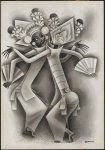
Legong dancers, #6
Unknown artist
- Collection:
- Prints & Photographs
- Source:
- Library of Congress
- Rights:
- Rights vary by item — check the source record before reusing this image. Source record ↗
- Recorded as:
- Library of Congress — no known restrictions (verify per item)
The print is evidence of how Legong and Balinese culture became subjects of artistic documentation and aesthetic fascination in the early twentieth century, at a moment when Western artists and writers were actively seeking out non-Western performance traditions. For historians of dance, it provides a visual record of Legong costume and movement quality at a specific historical moment, before Balinese dance was significantly transformed by tourism and external influence. The image shows an artist working to capture the precise, constrained quality of Legong movement—an achievement that requires understanding the dance beyond surface exoticism.
What you are looking at
A monochromatic print depicts two Legong dancers in elaborate traditional Balinese costume, captured mid-performance against a plain background. Both figures wear ornate headdresses adorned with flowers and jewels, their faces serene and stylized. Their upper bodies are bare or draped in decorative chest plates and jewelry; their lower bodies are wrapped in richly patterned sarongs with gold brocade detail. The dancers' arms are positioned in characteristic Legong angles—elbows bent, hands and fingers extended in precise, controlled gestures. One dancer leans slightly forward while the other stands more upright, suggesting a moment of coordinated but distinct movement. The composition emphasizes the intricate costume and the formal, almost sculptural quality of the pose. Fine line work and careful shading convey the texture of fabric and the three-dimensionality of the headdress and jewelry.
The dancing
Two female figures occupy the composition, positioned close together but not in contact. Both have their arms raised and bent at the elbows with hands and fingers extended in the characteristic Legong gesture vocabulary—wrists tilted, fingers isolated and extended. The weight of both dancers appears grounded and centered; neither shows the lifted, weightless quality of Western ballet. The upper body carriage is upright but with a subtle forward inclination, and the head position is level and frontal. The precision of the hand and arm position suggests the artist understood the geometric, angular quality of Legong movement, where the arms do not flow but articulate in distinct planes.
The dance depicted
This is Legong (also transliterated Leyong or Legung), the classical court dance of Bali, traditionally performed by young pre-adolescent girls in pairs or small groups. Legong is characterized by rapid, intricate hand and arm gestures combined with subtle hip and torso movement, performed in rigid upright posture. The costume shown here—the elaborate headdress, the ornate chest plate, the gold-patterned sarong—is the canonical Legong dress. The dancers' frozen pose captures the formal arm positions that are central to Legong technique: the precise angle of the elbows, the isolation of fingers, and the geometric spacing of the limbs. The image conveys that Legong is a dance of extreme refinement, constraint, and visual richness rather than dynamic locomotion.
How it was made
The work appears to be a fine line engraving or etching, possibly executed from a photograph or drawing made during or shortly after a viewing of Legong dancers. The technique uses careful parallel lines and cross-hatching to model form and convey the texture of fabric, jewelry, and skin. This method would have allowed relatively wide circulation as a print: single impressions could be distributed, collected, and displayed without the expense of an original oil painting. The monochromatic palette and the formality of the line work suggest the image was intended for publication or serious documentation rather than casual reproduction.
About this work
This print documents Legong, one of Bali's most refined classical dances, as it was performed in the 1930s. The image captures two dancers in full ceremonial costume at a moment of precise, controlled gesture-work. The artist has paid careful attention to both the physical form of the movement and the extraordinary visual apparatus of the costume—the headdress, the chest plate, the sarong—showing that Legong was understood in the West of the 1930s as an elite, highly codified dance form rather than an exotic curiosity. The work is one of a series of prints documenting Balinese dance, suggesting that Legong was a subject of sustained artistic and ethnographic interest during this period.
How to look at it
Attend first to the hands and arms: the artist has rendered the exact angle of the elbows, the tilt of the wrists, and the extension of the fingers with precision, showing that Legong movement is fundamentally about geometric positioning rather than fluid motion. Notice how the shoulders are held level and square, and how the upper torso is upright without the spinal flexibility of Western dance forms. Look at the costume: the headdress is a tower of flowers, jewels, and gold, and every surface of the body is covered in ornament—this is not incidental decoration but integral to how the dance is perceived and performed. The frontal, almost portrait-like quality of the composition suggests the artist wanted the viewer to see the dancers as formal, composed presences rather than as figures caught in dynamic action.
The period
The 1930s saw a surge of Western interest in non-European performance traditions, driven by modernist and primitivist aesthetics in visual art, music, and dance. Bali in particular became a focus of ethnographic and artistic attention following increased colonial and touristic contact with the Dutch East Indies. Dancers, anthropologists, and artists traveled to Bali to document its performance traditions, and Balinese dancers and musicians were occasionally brought to Europe for performances and exhibitions. In visual art, the period produced numerous prints, photographs, and drawings of Balinese dance, reflecting both genuine ethnographic interest and the era's appetite for aestheticized images of non-Western cultures. Legong, being the most codified and visually spectacular of Balinese dances, was a frequent subject.
Where it lives
The work is held in the Library of Congress Prints & Photographs collection and is catalogued as one of a series of six prints of Legong dancers, suggesting it was part of a documented portfolio or publication about Balinese performance.
Dance in this work
Questions about this work
Who were Legong dancers and who could perform it?
Legong was a classical court dance of Bali traditionally performed by young girls aged approximately 8–16, usually in pairs. It was transmitted within families and communities and was most closely associated with the courts and temples of southern Bali. The dance required years of training and was considered an elite accomplishment, marking its performers as cultivated members of the community.
What is that elaborate headdress?
The headdress is called a gelung or crown, typically composed of a rigid golden frame decorated with fresh flowers, jeweled ornaments, and gold leaf. It is not merely costume but a central visual element of the dance, and its weight and structure partly determine the upright, level carriage of the head and neck during performance.
Why are the arm positions so angular and controlled?
Legong arm movements are built on a vocabulary of precise, isolated gestures in which each part of the arm—shoulder, elbow, wrist, hand, and fingers—moves in specific geometric patterns. This is quite different from ballet or modern Western dance, where the arm is often used as a continuous, flowing line. The rigid, constrained quality is intentional and is central to Legong aesthetics.
What was the context for Western artists documenting Balinese dance in the 1930s?
The 1930s saw intense Western interest in non-Western cultures as modernist and primitivist aesthetics dominated the visual arts. Bali was under Dutch colonial rule and had become increasingly accessible to Western travelers. Legong and other Balinese dances were documented through photography, film, and prints, partly out of ethnographic interest and partly because Western artists found their formal qualities and exotic visual richness aesthetically compelling.
More dance artwork





