49 works in this view — arrow keys or swipe to move between them.
Dance in Art
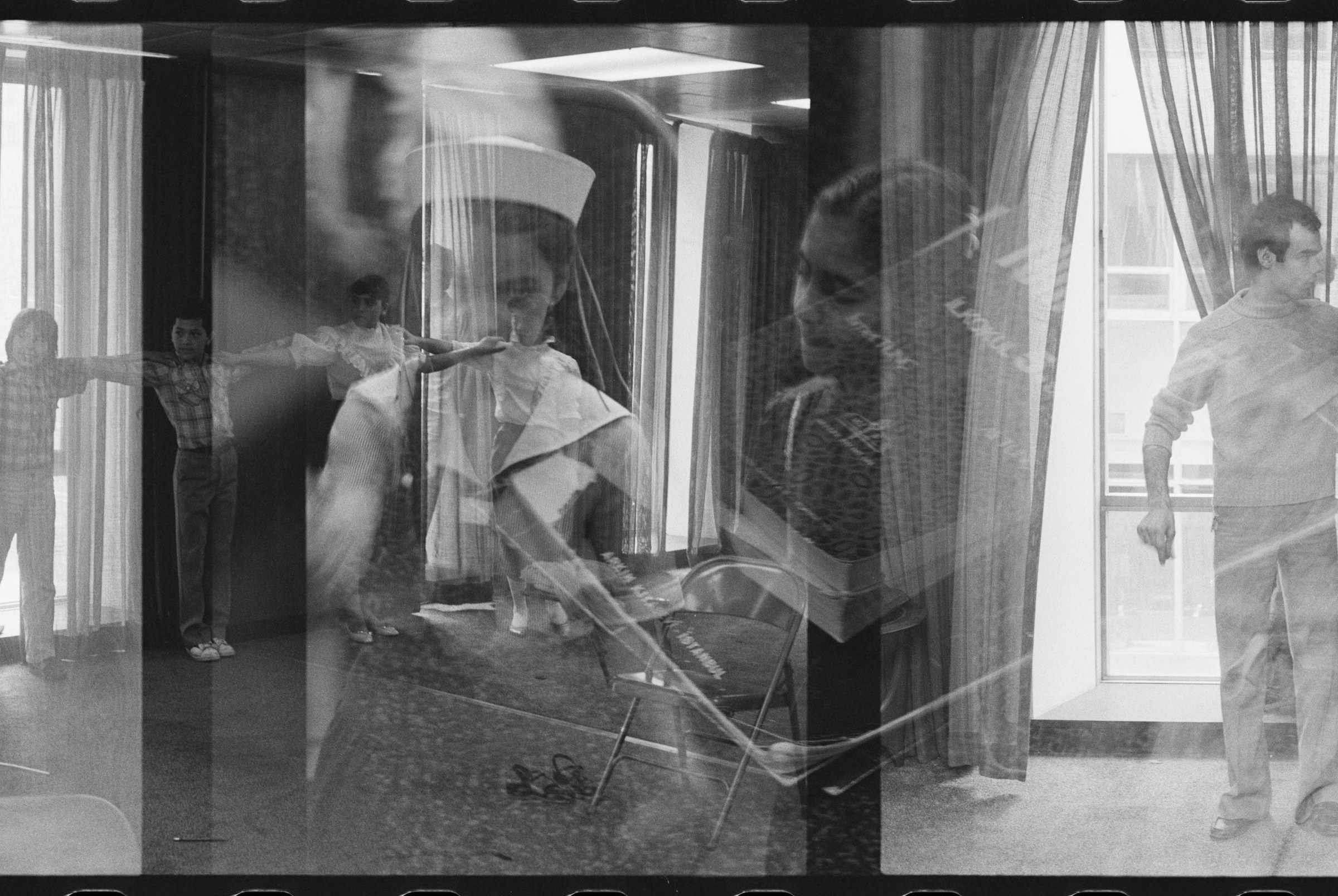
Ataturk School: children's folk dance class, New York, New York
Unknown artist
- Collection:
- Prints & Photographs
- Source:
- Library of Congress
- Rights:
- Rights vary by item — check the source record before reusing this image. Source record ↗
- Recorded as:
- Library of Congress — no known restrictions (verify per item)
This photograph documents folk dance as living educational practice within a diaspora community, rather than as staged performance. It captures the real conditions under which traditional movement is transmitted to children in an American institutional setting, offering insight into how immigrant communities maintained cultural knowledge and identity through dance in the post-war period.
What you are looking at
A black-and-white photograph captures a children's folk dance class in what appears to be a bright, modern institutional space—likely a school gymnasium or community center with large windows along one wall and vertical striped curtains. The room is filled with natural light from the right side. Multiple children are visible at different depths in the space, some in sharper focus in the middle ground, others blurred in the foreground and background, suggesting movement and the camera's attempt to hold a dynamic scene. Several children wear light-colored clothing; at least one wears what appears to be a patterned or decorated garment. The setting is spare and utilitarian, with a metal folding chair visible in the lower center. The composition captures the informal, educational character of a structured but energetic dance session rather than a performance.
The dancing
The children are distributed across the space in no rigid formation, suggesting an exploratory or instructional moment rather than a choreographed sequence. Several appear to have arms extended or raised—at least one child in the center-left has an arm stretched outward. The postures are upright and lively; weight appears to be on the balls of the feet. The multiple exposures or motion blur in parts of the image suggest the photographer captured actual movement rather than a static pose, with some figures appearing almost ghosted, indicating traveling or turning motions.
The dance depicted
This is a folk dance class, almost certainly drawing from Turkish traditions given the Atatürk School context and the educational setting in New York. The children appear to be learning traditional Turkish folk dances or dances from the broader Anatolian and Eastern Mediterranean tradition. The informal, hands-on instructional environment and the casual clothing indicate this is active pedagogy rather than performance rehearsal. Without closer examination of footwork or specific arm formations, the exact dance style cannot be pinpointed, but the upright carriage and arm positions are consistent with Turkish halay, hora, or similar circle and line dances common to the region.
How it was made
This is a black-and-white photograph, likely taken with available or ambient light given the bright naturalism and the slight grain visible in the print. The shallow depth of field and motion blur suggest it was shot at a moderate to fast shutter speed with a moderately wide aperture, freezing some movement while allowing others to register as blur. The technique captures a candid, documentary quality rather than posed formality, typical of educational or journalistic photography from the 1980s. The multiple ghosted figures indicate either camera movement, subject movement, or a fast film stock and available light conditions.
About this work
This photograph documents a children's folk dance class at the Atatürk School in New York in 1982, capturing an informal moment of cultural transmission in an educational setting. The image records not a performance but an actual teaching session, with children of various ages learning traditional Turkish and Eastern Mediterranean folk dances in a bright, modern gymnasium. It is a snapshot of immigrant cultural practice in America, showing how diaspora communities sustained and taught traditional movement forms to the next generation in schools and community institutions. The photograph's documentary style and emphasis on the actual bodies and space of learning—rather than spectacle—makes it a valuable record of folk dance pedagogy and Turkish-American cultural life.
How to look at it
Attend to the distributed, informal arrangement of the children across the space—this is not a lined-up demonstration but an active learning environment where children are moving and exploring. Notice the arm extensions and upright postures, which convey the fundamental character of the dances being taught: vertical, open, often with the arms reaching or traveling. The motion blur and multiple ghosted figures show that the photographer was documenting real movement rather than posing; the slight unsharpness in parts of the frame captures the energy and unpredictability of a teaching moment. Look at how the light from the windows frames the scene, emphasizing the brightness and openness of the institutional space.
The period
In 1982, Turkish and Eastern Mediterranean immigration to the United States was well established, with significant communities in New York City maintaining cultural institutions including schools and community centers. Folk dance held particular importance as a symbol of national and cultural identity; the Atatürk School likely served as both an educational and cultural institution for Turkish-American families. The photograph dates to the era before digital documentation, when black-and-white documentary photography was the standard means of recording educational and community activities. American schools and community centers increasingly hosted classes in world dance and folk traditions during the 1970s and 1980s, reflecting both immigrant community initiatives and broader American interest in cultural pluralism.
Where it lives
This photograph is held in the Prints & Photographs Online Catalog of the Library of Congress, a major research collection of documentary and historical photographs. It is catalogued as an educational or community documentation photograph from the early 1980s.
Dance in this work
Questions about this work
What dances were taught at the Atatürk School?
The photograph does not specify the exact dances, but the school's name and New York location suggest Turkish and Anatolian folk dances—likely including halay, hora, and other circle and line dances traditional to Turkey and the Eastern Mediterranean. Turkish folk dance pedagogy emphasizes community participation, upright carriage, and traveling steps, all visible in this image.
Why is this photograph important for understanding folk dance?
It documents folk dance as a living, transmitted practice within a diaspora community, rather than as staged performance or anthropological specimen. It shows children actively learning and moving, capturing the pedagogical and social contexts in which cultural knowledge survives and is renewed in immigrant communities.
Is the photographer identified?
The catalogue record does not identify the photographer. It is a documentary photograph likely taken as part of a project documenting community institutions, schools, or cultural activities in New York in 1982.
What can we see about the space and setting?
The setting is clearly a modern institutional gymnasium or community center with large windows, bright natural light, and a utilitarian, functional design. The bare floor and metal folding chair suggest a dual-purpose space used for classes and gatherings. This is not a theatrical stage or concert hall, but an everyday educational space.
More dance artwork





