49 works in this view — arrow keys or swipe to move between them.
Dance in Art
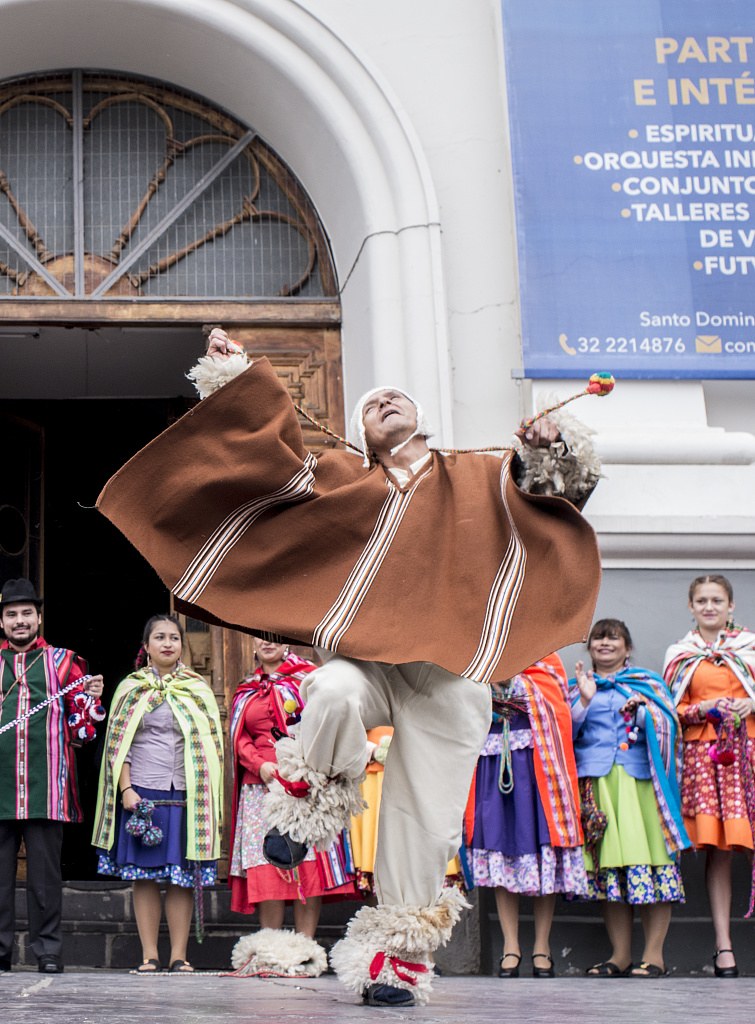
Folk dancing in front of the Iglesia de la Matriz, Valparaiso, Chile, 2018
Unknown artist
- Collection:
- Prints & Photographs
- Source:
- Library of Congress
- Rights:
- Rights vary by item — check the source record before reusing this image. Source record ↗
- Recorded as:
- Library of Congress — no known restrictions (verify per item)
This photograph documents Andean folk dance as living social practice rather than stage performance, showing how traditional movement, dress, and communal gathering function together in urban public space. The image records the role of animals in Chilean festival culture and the intergenerational transmission of folkloric traditions. For dancers and historians, it provides specific visual evidence of contemporary regional folk practice in the Andes.
What you are looking at
A street performance takes place in front of the Iglesia de la Matriz in Valparaíso, with a monumental arched wooden door and classical white portico visible behind. A single male dancer dominates the center, captured mid-leap with explosive energy: his body is airborne, legs extended, one arm thrust upward holding what appears to be a small object (possibly a lollipop or festive prop), the other arm spread wide. He wears a striking brown wool poncho with white stripes over light-colored trousers, and his head is tilted back in exuberant expression. His white hair and weathered face suggest he is an older man performing with uninhibited joy. At ground level, what appear to be llamas or alpacas sit or stand near him—their white wool visible at the edges of the frame. Behind him, arranged in a loose line against the church entrance, stands a group of perhaps eight people in vivid traditional Andean dress: women wear layered skirts in jewel tones (purple, red, orange, blue), decorative shawls, and embroidered borders; men wear striped ponchos and traditional textiles. The performers appear to be part of an organized folkloric group, posed formally for the camera while the central figure performs with unrestrained exuberance. The daylight is clear and bright, casting sharp shadows.
The dancing
The primary dancer executes a high vertical jump with arms spread in an open, celebratory frame—no formal ballroom hold or paired positioning. His weight is fully airborne; the leap shows explosive propulsion from the lower body. The accompanying group stands stationary, observing; they do not dance in unison with the soloist but function as an ensemble backdrop. The inclusion of llamas or alpacas as performers or props is distinctive and suggests this is not stage choreography but rather a street or ceremonial context where animals are integral to the performance. The soloist's age and the uninhibited quality of his movement suggest a vernacular, celebratory dance rather than a technically codified form.
The dance depicted
This appears to be Andean folk dance, most likely from a festival or ceremonial context in Chile. The costumes—ponchos, layered skirts, embroidered textiles—are characteristic of traditional Andean dress worn during regional folk celebrations. The presence of llamas or alpacas indicates this may be associated with herding cultures or agrarian festival traditions of the Central Andes. The soloist's uninhibited leap and the stationary ensemble positioning suggest a form in which individuals perform exuberant movements within or before a group context, rather than a strictly choreographed partner or group dance. The specific regional style cannot be definitively named from the image alone, but the visual evidence points toward Chilean or Peruvian Andean folklore.
How it was made
This is a color photograph, likely taken by a professional or semi-professional photographer with good light control and camera stability. The sharpness of detail, the natural color saturation, and the composition suggest a film camera operating in bright daylight. The image appears to be a documentary or journalistic photograph, capturing a live performance rather than a staged studio image. Such photographs were typically circulated as prints or slides and deposited in archives as records of cultural practice.
About this work
This 2018 photograph documents a street performance of Andean folk dance in front of one of Valparaíso's most iconic colonial landmarks. A soloist in traditional poncho executes an explosive vertical leap while llamas or alpacas stand nearby and an ensemble in vibrant traditional dress observe from the church steps. The image captures a moment of cultural celebration and communal performance in a public urban space.
The work belongs in a gallery of dance in art because it documents living folkloric practice in situ, shows the relationship between individual performer virtuosity and group identity, and records the integration of animals into ceremonial movement. The photograph preserves evidence of how Andean dance traditions are performed, transmitted, and celebrated in contemporary Chile.
How to look at it
Attend to the soloist's complete freedom of movement and the vertical thrust of the leap—this is exuberant, celebratory motion without the constraints of a partner hold or formal frame. Notice how his age and uninhibited quality of movement contrast with the more formal, observational posture of the ensemble behind him. Observe the detail of the animals in the frame: their inclusion is not incidental but suggests they are part of the performance tradition or ceremonial context. The bright daylight and public setting—a church plaza—indicate this is not a stage performance but a community gathering and celebration.
The period
In 2018, Andean folk dance traditions in Chile were being actively maintained and revived through street performances, festivals, and cultural events, particularly in historic port cities like Valparaíso. Contemporary photography of such events functions as documentation and promotion of indigenous and regional heritage. The photograph reflects early 21st-century practice in which folk traditions are performed in public urban spaces alongside heritage tourism and cultural preservation initiatives.
Where it lives
The image is held in the Library of Congress Prints & Photographs collection. It is catalogued as a color photograph documenting cultural practice in Valparaíso, Chile in 2018.
Dance in this work
Questions about this work
What are the animals in the photograph?
They appear to be llamas or alpacas. Their presence suggests this performance is connected to Andean herding traditions or agrarian festivals where these animals hold ceremonial or cultural significance. In some South American folk celebrations, llamas and alpacas participate in processions or are present as part of the cultural context.
Is this a formal dance company or a street performance?
This is a street or plaza performance, not a stage production. The setting (a church plaza), the informal arrangement of the group, and the documentary style of the photograph all indicate this is a community or cultural celebration performed in public space, likely part of a festival, holiday, or ceremonial occasion.
What region of Chile or South America is this dance from?
Based on the Andean costume elements—ponchos, layered skirts, embroidered textiles—this is rooted in highland Andean traditions, which span Chile, Peru, Bolivia, and Argentina. The specific regional substyle cannot be identified from the image alone, but the dress and movement are characteristic of Central Andean folklore.
Can you identify the specific dance form?
The photograph does not provide enough stylistic detail to name a specific Andean dance form. The explosive leap and the ensemble grouping suggest a festive or celebratory context rather than a formally choreographed partner dance, but the exact tradition would require additional documentation or ethnographic context.
More dance artwork





