49 works in this view — arrow keys or swipe to move between them.
Dance in Art
A Dance Program for Young Folk
Unknown artist
- Collection:
- Prints & Photographs
- Source:
- Library of Congress
- Rights:
- Rights vary by item — check the source record before reusing this image. Source record ↗
- Recorded as:
- Library of Congress — no known restrictions (verify per item)
This work is significant as a document of dance education and folk performance practice in the 1930s, showing how traditional regional dances were adapted and codified for young performers in theatrical settings. It demonstrates the period's investment in folk dance as a vehicle for cultural transmission and pedagogical expression, and the use of photography to record and disseminate performance knowledge.
What you are looking at
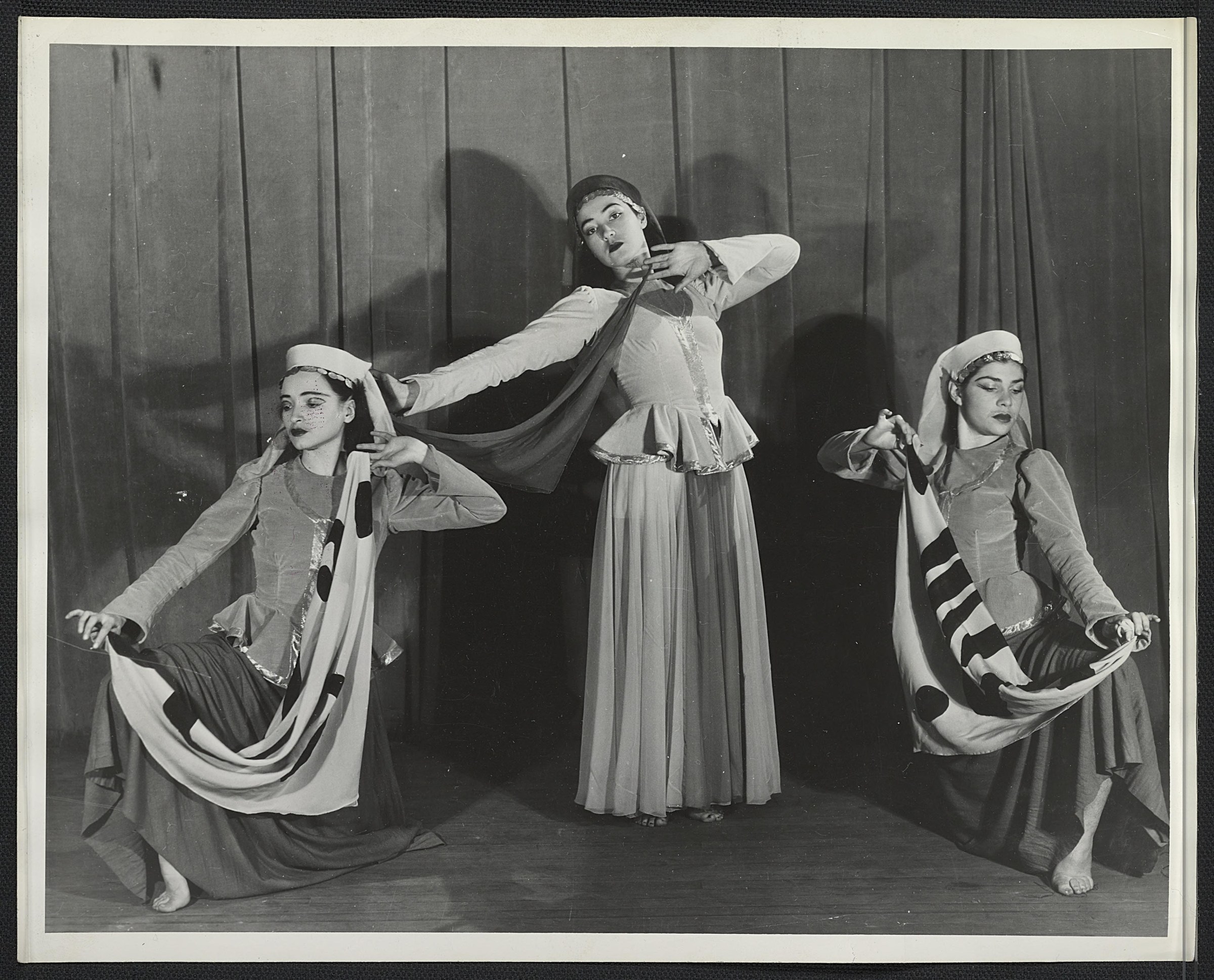
Three young dancers in a staged studio setting, posed against draped curtains that create dramatic shadows on the backdrop. The central figure stands elevated, wearing a long pleated skirt and short-sleeved bodice with a decorative headpiece, one arm extended upward in an expressive gesture while the other rests near the shoulder. The two flanking figures kneel or crouch at ground level, their bodies angled outward, wearing similar folk-style costumes with long skirts, white headdresses, and what appear to be striped or patterned leg coverings. Each of the kneeling dancers holds billowing fabric—possibly scarves or kerchiefs—that fans out across the floor, creating flowing lines that emphasize the staged, choreographed nature of the tableau. The lighting is studio photography of the period, with a single strong source creating definition in the figures and sharp shadows behind them.
The dancing
The composition uses verticality and spatial separation to suggest three distinct roles. The central dancer assumes an elevated, supported position with lifted, open upper-body posture and an upward-gazing gaze that conveys aspiration or transcendence. The two lower figures maintain grounded, supportive positions with their bodies angled away from center, their arms active in manipulating the flowing scarves or fabric elements. The contrast between the supported, lifted central figure and the grounded attendants suggests a hierarchical or narrative relationship rather than unison or partner dancing.
The dance depicted
This appears to be a folk or character dance, possibly from a European regional tradition—the white headdresses, pleated skirts, and patterned leg coverings suggest Eastern or Central European costume, while the theatrical arrangement and the emphasis on expressive arm and body positions indicates this is a staged performance rather than social dancing. The image documents a specific tableau vivant or dance pose created for young performers in an educational or performance context. The central figure's lifted posture and the use of draped fabric by the attendants suggest narrative or symbolic content—possibly a folk legend or fairy-tale adaptation. The title 'A Dance Program for Young Folk' indicates this was pedagogical in intent, likely created for a children's dance recital or educational demonstration.
How it was made
This is a black-and-white photograph, printed or reproduced on paper and likely produced as part of a documentary record or publicity material. The technical clarity and studio lighting suggest professional theatrical photography from the 1930s, using a large-format camera and controlled lighting to capture defined gesture and costume detail. As a photographic document, it served as a record of performance or rehearsal and likely circulated as a promotional or instructional image within dance education networks of the period.
About this work
This 1934 photograph documents a staged folk dance tableau created for a children's dance program. It captures three young dancers in a carefully composed group pose that privileges expressive upper-body gesture and the manipulation of draped fabric. The costume elements—embroidered or woven headdresses, pleated skirts, and patterned leg coverings—and the theatrical scaffolding of the pose suggest a European folk tradition adapted for educational performance. As a photographic record of early-20th-century pedagogical dance practice, it offers evidence of how folk dance was taught, staged, and documented in youth performance contexts.
How to look at it
Observe how the photographer has organized the three bodies in space to create a visual hierarchy: the elevated, open central figure draws the eye, while the lower flanking figures provide a supporting visual and spatial base. Notice how the fabric in the attendants' hands creates diagonal lines that echo and frame the center figure's upward-reaching arm. The shadows cast by the draped curtains behind the dancers create an almost architectural frame that emphasizes the staged, composed nature of the moment—this is a pose held for the camera, not a moment captured from continuous movement.
The period
In the 1930s, folk dance experienced a major revival in Europe and North America, both as a nationalist cultural project and as a progressive educational tool. Dance educators and choreographers sought to revive and systematize regional folk traditions for performance and instruction. The documentary photograph became a crucial medium for recording choreography and performance, especially in educational and institutional contexts. Youth dance programs and school recitals were increasingly documented through professional photography, which served both archival and promotional functions.
Where it lives
The work is held in the Prints & Photographs collection at the Library of Congress and is cataloged as a program photograph from 1934. It appears to be part of documentary records related to dance education and performance during the Depression-era cultural programming.
Dance in this work
Questions about this work
What kind of dance is this?
The costume elements and movement vocabulary suggest a European folk dance, likely Central or Eastern European based on the headdresses and embroidered skirts. The theatrical arrangement and young performers indicate this was a choreographed stage piece created for an educational dance program rather than traditional folk dancing.
Why are two dancers on the ground?
The spatial composition suggests a narrative or symbolic relationship between the figures. The elevated center figure and the lower attendants may represent a story or theme from folk tradition—a character being honored, protected, or supported by companions. The arrangement is thoroughly composed for the photograph.
What are they holding?
The flanking dancers hold draped fabric, likely scarves or large kerchiefs, which they manipulate to create flowing lines across the floor. This was a common element in folk dance performance, used both for visual effect and as a prop that allowed the dancer to extend the body's spatial reach.
More dance artwork





