James Leonard Plimpton
Legend of Dance
Why They Matter
Plimpton’s achievement was to make steering an embodied, repeatable action. The skater no longer needed to force a rigid wheeled frame through a turn; a lean could alter the wheel assemblies and carry the body through a curve. That mechanical change supported longer glides, turns, partnered circulat
Biography
James Leonard Plimpton (1828–1911) was an American inventor and entrepreneur who designed the first practical guidable quad roller skate and established the rink culture that would support social and artistic roller skating for generations to come.
Plimpton was born on 14 April 1828 in Medfield, Massachusetts, the fifth of nine children. He showed mechanical aptitude early, working on the family farm and in his father's cloth-manufacturing shop before apprenticing to a machine shop at sixteen. He became a foreman before eighteen and later worked in machinery and furniture businesses.
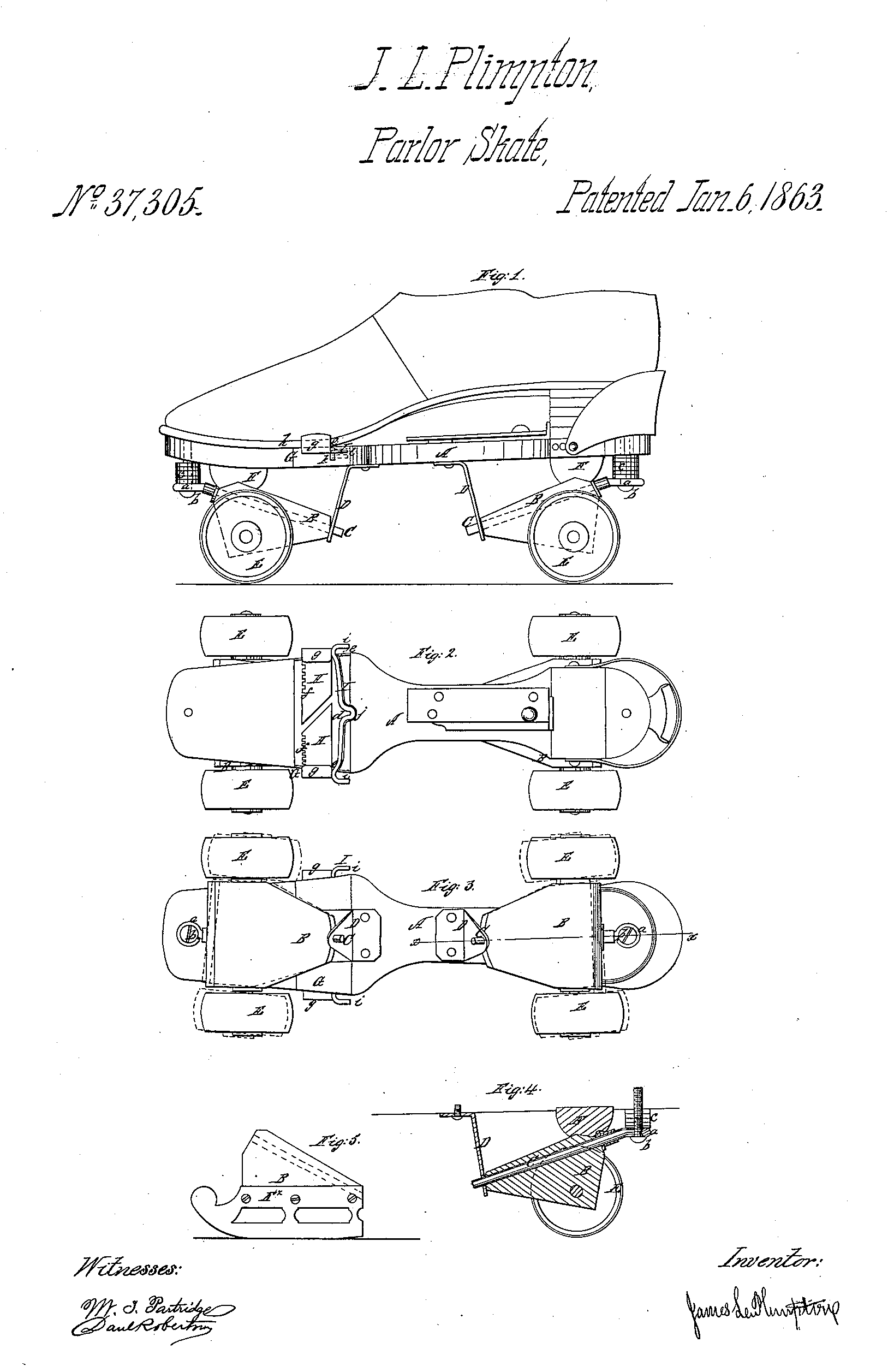
The origin of his skate lies in movement, not mechanics alone. During the winter of 1860–61, Plimpton took up ice skating on medical advice. When spring ended the season, he sought a wheeled device that could reproduce the curved, graceful travel he valued on ice. Existing roller skates were difficult to guide. Plimpton arranged two wheels under the forefoot and two under the heel so the assemblies could rock when a skater leaned, translating lateral pressure into a turn. On 6 January 1863, he received U.S. Patent 37,305 for his "improvement in skates." The four-wheel mechanism pivoted against rubber cushioning: leaning the body changed the wheel alignment, enabling curves, one- and two-foot turns, and propulsion through an in-and-out scissoring action. He received further patents on 26 June 1866 and, near the end of his life, U.S. Patent 906,281 on 8 December 1908, which added adjustable guiding and braking features.
Plimpton did not simply offer equipment; he organized a social practice around it. He demonstrated skates to invited audiences, helped form the New York Roller Skating Association and served as its first president. In 1865, he established a public rink in Newport, Rhode Island, beginning a franchising model that would eventually contribute to more than forty rinks. His promotion paired demonstrations and instruction with leased skates and local partnerships, making mixed-gender Victorian roller skating acceptable in affluent circles. He also established conduct codes and restrictions designed to keep his rinks socially elite, banning activities he considered improper.
Plimpton's patent strategy was vigorous. In 1871, a federal circuit ruling upheld the novelty of his design against fourteen defendants, protecting his business control. By making lean-steered curves and repeatable glides mechanically available on a floor, he changed the movement possibilities from which social roller skating and later artistic roller skating developed.
Career Highlights
Born on 14 April in Medfield, Massachusetts. Medfield Historical Society Medfield Historical Society
Entered a machine-shop apprenticeship at sixteen and became a foreman before eighteen. Medfield Historical Society Medfield Historical Society
Took up ice skating and began pursuing a wheeled device capable of reproducing curved ice-skating movement. Medfield Historical Society Medfield Historical Society
Received U.S. Patent 37,305 on 6 January for an improved, guidable four-wheel skate. Smithsonian Libraries and Archives Wikimedia Commons patent drawing Smithsonian Libraries and Archives
Established a public roller-skating rink at Newport, Rhode Island. Medfield Historical Society Medfield Historical Society
Received a further U.S. patent for improvements to the guidable curved-running skate on 26 June. U.S. Patent 906,281 U.S. Patent 906,281
Won a federal circuit ruling upholding his skate’s novelty against fourteen defendants. Medfield Historical Society Medfield Historical Society
Received U.S. Patent 906,281 for a later roller-skate design with additional guiding, adjustment and braking controls. U.S. Patent 906,281 U.S. Patent 906,281
Died after nearly five decades of roller-skate invention and promotion. Massachusetts Historical Society Massachusetts Historical Society
Gallery
Legacy & Impact
Plimpton's quad skate converted weight shift into trajectory in a way that rigid earlier designs could not. A lean altered the wheel assemblies and carried the body through a curve; alternating pressure created propulsion. This mechanical change enabled longer glides, turns, partnered circulation and patterns across a rink floor. While Plimpton did not invent roller dance itself, his skate established the controllable four-wheel platform on which social and artistic vocabularies of roller skating became possible. For dancers today, his contribution remains foundational to any practice on wheels.
Related Legends
Explore More Legends
Discover the dancers, teachers, choreographers, and cultural icons who shaped how the world moves.
Keep the thread going
Dance history, technique, and the occasional rabbit hole — in your inbox. Thoughtful, infrequent, unsubscribe anytime.
Free. No spam. One click to leave.