Dance in Film · 2010
Dancing Dreams (2010)
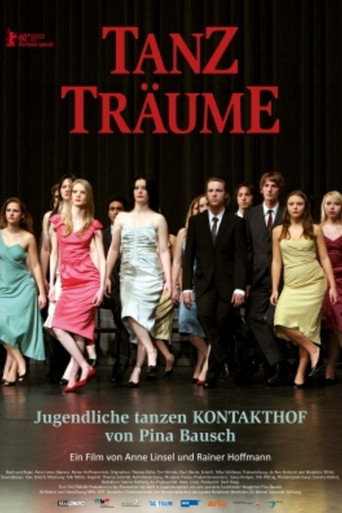
Documentary following teenagers as they learn Pina Bausch's "Kontakthof," exploring dance's power to transform.
Dancing Dreams is a 2010 dance documentary centred on ballroom and social dance. For dancers, it's a chance to see the style performed on screen — the phrasing, partnering, and musicality that the same dances carry onto a real floor.
Jump to the 7 dance sequences ↓
Where to watch: Streaming (various)
Trailer
Official trailer.
The dance sequences in Dancing Dreams
7 sequences — what is danced, by whom, and where to find it.
Across-room chair courtship
Danced by Unidentified teenage boy and girl from the Wuppertal ensemble · Choreography Pina Bausch (original choreography); Jo-Ann Endicott and Bénédicte Billiet (rehearsal direction)
Two chairs held far apart while the teenagers trade one hesitant item of clothing at a time.
A boy and girl sit on chairs at opposite sides of the room and answer one another by removing a single piece of clothing. The long gap between the chairs turns each small gesture into a risky public bid, matching the cast's interviews about shyness and first contact.
Not currently available to stream; timestamp is for reference. Timestamp left blank: no legal timed U.S. reference was accessible; the named First Run/OVID edition runs 89 minutes.
Fear-and-laughter perimeter run
Danced by Unidentified teenage cast member; Jo-Ann Endicott · Choreography Pina Bausch (original choreography); Jo-Ann Endicott and Bénédicte Billiet (rehearsal direction)
Jo-Ann Endicott taking the struggling student's hand and running the fearful laugh with her.
A teenage girl is asked to run the stage perimeter laughing from fear, but her first efforts tighten into frustration. Endicott takes her hand and runs beside her, so the sound changes through shared breath instead of another verbal correction.
Not currently available to stream; timestamp is for reference. Timestamp left blank: no legal timed U.S. reference was accessible; the named First Run/OVID edition runs 89 minutes.
First walk rehearsal
Danced by Wuppertal teenage ensemble; Jo-Ann Endicott; Bénédicte Billiet · Choreography Pina Bausch (original choreography); Jo-Ann Endicott and Bénédicte Billiet (rehearsal direction)
A plain walk repeatedly stopped until eyes, arms and spine all communicate.
Endicott and Billiet reduce the first assignment to an ordinary walk, then correct where each student looks and what the arms and back are saying. Keeping the correction beside the repeated attempt turns a basic crossing into Bausch's argument that the whole body—not just the step—reveals the person.
Not currently available to stream; timestamp is for reference. Timestamp left blank: no legal timed U.S. reference was accessible; the named First Run/OVID edition runs 89 minutes.
Group contact and aggression passage
Danced by Unidentified teenage girl; boys from the Wuppertal ensemble · Choreography Pina Bausch (original choreography); Jo-Ann Endicott and Bénédicte Billiet (rehearsal direction)
The smiling song continuing while the circle of boys turns touch into an assault on the still girl.
One girl holds herself almost motionless as the boys crowd around and handle her with mounting force to the bright song 'Frühling und Sonnenschein bist du allein'. The cheerful soundtrack and her impassive center make the scene's violence impossible to absorb as ordinary flirtation.
Not currently available to stream; timestamp is for reference. Timestamp left blank: no legal timed U.S. reference was accessible; the named First Run/OVID edition runs 89 minutes.
Hip-kick promenade and circle
Danced by Wuppertal teenage ensemble · Choreography Pina Bausch (original choreography); Jo-Ann Endicott and Bénédicte Billiet (rehearsal direction)
The cast forcing seductive glances through an exaggerated, awkward hip-kicked walk.
The teenagers travel in a line with their hips kicked out, then circle with rehearsed smiles and sidelong looks while a coy German lyric praises a beautiful lady. Their visible embarrassment makes Bausch's adult courtship code land as something they must try on rather than imitate smoothly.
Not currently available to stream; timestamp is for reference. Timestamp left blank: no legal timed U.S. reference was accessible; the named First Run/OVID edition runs 89 minutes.
Opening-night Kontakthof performance
Danced by Wuppertal teenage ensemble · Choreography Pina Bausch (original choreography); Jo-Ann Endicott and Bénédicte Billiet (rehearsal direction)
Forty first-time dancers carrying ten months of rehearsal into the public Kontakthof performance.
Opening night finally places all forty teenagers inside the same courtship arena they have rehearsed for ten months, with lines, circles and chairs now carried before an audience. The film's accumulation of failed walks, strained laughter and charged touch makes the ensemble read as lived adolescence rather than a replica of Bausch's 1978 cast.
Not currently available to stream; timestamp is for reference. Timestamp left blank: no legal timed U.S. reference was accessible; the named First Run/OVID edition runs 89 minutes.
Society-dance lesson: foxtrot and tango
Danced by Wuppertal teenage ensemble · Choreography Pina Bausch (original choreography); Jo-Ann Endicott and Bénédicte Billiet (rehearsal direction)
Teenagers negotiating old-fashioned foxtrot and tango etiquette among the chairs, piano and rocking horse.
Chairs, a piano and a rocking horse make the hall feel like a displaced 1950s social-dance lesson while the teenagers test foxtrot and tango manners in suits, dresses and unfamiliar shoes. Their formal partnering is less polished than their unease, which is precisely what lets Kontakthof expose the gender rules built into the hold.
Not currently available to stream; timestamp is for reference. Timestamp left blank: no legal timed U.S. reference was accessible; the named First Run/OVID edition runs 89 minutes.
Poster artwork from TMDB.
 This site uses TMDB and the TMDB APIs but is not endorsed, certified, or otherwise approved by TMDB.