Frente — eig. Foto · CC BY-SA 2.0 de
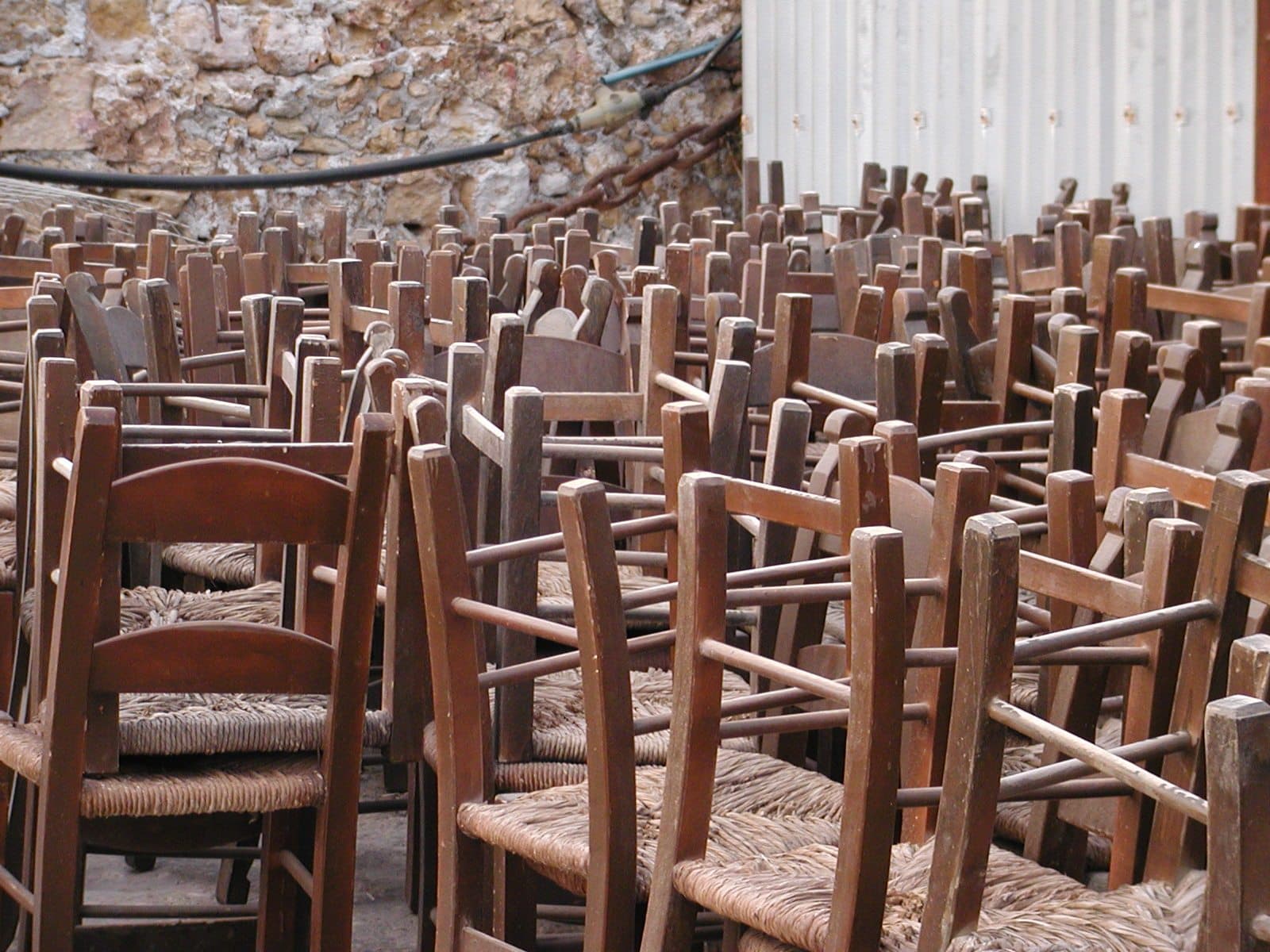
Café Müller is the Tanztheater work Pina Bausch created and originally danced herself with Tanztheater Wuppertal, premiered 20 May 1978 at the Opernhaus Wuppertal and set to excerpts from Henry Purcell's The Fairy-Queen and Dido and Aeneas. It grew out of Bausch's own childhood memory of watching her father run a café in Germany during and after the Second World War, and stages six performers picking their way, often blind, through a stage crowded with tables and chairs.
What is danced
Six dancers (three men, three women) work within a single continuous 45-minute stage picture of scattered café furniture, three doors, and a revolving door upstage right. The costuming marks distinct figures rather than a corps hierarchy: two men in suits and one barefoot in a loose shirt, two women barefoot in long white dresses (one role originated by Bausch herself) and one in a dress, overcoat and heels. There is no academic step vocabulary described here — no pointe work, no turnout, no set enchaînements. Instead the movement is built from pedestrian actions pushed to obsessive repetition: dancers lift, drop, and chase one another; duets form and dissolve; sequences run 'often frantic and repetitive, halting with a feeling of exhaustion.'
The piece's signature device is dancing with closed eyes: several performers cross the cluttered floor blind at speed while the sighted dancers race in parallel, physically clearing chairs and tables from their path in real time. This is not a virtuosic display technique but a trust-based composition — the choreography depends on split-second ensemble timing rather than individual line or extension, and the theme of manipulation and dependence is carried directly by this physical reliance rather than by mime or narrative. The article gives no scene or number breakdown; the vocabulary and its escalating repetition run through the whole piece rather than being localized to a section.
Context
The article situates Café Müller only within Bausch's own biography — as a working-through of her childhood memory of her father's café — and does not describe the wider dance landscape of 1978. Based on general knowledge of the period (not sourced from the article), this work belongs to the German Tanztheater movement Bausch was developing at Wuppertal through the 1970s, which broke from both classical narrative ballet and the formal abstraction of American modern dance by building choreography from repeated everyday gesture and psychological states rather than a fixed academic vocabulary.
Staging history
The original cast performing alongside Bausch was Malou Airaudo, Dominique Mercy, Jan Minarik, Nazareth Panadero and Jean Laurent Sasportes, with sets by Rolf Borzik. The work began touring internationally from a 1980 performance in Nancy, France, and was filmed under Bausch's own direction for German television broadcast in December 1985, with that recording later issued on DVD. It remains in the company's active repertory long after Bausch's death: in March 2025, under artistic director Boris Charmatz, Tanztheater Wuppertal presented it at the Adelaide Festival as part of a triptych titled Club Amour.
How to watch it
Watch the relationship between the dancers moving with eyes shut and the ones racing ahead of them to sweep chairs and tables out of the way — the seemingly random furniture layout is in fact held to exact positions night after night so this timing works. Track the recurring lifts, drops and pursuits between the same pairs; the piece accumulates meaning through the exhaustion of repetition rather than through a plotted sequence of events. Costume also functions as character coding here (suits, bare feet, an overcoat and heels), worth reading as psychological type rather than as social rank in a conventional ballet sense.