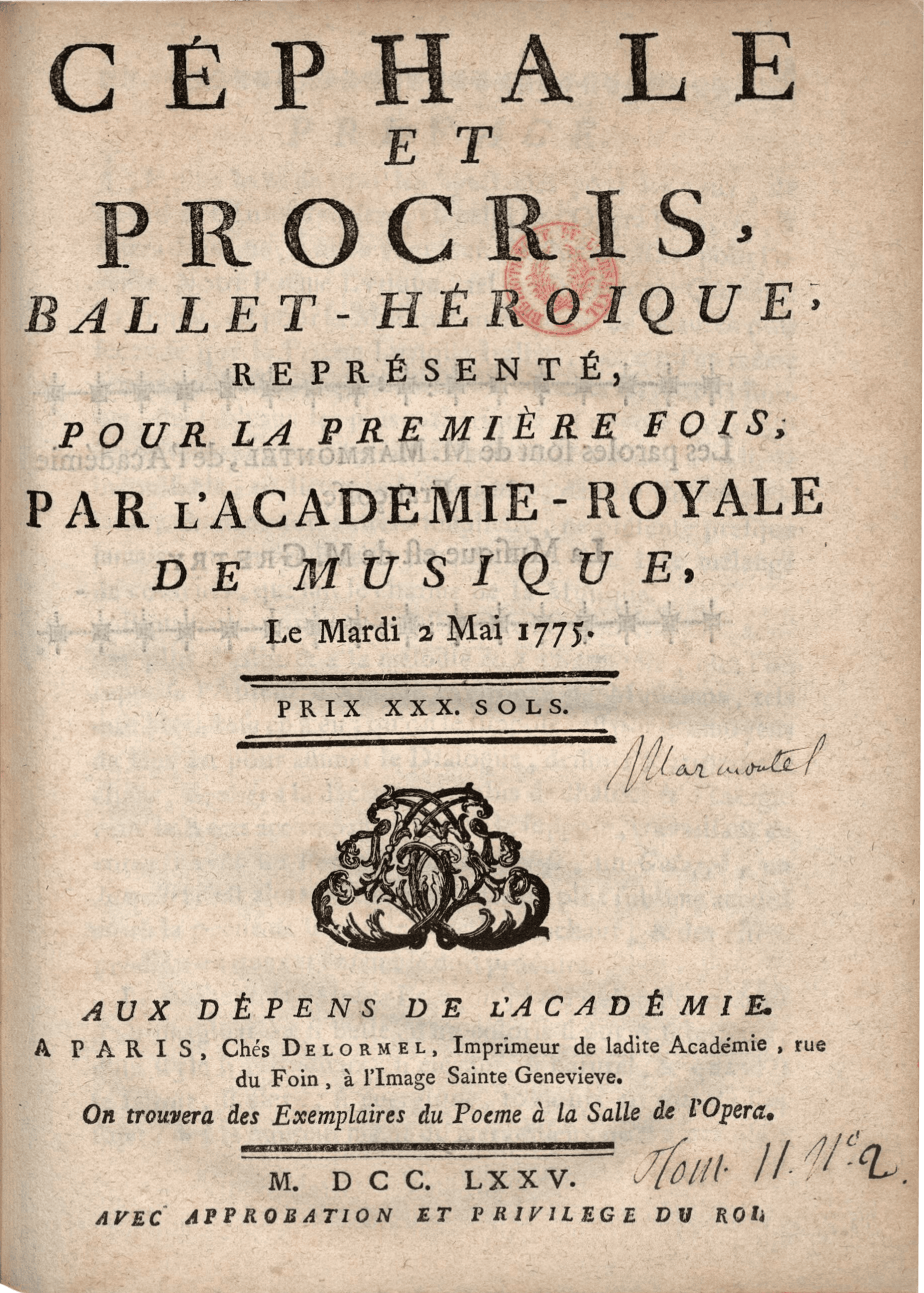
André Grétry / Jean-François Marmontel — This file comes from Gallica Digital Library and is available under the digital ID bpt6k1322159 · Public domain
Céphale et Procris is a French stage work first performed at Versailles on 30 December 1773 for the wedding celebrations of the Comte d'Artois, with music by André Grétry and a libretto by Jean-François Marmontel drawn from the Cephalus-and-Procris episode in Book Seven of Ovid's Metamorphoses. The article treats it primarily as an opera, describing it as taking 'the form of a ballet héroïque in three acts' — a mixed sung-and-danced genre of the period — though the musicologist Benoït Dratwicki is quoted arguing it sits closer to tragédie lyrique than to the ballet héroïque as understood earlier in the century.
What is danced
The source article gives no description of actual steps, holds, or choreographic vocabulary anywhere in the work. It documents the piece as an opera with a three-act plot (Procris's abandonment of Diana's following, Aurora's seduction attempt, and the fatal hunting accident followed by Cupid's intervention), but the synopsis is purely narrative — it names no divertissement, no dance number, no named suite of steps, and no choreographer. The only choreographic evidence supplied is generic: the label 'ballet héroïque,' a recognised 18th-century French genre that combined sung tragédie-lyrique-style scenes with integrated dance sequences, typically danced by the Paris Opéra's corps and principal dancers within scenes of divine or pastoral action (Aurora's palace in Act 2 would be a conventional site for such a divertissement, though the article does not say so).
Because of this gap, no specific dance_matches can be drawn from the text with confidence. A reader wanting to reconstruct the choreography would need to consult period sources on the original production or Vestris's known practice as a dancer, neither of which the article addresses.
Context
The article situates Céphale et Procris within a documented shift in French serious opera toward a more Italianate style of recitative, aria, and ensemble writing, grouping it with Philidor's Ernelinde, princesse de Norvège (1767) and Gossec's Sabinus (1773) — the latter also performed during the same wedding festivities. This places the work at a moment when the older French tragédie-lyrique model, with its formal integration of dance, was being renegotiated against newer musical fashions, and the article notes the piece even anticipates elements of Romanticism.
Staging history
The premiere at Versailles on 30 December 1773 was poorly received, the audience finding the music too modern. A Paris Opéra revival on 2 May 1775 ran for twelve performances but again drew poor reviews, this time aimed at the inadequacy of Marmontel's libretto. A further revival in May 1777 fared better, reaching twenty-six performances. The article also records later musical afterlife in the form of a complete-opera recording (Ricercar, 2010) and two recordings of a ballet suite, including one arranged by Constant Lambert and recorded by Robert Irving in 1955.
How to watch it
Watch for how the danced and sung portions are distributed across the three acts, since the article frames this as the central scholarly question about the piece — Dratwicki argues it does not fit the earlier ballet héroïque mould. Attend to Aurora's palace scene in Act 2 as the conventional locus for a divertissement in this genre, and to the Act 3 hunting scene, which stages a dramatic incident (the fatal arrow) rather than pure dance display.
Structure
- Act 1In a forest, Procris has left Diana's following for love of Cephalus; Aurora, also in love with him, disguises herself and prophesies he will kill Procris, prompting Cephalus to flee.
- Act 2In Aurora's palace, the goddess offers Cephalus a life of bliss, but he remains devoted to Procris.
- Act 3In a desolate forest, jealous Procris spies on the hunting Cephalus, who mistakenly shoots her; Cupid then revives her and grants the couple immortality.
Structure read from an encyclopaedia article, not from a libretto or score we hold. Confirm against a programme before treating the numbering as authoritative.
Credits
- composer: André Grétry
More from André Grétry
Other staged works in the register connected to this one by author or lineage.
