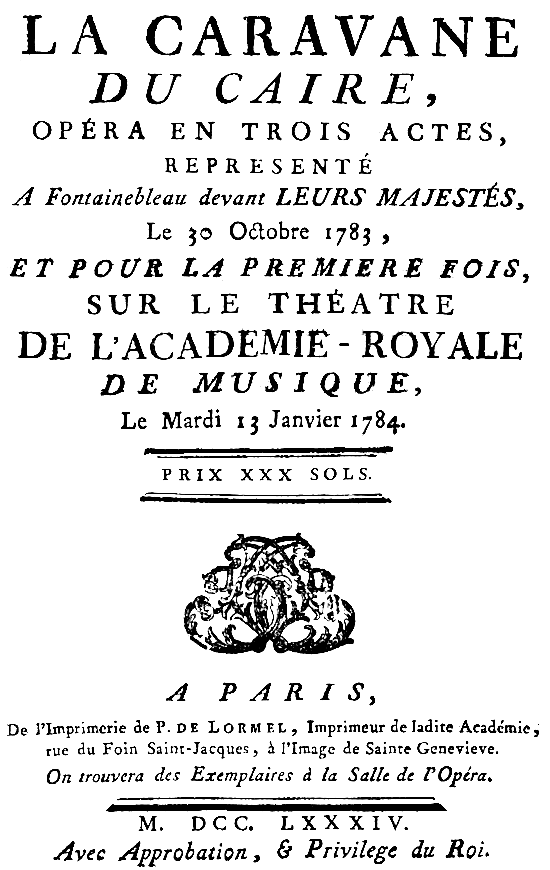
André Grétry / Étienne Morel de Chédeville / Louis XVIII of France — Google Books · Public domain
La caravane du Caire (1783)
La caravane du Caire is a three-act opera / opéra-ballet by André Grétry, first given at Fontainebleau on 30 October 1783 and reaching the Paris Opera's public stage in January 1784. Its libretto, by Étienne Morel de Chédeville and reportedly touched by the Count of Provence (later Louis XVIII), follows a French couple enslaved and separated in an Ottoman-Egyptian setting, with a happy reunion engineered through the Pasha's clemency. It sits in a dance catalogue because the period sources themselves label it an 'opéra ballet' and because its Act 2 bazaar and harem scenes were built around inset divertissements of dance and song from several nationalities, a structural feature typical of French court and civic entertainments of the ancien régime.
What is danced
The article confirms dance occurs at two identifiable points but does not describe the choreography itself. In Act 2, Almaïde tries to cheer the gloomy Pasha 'with a dance by the women of the harem' — an entertainment number staged for a character on stage, in the tradition of the harem/seraglio divertissement common to French opera of this period. Later in the same act, at the Cairo bazaar, the entertainment widens into a set of national turns: a Frenchwoman playing harp, an Italian singing a virtuoso aria, a German folk song, and, crucially for dance, 'dances from Georgians and Indians' — a sequence of exoticised national character dances assembled for the Pasha's amusement, a device standard to opéra-ballet divertissements of the 1780s. Beyond naming that these dances exist and where they fall, the source gives no steps, holds, floor pattern, or technical detail, so nothing further can responsibly be coded.
Because our offered taxonomy is built around named historical social/court dances, ballet methods, and 20th-century concert techniques, none of it accurately describes an 18th-century operatic 'national dance' divertissement of this kind — assigning, say, a Baroque court-dance code or a ballet-method code to 'dances from Georgians and Indians' would misrepresent the source. This is flagged below as a taxonomy gap rather than forced into an ill-fitting code.
Context
Grétry was the leading composer of opéra-comique in France in the 1770s–80s, and La Caravane du Caire represents his excursion into the grander, more spectacular opéra-ballet mode favoured for court occasions — it was first mounted at Fontainebleau for the royal household before transferring to the public Paris Opera. The Act 2 bazaar sequence, stacking a Frenchwoman, an Italian, a German, Georgians and Indians as successive turns, belongs to a long-running convention in French court and operatic spectacle of showcasing 'national' types through song and dance, a device that stretches back through ballets de cour and forward into 19th-century grand-opera divertissements.
Staging history
According to the article, the work was extraordinarily durable by the standards of its genre: it received over 500 performances at the Paris Opera up to 1829, was billed annually between 1785 and 1791 and (with one gap) again from 1806 to 1828, plus irregular revivals during the Revolutionary period — making it, in the article's words, 'the most successful of Grétry's large-scale works that are lighter in tone.' Modern documentation is limited to audio and audiovisual recordings rather than danced revivals as such: Ricercar's 1992 Minkowski recording, a 2014 Guy Van Waas recording, and a 2025 Blu-ray/DVD staged by Marshall Pynkoski with Le Concert Spirituel and the Ballet de l'Opéra royal, the last of which is the only cited modern production to explicitly involve a ballet company.
How to watch it
Watch for the Act 2 bazaar sequence as the structural heart of the work's dance interest: a sequence of discrete national 'turns' (harp, aria, folk song, then Georgian and Indian dances) presented as entertainment for an onstage audience (the Pasha), rather than dance integrated into dramatic action. The harem dance earlier in the same act functions similarly, as diegetic entertainment meant to lift a character's mood rather than to advance plot through movement.
Structure
- Act IA caravan bound for Cairo is attacked by Arabs; the slave Saint-Phar helps the dealer Husca fight them off and wins his own freedom but not that of his wife Zélime.
- Act IIIn the Pasha's palace, Almaïde arranges a harem dance to cheer him; at the bazaar, national turns including a Frenchwoman on harp, an Italian aria, a German song, and dances from Georgians and Indians are performed before the Pasha buys Zélime for his harem.
- Act IIIA plot to free Zélime is uncovered, Saint-Phar is revealed as Florestan's lost son, and the Pasha frees the couple, reuniting the family.
Structure read from an encyclopaedia article, not from a libretto or score we hold. Confirm against a programme before treating the numbering as authoritative.
Credits
- composer: André Grétry
More from André Grétry
Other staged works in the register connected to this one by author or lineage.
