Merlin — Own work · CC BY-SA 3.0
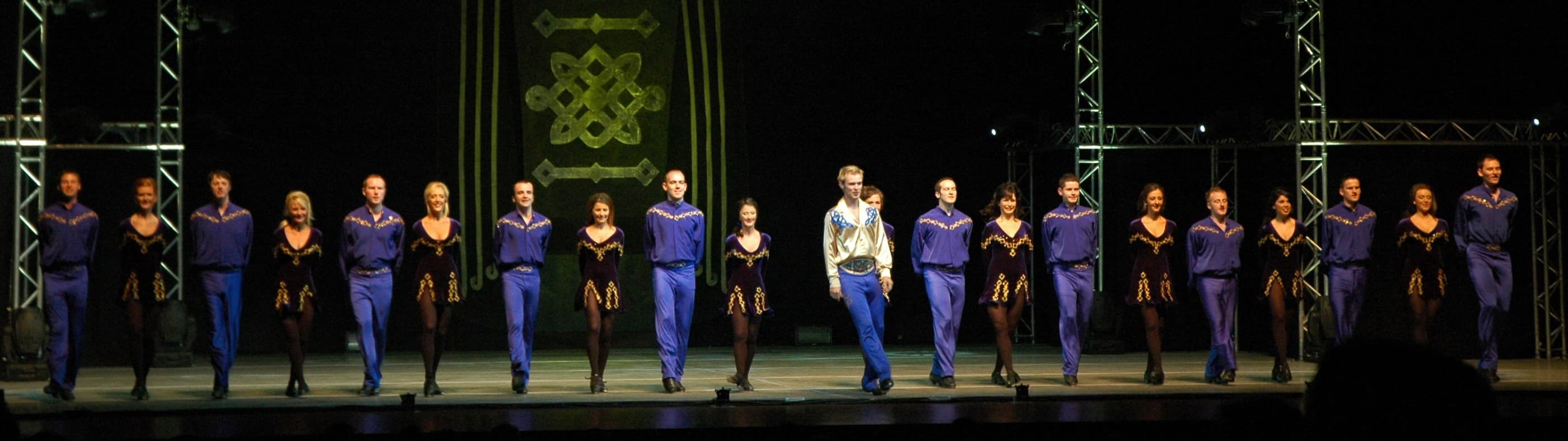
Lord of the Dance is an arena-scale Irish dance production created, choreographed and starred in by Michael Flatley, with music by Ronan Hardiman, that premiered in Dublin in 1996 shortly after Flatley left Riverdance over a dispute about creative control. It tells a Celtic-fantasy story of a title hero defending 'Planet Ireland' from the dark lord Don Dorcha, with a parallel love-versus-lust plot between the heroine Saoirse and the temptress Morrighan, told through named production numbers rather than a spoken book.
What it contains
- Theatrical Irish Step (Riverdance era) — The Lord of the Dance · Throughout the production, most concentrated in the title finale number and the solo-to-troupe entrances of each act — Solo dancers (the title character, Don Dorcha, Morrighan) introduce a rhythm or theme individually before the full company takes it up in unison, a structure repeated number after number; the show is explicitly framed as Irish stepdance staged as concert dance rather than as social or competitive dance. Source: "is an Irish dance show and dance production that was created, choreographed, and produced by Irish-American dancer Michael Flatley, who also took a starring role."
What is danced
The article's synopsis is built around a sequence of named numbers rather than a continuous narrative danced-through score: a solo tin-whistle opening ('Cry of the Celts') gives way to a sleeping female troupe being woken and led into group dance, an introductory solo for the title character that 'dances before an elated crowd before being accompanied by the entire dance troupe', a mechanical-doll number led by the female lead Saoirse ('Celtic Dream'), a menacing entrance number for the antagonist and his warriors ('The Warriors'), a temptress's solo introduction ('Gypsy'), a fight-and-costume-change sequence for the heroine and female troupe ('Breakout'), an unaccompanied ('a cappella') men's number ('Warlords'), and the eponymous finale in which paired male and female dancers precede a full-company number led by the title character. The pattern throughout is solo-to-ensemble: a lead figure introduces a rhythm or theme which the full troupe then takes up in unison, staged for large arena spaces rather than a proscenium theatre.
The Feet of Flames expansion added a landmark unaccompanied solo for Flatley himself — danced 'without music' — described in the article as a special feature of that production, and merged two touring troupes (nearly 100 dancers) with an all-male choir and live band for the finale staging. The article does not describe specific footwork technique, floor patterns, arm/upper-body carriage, or the hard-shoe/soft-shoe distinctions that would let a specific step vocabulary be verified beyond the general identification of the show as Irish dance; a reader wanting technical detail on the choreography itself will need a source beyond this one.
Context
The show was made in the immediate aftermath of Riverdance (1994), in which Flatley had starred before leaving over creative-control disputes in late 1995; Lord of the Dance was conceived within six months specifically to move Irish stepdance-based show dance out of conventional theatres and into arenas and stadiums. It sits at the center of the mid-1990s commercial boom in large-scale Irish dance spectacle that Riverdance had opened up, and its story of solo hero versus massed troupe, staged for stadium sightlines, reflects that shift in scale and venue rather than a change in vocabulary.
Staging history
The production previewed at Dublin's Point Theatre in late June 1996 and toured internationally for years afterward under multiple numbered touring troupes (Troupes 1–4), including residencies at Disney's Epcot (1999, 2000) and Disneyland Paris (2002–03). Flatley expanded it into Feet of Flames from 1998 (premiering with a one-off 25,000-capacity performance in London's Hyde Park, merging troupes and adding a live band and choir) before leaving the role himself; he returned to star in a 2010 reunion tour with a redesigned staging (screens and stairs replacing the original castle-courtyard set, aircraft landing lights used as stage lighting) that was filmed as the 3D concert film released as Michael Flatley Returns as Lord of the Dance. In 2014 the show was substantially reworked as the spinoff Dangerous Games, retaining half the original numbers but recasting Don Dorcha as an undead cyborg antagonist with new music by Gerard Fahy; a one-off 30th-anniversary performance with Flatley is recorded for 2026.
How to watch it
Watch for the solo-to-troupe structure repeated across numbers: a single dancer states a rhythmic idea (the title character, Don Dorcha, Morrighan) before the full company joins in unison, a device suited to arena sightlines rather than intimate stagecraft. Costume colour is used to carry the plot's moral geometry — white/bright for the heroine Saoirse, red/black for the temptress Morrighan — so the love-versus-lust subplot is legible through dress and grouping as much as through steps. In Feet of Flames, look for the unaccompanied solo danced without any music, staged as a deliberate showcase moment distinct from the ensemble numbers around it.
Structure
- Act I · Cry of the CeltsThe female troupe sleeps around the 'Little Spirit'; masked, torch-bearing figures arrive, after which the Little Spirit rises and plays the show's theme on tin whistle before waking the troupe into its first dance.
- Act I · Celtic DreamThe Little Spirit activates a mechanical musical doll, which then dances together with the female troupe led by the lead protagonist Saoirse.
- Act I · The WarriorsA suspenseful, terrifying number in which the dark lord Don Dorcha performs an introductory dance before being joined by his troupe of warriors.
- Act I · GypsyMorrighan the Temptress makes her introduction as a dancing character.
- Act I · BreakoutSaoirse leads the female troupe in fighting Morrighan and changes into black inner clothing after the fight, before being joined by the Lord of the Dance and his troupe.
- Act I · WarlordsAn unaccompanied ('a cappella') number for the Lord of the Dance and his troupe.
- Act I · The Lord of the DanceTwo pairs of male dancers accompany a pair of females in an introductory dance before the title character dances the show's upbeat main theme and is joined by his full troupe.
Structure read from an encyclopaedia article, not from a libretto or score we hold. Confirm against a programme before treating the numbering as authoritative.