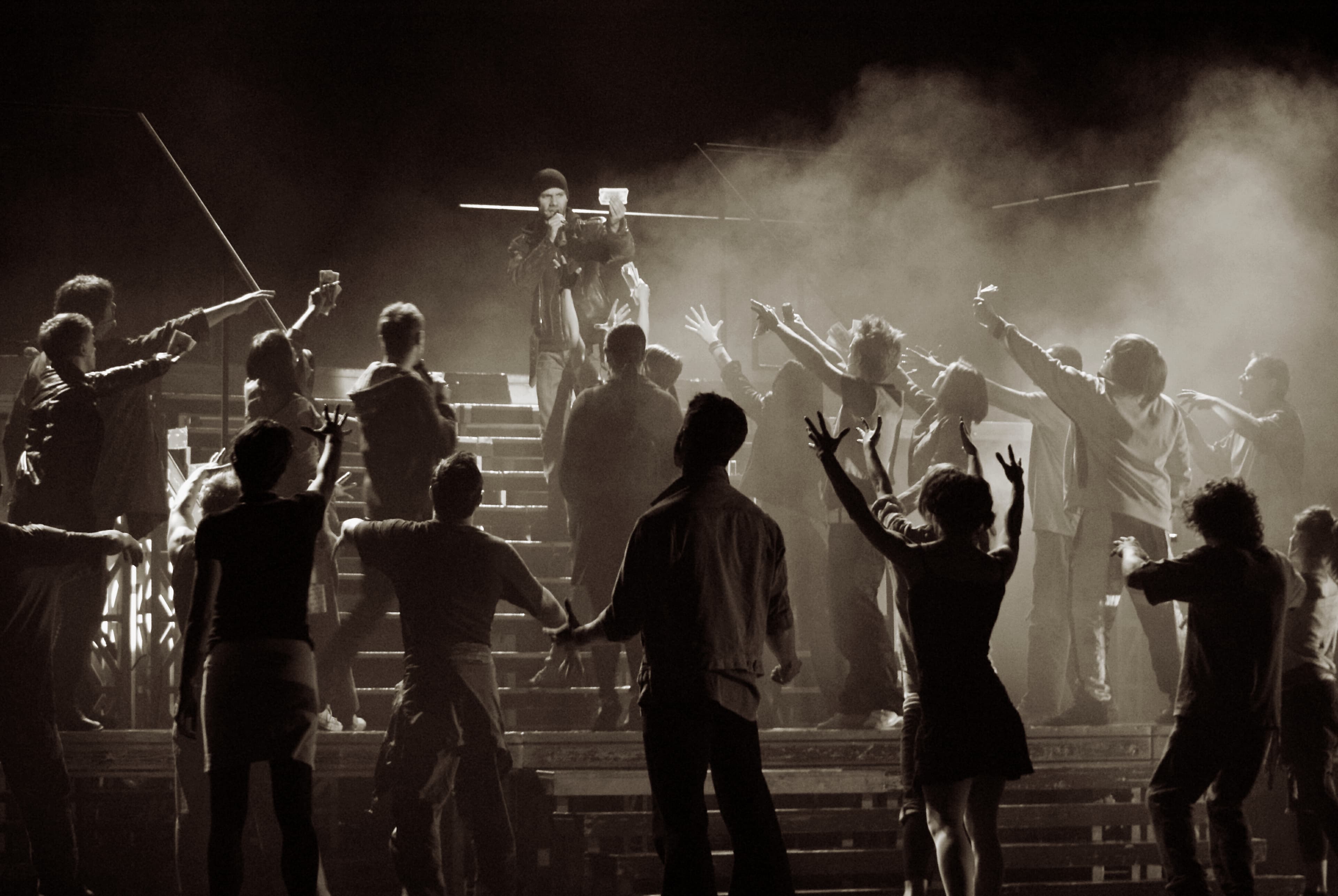
Daniel Kruczynski · CC BY-SA 2.0
Metro is a Polish-language rock/pop musical with music by Janusz Stokłosa and lyrics by Agata and Maryna Miklaszewska, conceived, choreographed and directed by Janusz Józefowicz. It premiered in Warsaw in January 1991 and became a career-launching vehicle for a generation of Polish performers before a brief, unsuccessful Broadway run in 1992.
What is danced
The article records Metro as a full sung-and-danced musical with a structured scene-and-number spine (an Overture, title number, ensemble numbers such as "Tower of Babel" and "Labels", and solo/duet numbers), and several numbers list separate credits for "singers" and "dancers" (e.g. "My Fairy Tale" credits singers Basia, Alicja, Denisa and dancers Iwona, Lidia, Violetta; "Windows" credits a dancer, Iwona, distinct from the singing lead Anka). This confirms that discrete choreographed ensemble passages exist within the show, staged separately from the vocal leads.
Beyond that structural evidence, the article gives no description of steps, holds, technique or vocabulary — no mention of jazz, ballet, tap, or any named idiom. It is therefore not possible from this source to say what the dancers actually did on stage, only that dance numbers were built into the show's musical-theatre format and that Józefowicz served as both choreographer and director throughout.
Context
Metro appeared in Poland in 1991, right at the start of the post-1989 transition, and its 1992 transfer to Broadway's Minskoff Theatre made it one of the very few Polish stage musicals to be produced commercially in New York. The show is chiefly remembered in dance/theatre history for the number of young performers who went on to prominent careers after passing through its original company, rather than for a documented choreographic innovation.
Staging history
The production opened at Warsaw's Dramatic Theatre on 31 January 1991, funded and initially produced by Wiktor Kubiak, and proved a major popular success. It transferred to Broadway's Minskoff Theatre on 16 April 1992 with lyrics translated by Mary Bracken Phillips and Józefowicz again directing and choreographing, but closed after only 13 performances and 24 previews following mixed reviews, though it received a Tony nomination for Best Original Score. In 1997 the show moved to Warsaw's Studio Buffo in a simplified arrangement, where it has been performed more than 2,100 times to an estimated two million viewers, and a 1998 Moscow production was also a success, with occasional stagings continuing in both Poland and Russia.
How to watch it
Watch for the split between sung leads and a separate credited dance ensemble within individual numbers, which points to production numbers built around ensemble choreography rather than dance carried by the principal singers. Because the Studio Buffo version runs in a "simplified arrangement" compared with the original and Broadway stagings, expect visible differences in scale and possibly in choreographic complexity between the 1991/1992 productions and the long-running Warsaw revival.
Structure
- Act I · Scene 1 · OvertureThe orchestra plays the overture in a theatre setting with Philip, Jan and the company.
- Act I · Scene 2 · MetroJan and the company perform the title number set in a metro somewhere in Europe.
- Act I · Scene 3 · My Fairy Tale (Chcę być kopciuszkiem)At the theatre, singers Basia, Alicja and Denisa perform while dancers Iwona, Lidia and Violetta dance the number.
- Act I · Scene 5 · Windows (Szyba)Anka sings at the theatre while dancer Iwona performs the accompanying choreography.
- Act I · Scene 7 · That's Life / Bluezwis / Love DuetAudition results are revealed; several numbers follow including an ensemble number for Jan, Wojtek and the company and a duet between Anka and Jan.
- Act I · Scene 8 · Tower of Babel (Wieża Babel)A company ensemble number closes Act 1.
- Act II · Scene 1 · Labels (Hasła)An opening company ensemble number for Act 2.
- Act II · Scene 3 · UciekaliAt an abandoned subway station, Jan and the company perform an ensemble number.
- Act II · Scene 5 · Waiting (Wszystko jedno czy słońce, czy deszcz)Edyta and Anka perform with a group of dancers in the metro.
- Act II · Scene 9 · Dreams Don't Die (Tylko w moich snach)Anka closes the show with a solo number in the metro.
Structure read from an encyclopaedia article, not from a libretto or score we hold. Confirm against a programme before treating the numbering as authoritative.