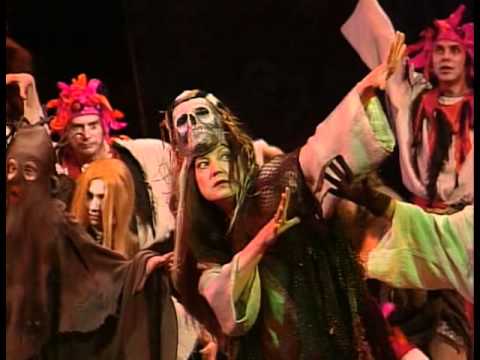
Mlada (1892)
Mlada is an opera-ballet in four acts by Nikolai Rimsky-Korsakov, composed 1889-90 to a libretto by Viktor Krylov that had originally been drafted in 1872 for an abandoned collective project. It fuses sung opera with extended danced episodes, ghost apparitions and stage transformation effects, moving between a pagan Slavic festival on the Baltic coast and a fantastical vision of Cleopatra's Egypt. It sits in the catalogue as a ballet on the strength of its large-scale danced set pieces and its 1892 Mariinsky premiere, which had dedicated balletmasters rather than being purely sung drama.
What it contains
- Grand March — Procession of the Nobles · Act 2, Scene 3 - the entry of the princes — A formal processional entrance of the assembled princes/nobility, staged as a cortège and known independently as the Procession of the Nobles; danced/marched entrance of ranked dignitaries rather than a social couple dance. Source: "The cortège is the well-known Procession of the Nobles (Russian: Шествие князей, literally, Procession of the Princes), and appears in Act 2, Scene 3."
- Redowa · Act 1 — A Redowa - a mid-19th-century couple turning dance related to the waltz and polka family - is danced during Act 1's festivities and was extracted verbatim into the concert suite as a discrete number. Source: "The Redowa appears in Act 1."
What is danced
The article gives concrete evidence of at least three distinct danced numbers. Act 1 contains a Redowa ("The Redowa appears in Act 1"), a couple-dance number later extracted for the concert suite. Act 2, Scene 5 supplies a Lithuanian Dance and an Indian Dance, both national/character numbers pulled into the same suite; Act 2, Scene 3 carries the Procession of the Nobles, a ceremonial cortège accompanying the entry of the princes at the midsummer festival, which became the best-known excerpt from the score. The synopsis also describes a folk festival scene where "the people dance" in couples arranged in a circle, into which the ghost of Mlada intervenes between Yaromir and Voyslava - a set-piece of massed social/character dancing rather than a formal pas.
Act 3's Witches' Sabbath on Mount Triglav and the visionary appearance of Cleopatra (with dances the composer says he modelled on Hungarian tsevnitsa playing and an Algerian café drum rhythm heard at the 1889 Paris World Exhibition) are clearly danced episodes but the article gives no step-level detail, only the exotic instrumentation and dramatic staging (thunder, a crimson moon, a vision conjured by Chernobog).
For concrete style attribution, only the Redowa and the Procession of the Nobles map onto codes in the offered taxonomy; the Lithuanian Dance, Indian Dance, the circle-dance folk scene, and the Cleopatra/Witches'-Sabbath sequences describe real danced content that the taxonomy as narrowed here has no code for, and are listed as gaps rather than forced into a nearby label.
Context
The 1892 St. Petersburg premiere used Lev Ivanov and Enrico Cecchetti as balletmasters - the same Ivanov who was shortly to co-choreograph Swan Lake and Cecchetti, the codifier of the method that bears his name - placing the danced sequences squarely within the vocabulary of the late Imperial Mariinsky stage, though the article does not describe their choreography in technical terms. The piece is notable in operatic history for combining song, dance, decor and the supernatural within a single continuous scenic fabric, described by commentators as ahead of its time; the same production's decor was later reused for a wholly separate full ballet on this scenario.
Staging history
The premiere (1 November 1892, St. Petersburg, conducted by Eduard Nápravník) was not a success and the work never entered regular repertory. Its decor was reused for Marius Petipa's 1896 revival of a different, purely balletic treatment of the same scenario composed by Ludwig Minkus (first given 1879) - a distinct work from the Rimsky-Korsakov opera-ballet. Later notable revivals of the Rimsky-Korsakov version include 1904 in St. Petersburg, 1913 in Moscow (Zimin Opera), 1923 in Petrograd, a 1988 Bolshoi production by Alexander Lazarev with choreographer/ballet-master Andrei Petrov (issued on video/DVD, with Nina Ananiashvili dancing the ghost of Mlada and Cleopatra), a 1989 semi-staged London Symphony Orchestra performance at the Barbican, and a 1990 Glasgow showing of the Bolshoi production during that city's European City of Culture year.
How to watch it
Watch for the shift in register between the pagan Slavic festival dances (Redowa, the folk circle-dance, the Procession of the Nobles as a formal entrance) and the exoticised Cleopatra vision, which the composer deliberately colored with instruments and rhythms he had heard from Hungarian and Algerian musicians in Paris - listen for the tsevnitsa (Pan-flute) sound and the heavy drum beat as markers of that scene. The Witches' Sabbath on Mount Triglav is the work's supernatural set-piece and should read as a break from the social/character dancing that dominates the festival scenes.
Structure
- Act IVoyslava murders Mlada and is rejected by Yaromir; she pledges to Morena. A Redowa is danced during the act's festivities.
- Act IIMidsummer folk festival at Rethra: the people dance in couples in a circle; the ghost of Mlada intervenes between Yaromir and Voyslava.
- Act II · Scene 3 · Procession of the NoblesEntry of the princes, staged as a formal cortège/procession.
- Act II · Scene 5 · Lithuanian Dance / Indian DanceNational character dances performed within the festival scene.
- Act IIIMlada leads Yaromir to Mount Triglav; a Witches' Sabbath begins and Chernobog conjures a vision of Cleopatra with associated dances.
- Act IVVoyslava is exposed and killed by Yaromir; Morena destroys the city but Yaromir is united with Mlada in heaven.
Structure read from an encyclopaedia article, not from a libretto or score we hold. Confirm against a programme before treating the numbering as authoritative.
Credits
- composer: César Cui
- composer: Nikolai Rimsky-Korsakov
More from César Cui
Other staged works in the register connected to this one by author or lineage.
