Unknown authorUnknown author — IMSLP · Public domain
Mlada
Mlada (1872) was a Saint Petersburg Imperial Theatres project for a four-act opera-ballet, with a libretto by Viktor Krïlov and music divided collaboratively among four members of The Mighty Handful — César Cui, Modest Mussorgsky, Nikolai Rimsky-Korsakov and Alexander Borodin — with additional ballet numbers commissioned from the Imperial Ballet's official composer Ludwig Minkus. It began life in 1870 as a straight ballet, to be composed by Alexander Serov with choreography by Marius Petipa, but Serov died in 1871 before writing anything, and director Stepan Gedeonov recast it as the collective opera-ballet described here. The project collapsed after Gedeonov left his post, and the work was never staged.
It belongs in a performance catalogue chiefly as a documented non-event: a large-scale imperial theatrical commission whose music exists (in varying states of completion) but whose choreography, cast and mise-en-scène were never realized. It is distinct from — but shares a libretto with — the completed and occasionally performed 1890 opera-ballet Mlada by Rimsky-Korsakov alone, and from Petipa and Minkus's separate 1879 ballet Mlada, which recycled the same scenario into an actually danced, actually choreographed work.
What is danced
The article does not describe any choreography, staged dance numbers, or movement vocabulary for the 1872 Mlada itself, because the production never reached the stage — the composers wrote music (Cui completed Act 1; Mussorgsky, Rimsky-Korsakov and Borodin contributed to other acts; Minkus was engaged for inserted ballet music) but no choreographer beyond the original, abandoned 1870 conception (Marius Petipa, for a version to be composed by Serov, which was scrapped before any music existed) is recorded as ever having worked on it. The listed roles include 'corps de ballet' and silent crowd roles (maidens, hunters, merchants, witches, dwarves), which signal that dance was structurally intended within the opera-ballet format, but nothing in the article specifies what those dancers would have done.
The synopsis provided is explicitly flagged by the article as reconstructed, not from the 1872 materials, but from two later, unrelated stagings: Minkus's 1879 ballet and Rimsky-Korsakov's 1890 opera. Within that reconstructed synopsis, Act 2 mentions a midsummer festival at which 'the people dance,' but since this detail is borrowed from those other works rather than documented for the 1872 collaboration, it cannot responsibly be used to assign a dance style to this specific catalogue entry.
For a dancer or choreographer researching this title, the practical value lies in the surviving music rather than any inherited choreography: several numbers later became independently famous concert or operatic pieces (Mussorgsky's 'Glorification of Chornobog' became the basis for the 'Dream Vision of the Peasant Lad' in Sorochintsï Fair, and his 'March of the Princes' parallels the 'Procession of the Nobles' familiar from Rimsky-Korsakov's later Mlada), and any modern staging attempt would necessarily invent new choreography rather than revive a historical one.
Context
The project sits at a pivot point in Russian imperial theatre: Gedeonov's original 1870 plan paired the era's leading choreographer, Marius Petipa, with a leading nationalist composer, Serov, for a ballet adapted from Filippo Taglioni's 1839 Saint Petersburg ballet The Shadow. When Serov died, Gedeonov's decision to distribute the commission across four members of The Mighty Handful, layered with Minkus's official ballet interludes, was an unusual experiment in collective imperial composition rather than a single choreographer's vehicle. Its collapse after Gedeonov's departure meant the vocabulary of the piece — musical and presumably choreographic — never crystallized, and each composer instead folded the material into other, individually authored works (Cui into Prisoner of the Caucasus, Mussorgsky into Sorochintsï Fair and The Capture of Kars, Borodin's finale published posthumously as a concert piece).
Its real dance-historical afterlife runs through its successors rather than itself: Petipa returned to the same scenario in 1879 with Minkus as sole composer, producing an actually danced ballet at the Imperial Bolshoi Kamenniy Theatre, and Rimsky-Korsakov independently reused the Krïlov libretto for his own complete 1890 opera-ballet. The 1872 collaboration is therefore best understood as the unrealized ancestor of two separate, completed stage works.
Staging history
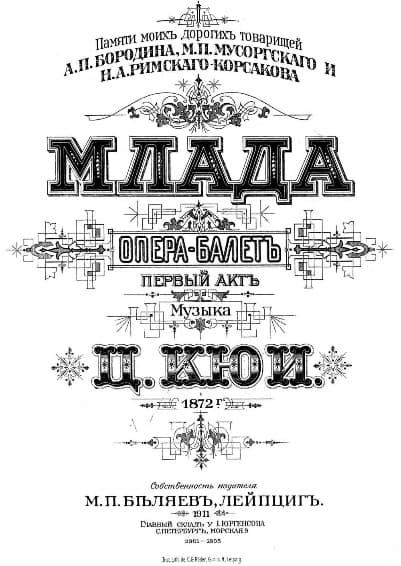
The article states plainly that the 1872 work 'was never staged,' and that to date 'there is no published edition that collates the original manuscripts containing all the extant music.' A piano-vocal edition drawing on surviving materials was published in 2016 by A-R Editions under Albrecht Gaub, and a performing version of the complete opera was completed by British composer Peter Cowdrey in 2023 — but the article gives no indication that this performing version has been staged with choreography, only that it exists in score form. Cui separately edited and published his own Act 1 in 1911, dedicating it to the memory of his three collaborators.
How to watch it
There is no performance of this exact 1872 work to watch, since it never reached the stage; audiences encounter its material secondhand, either through Rimsky-Korsakov's 1890 opera-ballet Mlada (which reuses the same Krïlov libretto) or through individual numbers that its composers recycled into other pieces, such as Mussorgsky's 'Dream Vision of the Peasant Lad' in Sorochintsï Fair. Anyone approaching a modern realization of the 2016 or 2023 editions should treat any staged choreography as a new creation responding to fragmentary music, not a revival of historical steps.
Structure
- Act IAt the castle of Mstivoy, Prince of Retra, Voyslava has killed Mlada to win Yaromir for herself and, with Morena's help, has captivated him, though he sees the murder in his dreams.
- Act IIAt the midsummer festival on the plain near Retra the people dance, but the spirit of Mlada intervenes between Yaromir and Voyslava.
- Act IIIBy night, on Mount Triglav, Mlada leads Yaromir among the dead before a Witches' Sabbath in which he is shown a vision of Cleopatra.
- Act IVOutside the Temple of Radegast, Yaromir learns of Voyslava's guilt and kills her; Morena destroys the temple and city, but Yaromir is united with Mlada in heaven.
Structure read from an encyclopaedia article, not from a libretto or score we hold. Confirm against a programme before treating the numbering as authoritative.
Credits
- composer: Alexander Borodin
- composer: César Cui
- composer: Modest Petrovich Mussorgsky
- composer: Nikolai Rimsky-Korsakov
Related works
Other staged works in the register connected to this one by author or lineage.

