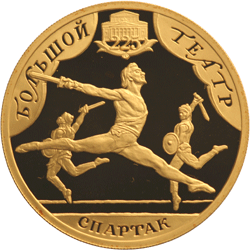
Банк России — http://www.cbr.ru/cash_circulation/memorable_coins/coins_base/showcoins/?cat_num=5217-0028 · Public domain
Spartacus is a full-length narrative ballet built on Aram Khachaturian's 1954 score, dramatising the Thracian gladiator's revolt against Rome through the invented figures of his wife Phrygia and the courtesan Aegina. The version this record holds is Leonid Yakobson's original staging, given at the Kirov (Mariinsky) in Leningrad in December 1956; the ballet went on to become one of the most frequently restaged Soviet works of the twentieth century, with rival productions by Igor Moiseyev and, later, Yury Grigorovich competing for the repertoire slot.
What is danced
The article's clearest statement about how the piece moves is negative but important: Yakobson's 1956 choreography 'abandoned conventional pointe,' which the source says cost the production some critical favour even as it stayed in the Kirov repertory for years. That single fact matters more to a dancer than it looks — it means the founding staging of Spartacus deliberately broke with the pointe-based vocabulary that otherwise defines Soviet classical ballet of the period, in favour of a more sculptural, grounded, ostensibly 'antique' physicality suited to gladiators and slaves rather than court dancers.
Context
The ballet belongs to the mid-1950s Soviet ballet establishment, where large-scale narrative works on heroic or classical-antiquity subjects, scored by leading Soviet composers and mounted at the Kirov or Bolshoi, were a prestige genre; Khachaturian received the Lenin Prize for the score in the year he composed it. Yakobson's decision to move his cast off pointe is presented in the article as a departure from that house style, one that unsettled contemporary reception even as the work held its place in repertory. I have supplemented this with outside knowledge that this fits the broader Soviet 'drambalet' current, which prized dramatic and mimetic clarity over pure classical display — this addition is not drawn from the article and is flagged in uncertainties.
Staging history
The article records a crowded staging history: Yakobson's original for the Kirov (1956), his own restaging for the Bolshoi (1962, taken on the Bolshoi's 1962 New York tour), a separate first Bolshoi staging by Igor Moiseyev (1958), and finally Yury Grigorovich's 1968 Bolshoi production, which the article states achieved the greatest acclaim of any version and was later filmed as the 1977 Soviet musical/ballet film Spartakus. Only the Yakobson strand is on our record; the Moiseyev and Grigorovich productions are separate choreographic treatments of the same score and are noted here as research leads, not as attributes of this entry's credited staging.
How to watch it
Watch for the absence or presence of pointe work as a marker of which production is on stage — Yakobson's original avoided it, while later Bolshoi versions returned to more conventional balletic display, so companies advertising 'Spartacus' may be showing quite different choreographic languages under one title and score. The 'Adagio of Spartacus and Phrygia,' the ballet's best-known set piece, is worth attending to as the emotional hinge of the work; it has had an independent life in film and skating far beyond the stage production.
Structure
- Act ICrassus returns to Rome in triumph with Spartacus and Phrygia among his captives; Spartacus is forced into the gladiatorial ring to kill a friend and incites the captives to revolt.
- Act II · Adagio of Spartacus and PhrygiaThe escaped captives celebrate freedom and disrupt Crassus's orgy to rescue the slave women; the reunited lovers dance the Adagio of Spartacus and Phrygia.
- Act IIIAegina betrays Spartacus's camp to Crassus, whose army pursues and kills Spartacus; his followers carry off his body as Phrygia mourns.
Structure read from an encyclopaedia article, not from a libretto or score we hold. Confirm against a programme before treating the numbering as authoritative.
Credits
- composer: Aram Khachaturian
Related works
Other staged works in the register connected to this one by author or lineage.