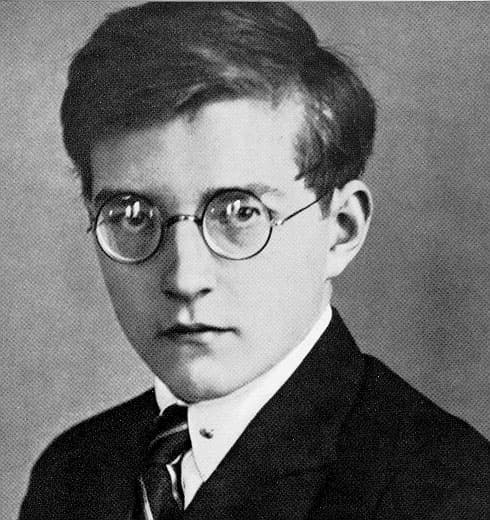
Unknown authorUnknown author — http://www.sewersofbabel.com/index.php/braineel/2006/01/ (no copyright protection, and is took before 1954) · Public domain
The Golden Age is a three-act, six-scene ballet with music by Dmitri Shostakovich (Op. 22) and a libretto by Alexander Ivanovsky, premiered on 26 October 1930 at the Kirov Theatre. The article credits the choreography to three hands working act by act: Vasili Vainonen (Act I), Leonid Jacobson (Act II), and V. Chesnakov (Act III). The plot is a piece of Soviet political satire: a Soviet football team touring a Western city runs into a gallery of caricatured antagonists (the Diva, the Fascist, the Agent Provocateur) before being freed from unjust imprisonment when local workers rise against their capitalist rulers.
What it contains
- Classical Ballet — Exhibition Hall · Act I, Scene 2, Exhibition Hall — The Diva's number is titled 'Adagio,' the standard classical-ballet term for a slow duet or solo display section, distinguishing it from the surrounding character numbers. Source: "Act I, Scene 2, Exhibition Hall: Dance of Diva: Adagio"
- Galop — A Street in the Same City · Act II, Scene 3, A Street in the Same City — A galop accompanies the mimed provocation and arrest scene, a single named social-dance number within the sequence rather than the ballet's general idiom. Source: "Act II, Scene 3, A Street in the Same City: Mime of the Agents Provocateurs, Provocation and Arrest: Galop"
- Polka — Music Hall · Act III, Scene 5, Music Hall — Two named polkas ('Once upon a Time in Geneva' and 'Angel of Peace') form part of the music-hall cabaret sequence satirizing bourgeois politics. Source: "Polka, "Once upon a Time in Geneva" - Polka, "Angel of Peace""
What is danced
The numbered sections in the article show the ballet built as a run of contrasting set-pieces rather than a single continuous idiom. The 'bourgeois' scenes are carried by named Western social and theatrical dance forms used satirically: a Foxtrot repeated three times over ('Foxtrot ... foxtrot ... foxtrot'), a Tango, a Can-can, two Polkas ('Once upon a Time in Geneva' and 'Angel of Peace'), and a Galop that accompanies the agents provocateurs' arrest scene in Act II. A 'Chechotka' number, titled 'Shoe Shine of the Highest Grade,' is a Russian rhythmic step/tap idiom distinct from any Western clog or tap tradition. Exoticized specialty numbers appear too, including a 'Dance of the Hindu' performed by a magician-advertising agent and a 'Dance of the Black Man and 2 Soviet Football Players' — both typical of the era's orientalist and racialized theatrical-dance conventions, though the article gives no technical detail on their vocabulary.
Context
Made in 1930 at the Kirov (former Imperial Mariinsky) Theatre, the ballet sits at a hinge point for Soviet dance: choreographers trained in the classical tradition were being asked to stage explicitly ideological, contemporary subject matter, including football, jazz-age social dance and political caricature, just before Socialist Realism hardened into doctrine. The article states the work was 'initially censored due to its inclusion of modern European dance styles' and was performed only eighteen times, which points to real institutional discomfort with putting foxtrot, tango and can-can on the Kirov stage as satire rather than as decadence to be simply denounced.
Staging history
The original 1930 production had a short run of eighteen performances before censorship curtailed it. In 1982, Yury Grigorovich and Isaak Glikman revived the ballet with an entirely new libretto, folding in other Shostakovich scores; Grigorovich's own version premiered at the Bolshoi Theatre on 4 November 1982, relocating the action to a 1920s Soviet restaurant called 'The Golden Age' and setting the young workers' leader Boris (created by Irek Mukhamedov) against a gang, rather than football against fascism. In 2006, playwright Konstantin Uchitel wrote yet another libretto, set in the present day around an old couple recalling their youth, premiered at the Mariinsky Theatre on 28 June 2006 — so the same Shostakovich score has carried at least three unrelated stage narratives.
How to watch it
Watch for the deliberate contrast in vocabulary between the 'Western' scenes, built from recognizable social and theatrical dance forms (foxtrot, tango, polka, galop, can-can) used to satirize the Diva, the Fascist and the bourgeoisie, and the 'Soviet' scenes of the football team, Young Pioneers and workers, which the sectional titles ('Soviet Dance,' 'Final Dance of Solidarity') frame as collective and unified rather than individually characterized. The Chechotka number is worth noting as a distinctly Russian rhythmic step idiom rather than Western tap or clog.
Structure
- Act I · Scene 1 · The Golden Age of Industry ExhibitionThe Soviet football team appears at a Western industry exhibition amid advertising stunts, a boxing match and police intervention.
- Act I · Scene 2 · Exhibition HallCharacter numbers for the Diva, the Fascist and Western 'golden youths' surround the Soviet team, culminating in a Foxtrot and a false terrorism scare.
- Act II · Scene 3 · A Street in the Same CityAgents provocateurs stage a mimed provocation leading to the team's arrest, set to a Galop.
- Act II · Scene 4 · Workers' StadiumWorkers, Young Pioneers and Western Komsomol sportsmen fill the stadium with sports games and a joint sports dance before the Soviet team exits.
- Act III · Scene 5 · Music HallA cabaret sequence of Chechotka, Tango, two Polkas, a class-coalition satire and a Can-can, including a duet for the Diva and the Fascist.
- Act III · Scene 6 · Prison BuildingThe imprisoned team is freed as the conspiracy against them is exposed, ending in a final dance of solidarity between workers and footballers.
Structure read from an encyclopaedia article, not from a libretto or score we hold. Confirm against a programme before treating the numbering as authoritative.
Credits
- composer: Dmitri Shostakovich
Related works
Other staged works in the register connected to this one by author or lineage.
 SpartacusBallet · 1956Yakobson · video
 Flames of ParisBallet · 1932Vainonen · video
 The Limpid StreamBallet · 1935Music by Shostakovich · video
 ConcertoBallet · 1966Music by Shostakovich · video
 Concerto DSCHBallet · 2008Music by Shostakovich · video
 Mercurial ManoeuvresBallet · 2000Music by Shostakovich · video
 FaçadeBallet · 1931Same lineage · video
 Allegro BrillanteBallet · 1956Same lineage · video