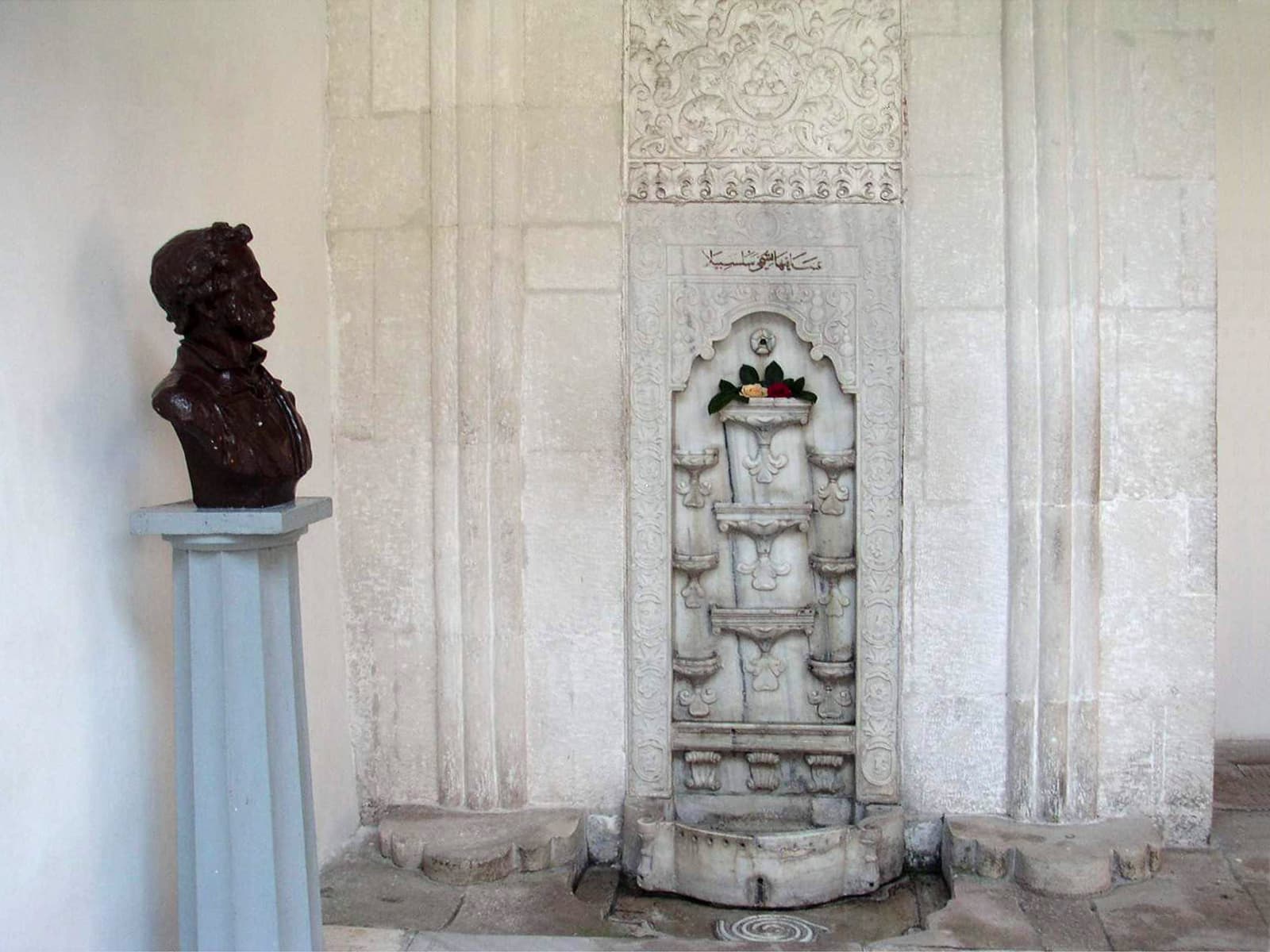
http://en.wikipedia.org/w/index.php?title=User:Wardlemke&action=edit&redlink=1 — http://en.wikipedia.org/wiki/Image:Fountain_of_Tears.jpg · Public domain
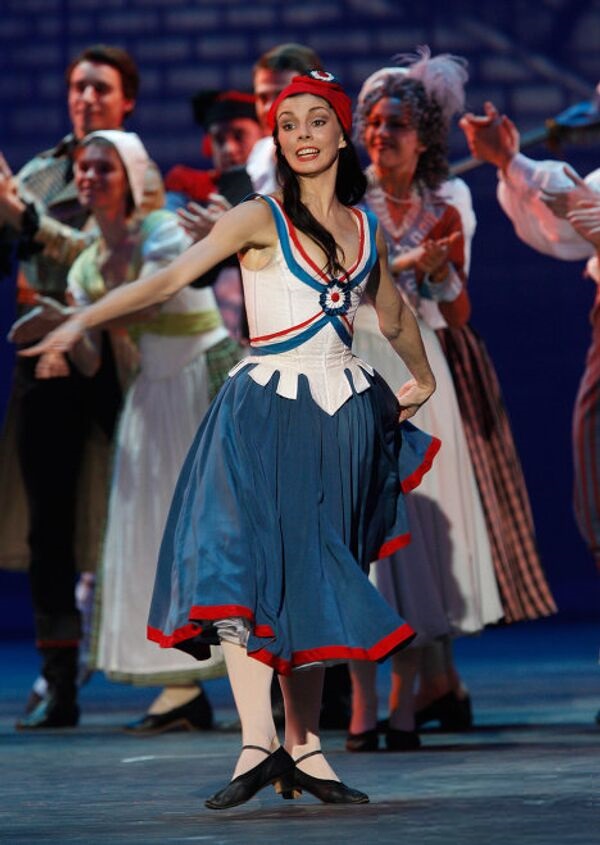
The Fountain of Bakhchisarai is a four-act narrative ballet made for the Kirov (Mariinsky) company in Leningrad, with choreography credited to Rostislav Zakharov and a score by Boris Asafyev, drawn from Nikolai Volkov's libretto after Pushkin's 1823 narrative poem of the same title. It premiered on 28 September 1934 with Galina Ulanova as Maria, Olga Iordan as Zarema, Mikhail Dudko as Khan Girey and Konstantin Sergeyev as Vaslav — a premiere cast significant enough that it is still cited whenever the ballet is discussed.
What is danced
The article is a plot synopsis, not a piece-by-piece account of the choreography, so it does not describe steps, holds or technique in any detail. What it does establish is the dramatic shape a choreographer or dancer needs to know: the ballet turns on a love triangle played out almost entirely through mime and confrontation rather than divertissement — Zarema dancing to win back the Khan's attention ('Zarema tries to win his attention by dancing for him'), and two extended pas de deux-scaled encounters (Khan Girey and Maria; Zarema and Maria) that carry the drama through physical gesture rather than set steps. The synopsis foregrounds a stolen scarf, a dropped hat and a concealed dagger as stage properties that drive the mimed action, and both female leads have a moment of offering themselves to death by opening their arms to the blade — a repeated gesture the article specifies twice.
Beyond this, the source gives no detail on pointe work, partnering, corps patterning or the specific vocabulary of any named number, so nothing more specific can be attributed to it without inventing content the article does not support.
Context
The work sits at the start of Soviet ballet's turn toward large-scale narrative works built on canonical Russian literature, staged by a state company (the Kirov) with a purpose-written score, in the years right after socialist realism became official cultural policy. The article's own framing — a full-length work built from a poem via a written libretto, premiered at a state academic theatre in 1934 — situates it squarely in that moment, though the article itself does not use the term for the broader movement this ballet is usually placed within.
Staging history
The clearest staging fact the article supplies beyond the 1934 premiere is the 1953 Soviet film The Stars of the Russian Ballet, which includes an abridged version of the ballet alongside Swan Lake and Flames of Paris, with Galina Ulanova again as Maria, Maya Plisetskaya as Zarema, Pyotr Gusev as Khan Girey and Yuri Zhdanov as Vaslav. The article notes this is the only known footage of Ulanova and Plisetskaya — who succeeded her as prima ballerina assoluta at the Bolshoi — dancing together, which makes the film a documentary record as much as an adaptation. The article also lists three later newspaper reviews (1954, 1984, 1999) without quoting them, which is a sign the ballet and its film continued to be revived, screened or restaged well beyond 1934, though the article does not say where or by whom.
How to watch it
Watch how the two female leads are distinguished through mime rather than contrasting step vocabulary — Zarema's attempt to dance for the Khan's attention against Maria's static refusals — since the article's synopsis is built almost entirely around gesture, stage properties (scarf, hat, dagger) and confrontation rather than divertissement. The repeated gesture of a woman opening her arms to invite a killing blow, used for both Maria and Zarema, is worth tracking as a piece of authored stage business rather than incidental pantomime.
Credits
- composer: Boris Asafyev
Related works
Other staged works in the register connected to this one by author or lineage.