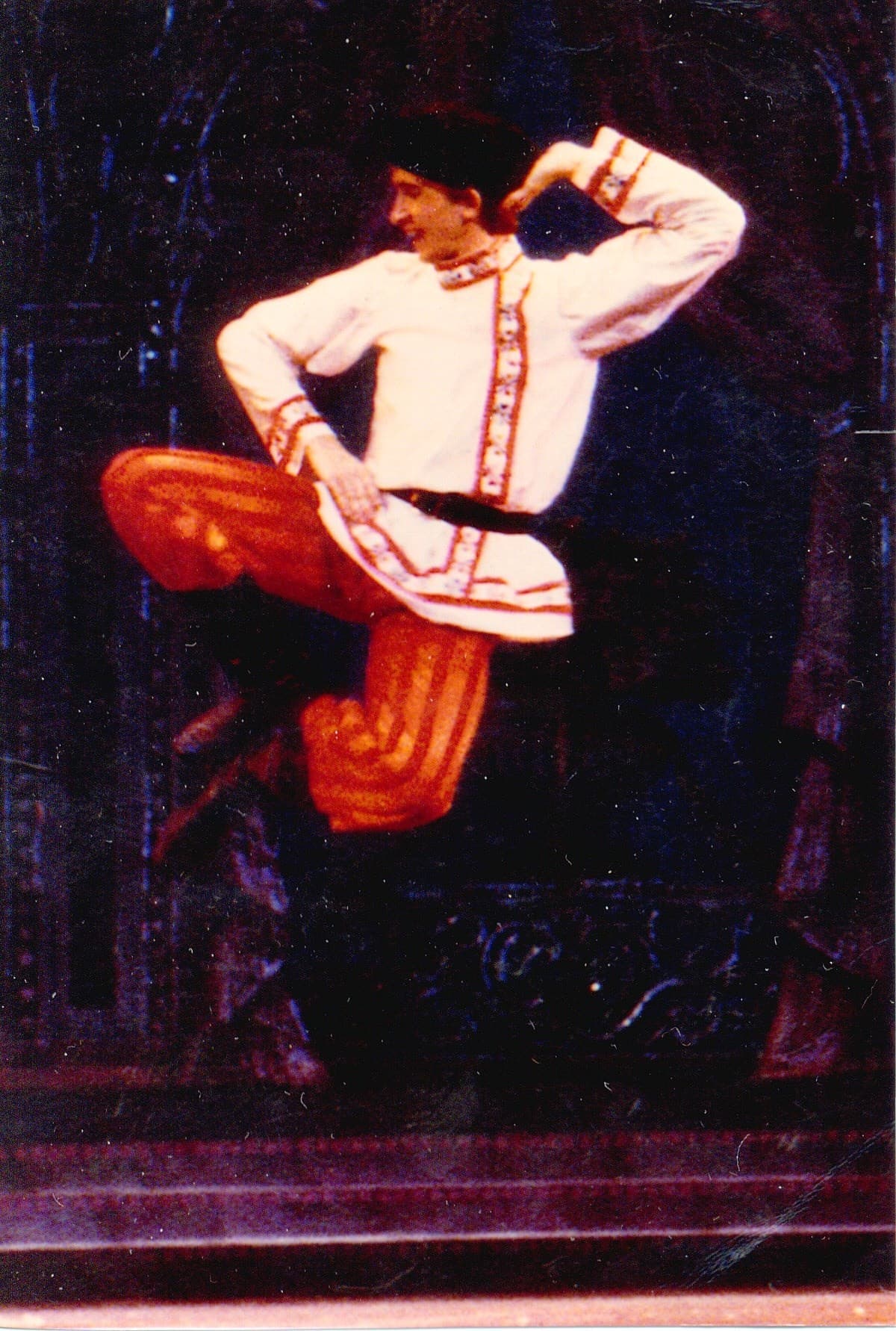
Stas Kmiec, Bernie Gardella — Own work · CC BY-SA 3.0
Trepak, often billed as the "Russian dance," is the third of four national character dances in the Act II divertissement of Tchaikovsky's The Nutcracker (1892), sitting alongside the Spanish, Arabian and Chinese numbers. It takes its name and its identity from a traditional Russian and Ukrainian folk dance of the same name, stylised for the stage rather than reproduced as folk practice.
What is danced
The article's description of the piece is almost entirely musical rather than choreographic: it is written in AABA form, marked molto vivace to prestissimo, set in 2/4 time and in G major. That structure and tempo profile — a driving, accelerating dance in a fast duple metre — is the strongest evidence the article gives about what the number demands: sustained speed, rhythmic drive, and a musical arc that pushes toward a prestissimo close, which in performance translates into stamina and precision at high tempo rather than the sustained adagio work found elsewhere in the ballet.
Context
The article places Trepak among a set of stylised national dances — Spanish (Chocolate), Arabian (Coffee), Chinese (Tea), and Russian/Ukrainian (Trepak) — gathered into a single divertissement in Act II, Tableau III. This is the convention of the Imperial-era grand ballet: a sequence of short character numbers, each drawing its identity from a real or imagined national dance idiom, inserted as a suite of contrasting entertainments within a larger narrative frame.
How to watch it
Listen for the AABA structure resolving into the prestissimo close — the tempo marking (molto vivace to prestissimo) is built into the piece's identity, not an interpretive choice. Watch how the number sits against its divertissement neighbours: Chocolate, Coffee and Tea each stand in for a different national idiom, and Trepak's identity as the 'Russian dance' only registers fully in that contrast.
Structure
- Act II · Scene Tableau III · Divertissement — Trepak (Russian dance)Trepak is danced as one of four character numbers in the Act II divertissement, alongside Chocolate (Spanish dance), Coffee (Arabian dance) and Tea (Chinese dance).
Structure read from an encyclopedia article, not from a libretto or score we hold. Confirm against a program before treating the numbering as authoritative.
Credits
- composer: Pyotr Ilyich Tchaikovsky