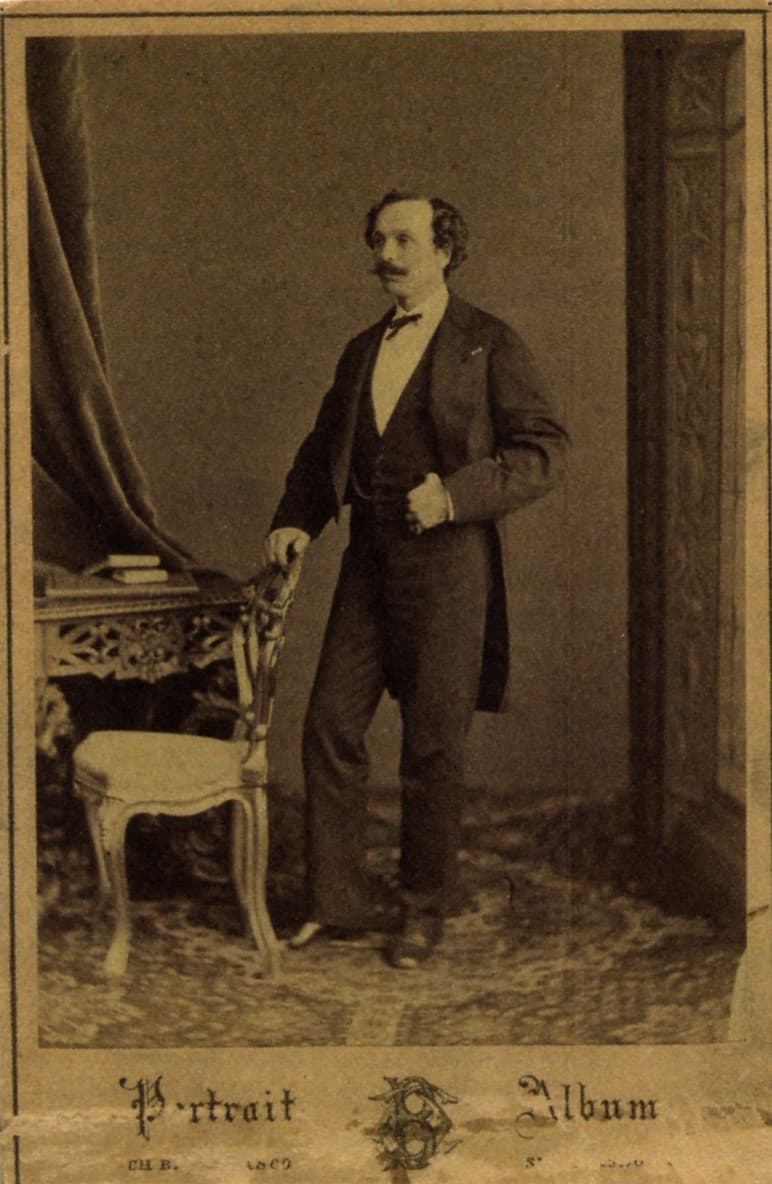
Marius Petipa
Legend of Dance
Why They Matter
Petipa matters because he turned the institutional resources and collaborative practices of the Imperial Theatres into a durable model of classical ballet: narrative mime, grand ensembles, character dances, formal divertissements, and demanding solo variations arranged across full-evening works. His
Watch
Ballet Evolved - Marius Petipa 1818-1910
Royal Ballet and Opera
Concise institutional introduction to Petipa's place in the development of classical ballet
Biography
Victor Marius Alphonse Petipa was born in Marseille on 11 March 1818 into a theatrical family. His father, Jean-Antoine Petipa, was a dancer, ballet master, and teacher; his mother, Victorine Grasseau-Maurel, was an actress and drama teacher. The young Petipa studied dance with his father and made his documented stage debut in 1831 in Jean-Antoine's production of *La Dansomanie*. Early engagements took him through European theatre centers as both dancer and choreographer. By 1838 he was premier danseur in Nantes, where he began making ballets and dances. Subsequent work in Bordeaux and Spain expanded his theatrical range before he arrived in St. Petersburg in 1847 as a principal dancer for the Imperial Theatres.
In Russia, Petipa built his authority through performance, teaching, and stagecraft. He appeared in and helped prepare the St. Petersburg production of *Paquita*, taught at the Imperial Ballet School, and developed new ballets alongside revivals. His breakthrough as a choreographer came with *The Pharaoh's Daughter* in 1862, a success that established him as a leading ballet master. By 1871 he held the title of premier maître de ballet of the Imperial Theatres.
Across the following decades, Petipa worked within the well-resourced court-theatre system alongside major collaborators. With composer Ludwig Minkus he created *Don Quixote* (1869) and *La Bayadère* (1877). With Pyotr Ilyich Tchaikovsky and theatre director Ivan Vsevolozhsky he shaped *The Sleeping Beauty* (1890). For *The Nutcracker* (1892), Petipa prepared the scenario and choreographic plan while Lev Ivanov staged the choreography and Tchaikovsky composed the score. The 1895 revival of *Swan Lake* emerged from collaboration between Petipa and Ivanov, with Riccardo Drigo revising Tchaikovsky's score. His final major work, *Raymonda* (1898), paired him with composer Alexander Glazunov.
Petipa's long tenure ended as administrative priorities and aesthetic values shifted in the early twentieth century. He effectively stepped back from active leadership in the first years of the 1900s and spent his final years away from St. Petersburg. His diaries from 1903 to 1907, preserved and published through Columbia University, offer direct evidence of his working life, health, and late reflections. He died at Gurzuf in the Taurida Governorate of the Russian Empire in 1910.
Petipa's repertory did not survive as an untouched authorial text. Stepanov notation, the Sergeyev Collection, dancers' memories, revisions, and twentieth-century productions all transmitted and transformed it. What audiences now call "Petipa" often combines surviving design, choreographic architecture, later additions, and reconstruction. That layered history is essential to understanding both his influence and the limits of attribution.
Career Highlights
Petipa made his documented stage debut in his father’s production of La Dansomanie. Pittsburgh Ballet Theatre
He became premier danseur in Nantes and began choreographing ballets and dances there. Petipa Heritage Foundation
He arrived in St. Petersburg to work as a principal dancer with the Imperial Theatres. Petipa Society
The Pharaoh’s Daughter established Petipa as a major choreographer in St. Petersburg. American Ballet Theatre biography
Don Quixote, with music by Ludwig Minkus, premiered in Moscow. Petipa Society
Petipa became premier maître de ballet of the St. Petersburg Imperial Theatres. Wikimedia Commons file record
La Bayadère, created with Minkus, entered the Imperial repertory. Petipa Society
The Sleeping Beauty, choreographed by Petipa to Tchaikovsky’s score, premiered in St. Petersburg. Petipa Society
The Nutcracker premiered; Petipa supplied the scenario and plan, while Lev Ivanov is credited with the stage choreography. Petipa Society
Petipa and Lev Ivanov staged the influential revival of Swan Lake, with Riccardo Drigo revising Tchaikovsky’s score. Petipa Society
Raymonda, with music by Alexander Glazunov, premiered at the Mariinsky Theatre. Petipa Society
Petipa kept the late diaries now available through Columbia University’s scholarly archive. Columbia University
Gallery
Works
21 stage works credited to Marius Petipa, 1846–1900 · 6 reached the screen.
- Paquita (1846)Ballet · Choreographer
- The Blue Dahlia (1860)Ballet · Choreographer
- The Pharaoh's Daughter (1862)Ballet · Choreographer
- The Traveling Dancer (1864)Ballet · Choreographer
- Don Quixote (1869)Ballet · Choreographer
- Camargo (1872)Ballet · Choreographer
- Les Aventures de Pélée (1876)Ballet · Choreographer
- Swan Lake (1877)Ballet · Choreographer · 5 screen versions
- La Bayadère (1877)Ballet · Choreographer
- The Daughter of the Snows (1879)Ballet · Choreographer
- Zoraiya (1881)Ballet · Choreographer
- The Vestal (1888)Ballet · Choreographer
- The Whims of the Butterfly (1889)Ballet · Choreographer
- The Sleeping Beauty (1890)Ballet · Choreographer · 1 screen version
- The Nutcracker (1892)Ballet · Choreographer
- Le Réveil de Flore (1894)Ballet · Choreographer
- Barbe-Bleue (1896)Ballet · Choreographer
- Raymonda (1898)Ballet · Choreographer
- Les Millions d'Arlequin (1900)Ballet · Choreographer
- TitaniaBallet · Choreographer
- TrepakBallet · Choreographer
Credits sourced from Wikidata (CC0), one citation per field. Works without a recorded premiere date are listed last. Titles link to the work in Limelight.
Legacy & Impact
Petipa established a model of classical ballet—narrative mime, grand ensembles, character dances, formal divertissements, and demanding solo variations arranged across full-evening works—that became a reference point for dancers and choreographers worldwide. His ballets shaped how later artists preserved, revised, and reconstructed nineteenth-century classicism. The legacy belongs not only to Petipa alone, but also to the composers, dancers, répétiteurs, notators, designers, and later stagers who carried the repertory forward. Understanding Petipa means understanding the collaborative and institutional systems that made his work possible.


Explore More Legends
Discover the dancers, teachers, choreographers, and cultural icons who shaped how the world moves.
Keep the thread going
Dance history, technique, and the occasional rabbit hole — in your inbox. Thoughtful, infrequent, unsubscribe anytime.
Free. No spam. One click to leave.