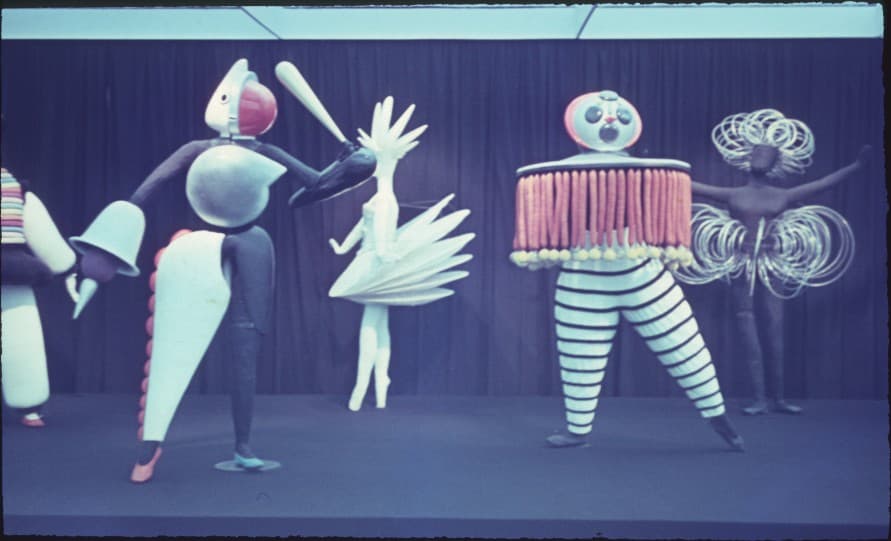
Peter H. Feist — Feist collection of slides, resource ID 12551 · Public domain
Triadisches Ballett (Triadic Ballet) is Oskar Schlemmer's Bauhaus stage work, developed from 1912 with the Stuttgart dance troupe of Albert Burger and Elsa Hötzel and premiered at the Stuttgart Landestheater on 30 September 1922 with a score by Paul Hindemith. It is not a narrative ballet in the classical sense but a demonstration piece: three dancers (two men, one woman) perform twelve dances across three colour-coded scenes wearing eighteen sculptural costumes, built to test Schlemmer's idea of the human body as an abstract, geometric medium.
It belongs in a dance catalogue as one of the most performed pieces of interwar avant-garde stage dance and as the clearest surviving demonstration of Bauhaus movement theory: the article credits it with helping 'spread the ethos of the Bauhaus' as it toured while Schlemmer taught there from 1921 to 1929.
What is danced
The article describes the vocabulary in terms of concept rather than step: Schlemmer wanted the dancers to move like 'puppets and marionettes', which he considered 'aesthetically superior' to natural human movement because it foregrounded the artificiality of the medium. Movement was generated from costume outward — Schlemmer first worked out an abstract geometry for the body (a cylinder for the neck, a circle for the head and eyes), then built the 'figurine' costumes from that geometry, and only after the costumes existed were the dance movements decided. This means the piece is costume-driven and pose/shape-based rather than built on a named technique or step vocabulary — the source gives no ballet positions, holds, or floor patterns to cite.
Structurally the work runs in three colour-and-mood blocks rather than a plot: a 'cheerful, burlesque' opening set of scenes on lemon yellow, a 'festive and solemn' middle set on pink, and a 'mystical and fantastic' closing set on black. Schlemmer framed the overall trajectory as a synthesis of two currents he saw driving modern movement — the mechanised body-as-machine, and 'primordial impulses' — resolving from Dionysian origins into a strict, Apollonian final form. Beyond this description of tone and intent, the article gives no technical detail (turns, lifts, partnering, floor work) that would let a dancer reconstruct the material.
Because the piece was conceived costume-first and performed 'in stasis' for museum exhibition of the figurines alone (1930, 1938), it is as much a costume/design object as a performed dance, and later showings (the V&A, 2006) had to supply video to restore the movement dimension that the sculptural costumes alone could not convey.
Context
The work sits at the start of Bauhaus involvement with performance (Schlemmer joined in 1921) and follows directly from Schoenberg's Pierrot Lunaire and Schlemmer's wartime experience, which pushed him toward treating the body as an artistic material rather than an expressive instrument — a stance opposed to the psychological, narrative ballet and pantomime traditions he saw as burdened by 'historical baggage'. Its ten-year gestation (conceived 1912, partially performed 1915, premiered 1922) also tracks a search for the right composer: Schoenberg was asked and declined, Enrico Bossi's music served the partial 1915 performances, and Paul Hindemith supplied the score for the full 1922 premiere.
Within dance history it stands alongside Schlemmer's other Bauhaus stage experiments — the 'Figural Cabinet' mechanical cabaret, the Gesture, Hoop, Rod, Metal and Glass dances, and Men in Space — as part of a broader Bauhaus project to redesign the moving body through costume, geometry and stage space rather than through inherited technique.
Staging history
After its 1922 Stuttgart premiere it was performed in 1923 during Bauhaus Week at the Nationaltheater, Weimar, and at the Annual Exhibition of German Crafts in Dresden, spreading with Schlemmer's Bauhaus tenure through 1929. Its costumes later had an exhibition afterlife independent of performance: the figurines were shown in Paris in 1930 (Société des Arts Décoratifs) and at MoMA's 1938 Bauhaus exhibition in New York, displayed 'in stasis, without their choreography'; surviving original costumes are held at the Neue Staatsgalerie in Stuttgart. The V&A's 2006 Modernism exhibition paired the figurines with video recordings to restore a sense of movement, and in 1970 Bavaria Atelier GmbH produced a 30-minute colour film, Das triadische Ballett, with live dancers and a new score by Erich Ferstl.
How to watch it
Watch the costume, not the footwork: the piece was built figurine-first, so the sculptural silhouettes (cylindrical, spherical, disc-like forms) are the primary choreographic statement, with movement constrained and shaped by what the costumes physically allow. Track the colour progression across the three scene-groups — yellow/burlesque, pink/festive-solemn, black/mystical — as the work's real dramatic structure, since there is no plot to follow. Because much of the surviving record is costume exhibited in stasis, footage (such as the 1970 film) is needed to see the movement the figurines were designed to produce.
Structure
- Scene opening scenesScenes performed against a lemon yellow background, intended to be cheerful and burlesque in mood.
- Scene middle scenesScenes performed on a pink stage, intended to be festive and solemn.
- Scene closing scenesScenes performed on a black stage, intended to be mystical and fantastic.
Structure read from an encyclopaedia article, not from a libretto or score we hold. Confirm against a programme before treating the numbering as authoritative.
Credits
- composer: Paul Hindemith
On screen
- The Triadic Ballet (1970)
More from Paul Hindemith
Other staged works in the register connected to this one by author or lineage.
