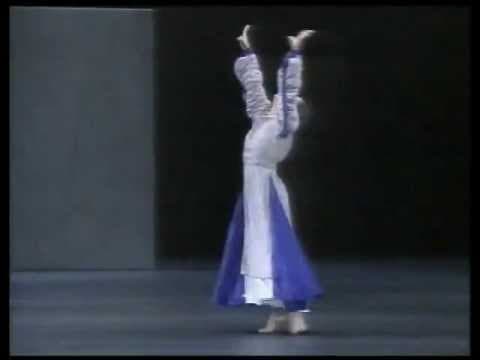
Hérodiade (1944)
Hérodiade is the ballet built around Paul Hindemith's 1944 score "Hérodiade de Stéphane Mallarmé: Recitation orchestrale," commissioned for Martha Graham with funding from the Elizabeth Sprague Coolidge Foundation. It premiered on 30 October 1944 at the Coolidge Auditorium of the Library of Congress, on a program shared with Aaron Copland's Appalachian Spring and Darius Milhaud's Jeux du printemps — three commissions from the same patron, danced the same night.
What it contains
- Graham Technique · whole work — The article credits Martha Graham as choreographer for the 1944 premiere with herself and May O'Donnell dancing the leads; the vocabulary described here as characteristic of Graham's own technique (spinal contraction-release, floor work, spiral torso) is drawn from general knowledge of her practice, not from movement description in the article itself. Source: "The choreography was by Martha Graham, stage design was by the Japanese American sculptor Isamu Noguchi"
What is danced
The article is a music-history source and does not describe the choreography in movement terms: no steps, holds, or technical vocabulary are given. What it does establish is that the piece follows Mallarmé's poem 'Hérodiade' as dramatic through-line, that Hindemith deliberately gave the vocal/text lines to solo instruments rather than a singer so as not to distract from the dancing, and that the score runs as one continuous movement in eleven sections tied to specific lines of the poem (a Nurse figure and Hérodiade before her mirror recur as dramatic anchors). This tells a choreographer or historian what the music is doing at each point of the ballet's narrative — mirror scene, Nurse's recurring music, a 'Triumphant waltz' passage — without telling us what Graham's body was doing to it.
Context
The commission sits at a key moment for American concert dance patronage: the Coolidge Foundation underwrote three new ballet scores in 1944 for Martha Graham (Hindemith), Copland (for Graham's own Appalachian Spring/Imagined Wing) and Milhaud, staged together at the Library of Congress rather than in a theatre. Hindemith's insistence that the melodic 'recitation' belongs to the orchestra, not a spoken or sung voice, reflects a broader mid-century concern in dance scores with keeping text-based drama out of the way of the moving body — a concern directly relevant to how Graham-era modern dance used music as dramatic scaffolding rather than accompaniment to song.
Staging history
The article records only the premiere details: 30 October 1944 at the Library of Congress, with Graham and May O'Donnell in the leading roles, sets by Isamu Noguchi and costumes by Edythe Gilfond. It notes that the subtitle 'orchestral recitation' has been misread by later performers and recorders as calling for an actual spoken recitation of Mallarmé's poem over the music, which Hindemith explicitly denied in a letter to his publisher Willy Strecker — a documented history of the score being misperformed independent of Graham's ballet, but no further account of the ballet itself being revived.
How to watch it
Listen for the instrumental lines that stand in for spoken French verse — Hindemith wrote the winds and strings to mimic the cadence and declamation of Mallarmé's poem rather than setting it as song, so the 'text' of the ballet is audible only as instrumental phrasing, not as words. Watch for the recurring string-quartet passage marked as the Nurse's music and the mirror scene built around Hérodiade's line 'O miroir! Eau froide par l'ennui dans ton cadre gelée,' since the article ties both directly to specific structural returns in the score.
Structure
- Prélude / MelodyOpening string prelude followed by a wide-spun melody for full ensemble, closing with a wind repetition of the opening phrase.
- Nurse: 'Tu vis! ou vois-je ici l'ombre d'une princesse?'The Nurse's music, given to a string quartet, opens the dramatic exchange with Hérodiade.
- Hérodiade: 'Reculez. Le blond torrent de mes cheveux immaculés...'Hérodiade's extended solo passage (Modéré), featuring flute and oboe.
- 'Sinon la myrrhe gaie...'A return of the Nurse's string-quartet music.
- Hérodiade: 'Laisse la ces parfums'A loud full-ensemble outburst (Vif).
- Nurse: 'Pardon! l'âge effaçait'Another return of the Nurse's music, followed by a clarinet aria.
- Hérodiade's scene before the mirror: 'O miroir! Eau froide par l'ennui dans ton cadre gelée'The mirror scene, set against an energetic full-ensemble passage (Agité).
- Hérodiade: 'Arrête dans ton crime'Continuation of the dramatic confrontation, into the triumphant waltz section (Vif et passioné).
- Hérodiade: 'Oui, c'est pour moi, pour moi, que je fleuris, déserte!'Hérodiade's declaration of solitary self-possession.
- Hérodiade: 'Non, pauvre aieule'A bassoon aria accompanies this exchange.
- 'Vous mentez, ô fleur nue de mes lèvres'A brief, pathetic finale closes the continuous one-movement structure.
Structure read from an encyclopaedia article, not from a libretto or score we hold. Confirm against a programme before treating the numbering as authoritative.
Credits
- composer: Paul Hindemith
More from Paul Hindemith
Other staged works in the register connected to this one by author or lineage.
 Triadic BalletBallet · 1922Music by Hindemith · video
 Appalachian SpringBallet · 1944Same lineage · video
 LamentationBallet · 1930Same lineage · video
 Cave of the HeartBallet · 1946Same lineage · video
 EpisodesBallet · 1959Same lineage · video
 Errand into the MazeBallet · 1947Same lineage · video
 Primitive MysteriesBallet · 1931Same lineage · video
 Maple Leaf RagBallet · 1990Same lineage · video