49 works in this view — arrow keys or swipe to move between them.
Dance in Art
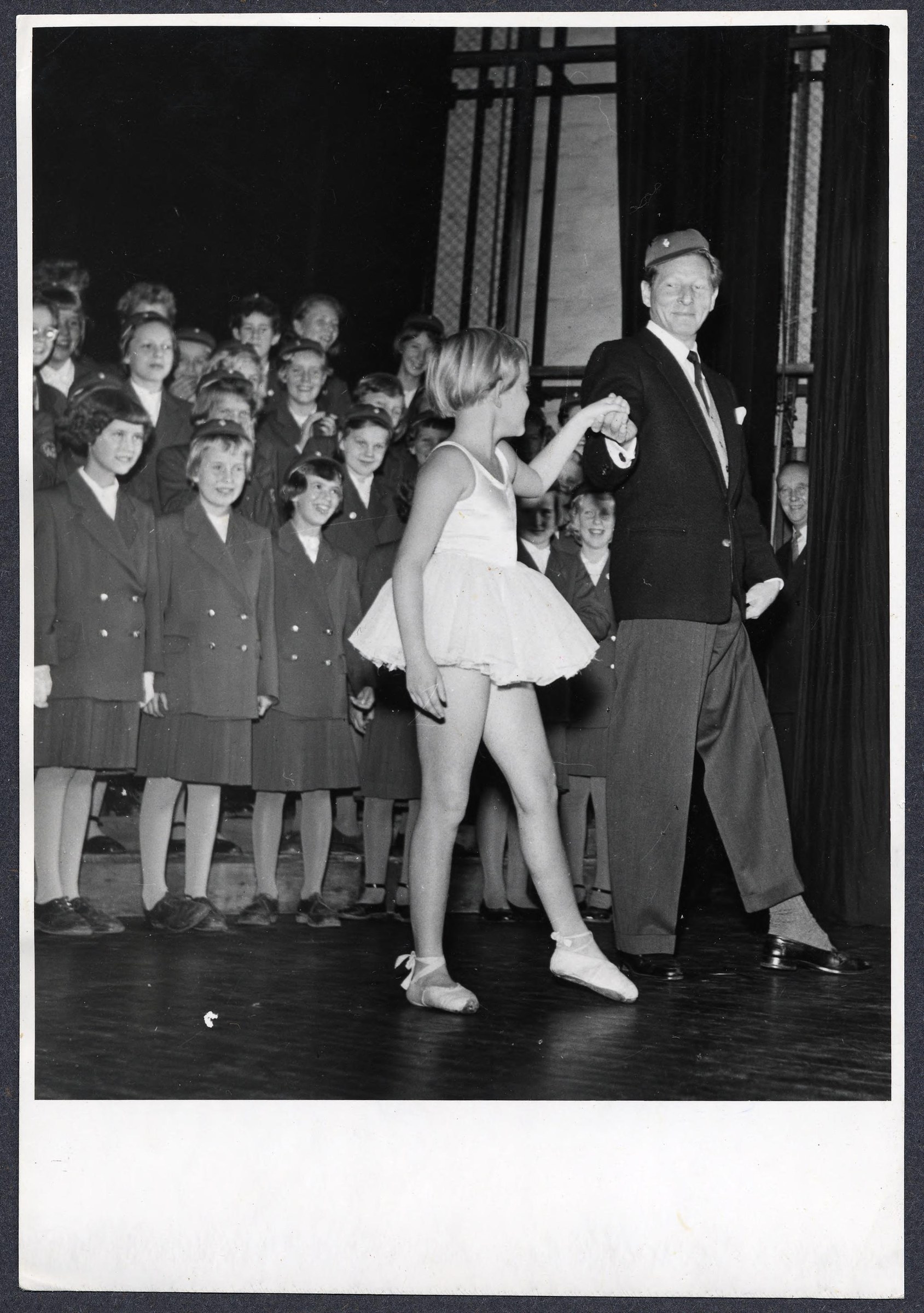
From the performance in the Saga theatre in Oslo, 1955 [Danny Kaye on stage dances with young ballerina]
Unknown artist
- Collection:
- Prints & Photographs
- Source:
- Library of Congress
- Rights:
- Rights vary by item — check the source record before reusing this image. Source record ↗
- Recorded as:
- Library of Congress — no known restrictions (verify per item)
This image shows how theatre audiences and performers understood entertainment and spectacle in the immediate postwar period, and specifically how a young female dancer was positioned as an object of audience attention within a theatrical frame. It also records the presence of American-style entertainment—identifiable by the staging, costuming, and partner dynamic—in Norwegian cultural institutions at a moment when such American forms were reshaping European entertainment.
What you are looking at
A man in a dark suit and fedora stands stage-right, holding the hand of a young female dancer in a white sleeveless dress with a very short skirt, posed in a playful attitude. She faces away from him, her weight shifted, one leg extended, her posture suggesting lightness and youth. Behind them, an audience of women—many in dark uniforms or business suits, some in hats—fills the stage, watching intently. The setting is clearly a theatre interior, with dark curtains framing the scene and a theatrical floor beneath. The photograph captures a moment of entertainment or performance, with the male figure appearing to guide or present the young dancer to an attentive crowd. The formal dress of the onlookers and the theatrical staging suggest this is an official event or concert performance rather than a casual gathering.
The dancing
The male figure stands upright in a classic ballroom frame, his right arm extended to hold the dancer's hand at roughly shoulder height. The young woman is positioned in a turned-out stance with an extended leg, her body angled away, suggesting a ballet or ballroom posture. Her dress and bare legs emphasize youth and lightness. The spatial relationship—his guiding hand, her responding position—suggests partner dancing or at minimum a choreographed presentation. The crowd's focused attention creates an audience-performer dynamic, not a social dance among equals.
The dance depicted
This appears to be a theatrical performance rather than social dancing, most likely from a musical theatre or vaudeville context. The presentation setup—a solo male performer with a young female dancer before an assembled audience—is characteristic of 1950s entertainment spectacle. The woman's posture and the man's guiding gesture suggest either a simple ballroom frame or a theatrical moment adapted from jazz or musical theatre idiom. The extreme youth of the female dancer and the formal audience context are consistent with entertainment of the period, though without clearer detail of footwork or frame, a precise identification is difficult. This may represent a choreographed comedy sketch or entertainment number rather than exhibition of a specific dance style.
How it was made
This is a black-and-white photograph, likely taken during a live performance under stage lighting. The photograph captures the grainy quality typical of mid-20th-century theatre photography—the background is largely obscured by shadow, while figures are lit dramatically from front and side. The technical choices (exposure, focus on the performers rather than the crowd) prioritize documentation of the performance moment. This appears to be a professional or semi-professional photograph, likely taken for press or archival purposes, as evidenced by its composition and clarity.
About this work
This photograph documents a theatrical performance at the Saga theatre in Oslo in 1955, capturing a moment of staged entertainment involving a male performer and a young female dancer before a formally dressed audience. The image reveals conventions of 1950s variety entertainment: the presentation of youthful female dancers as spectacle, the framing of performance within a theatrical institution, and the formality of audience and venue. For dance historians, the work offers evidence of how partnered dance and theatrical presentation operated in postwar European entertainment culture, and specifically how American entertainment idioms (suggested by the staging) were received and performed in Scandinavian venues. The photograph is a document of performance practice and theatrical custom of its moment.
How to look at it
Observe the geometry of the partnering: the man's posture is formally upright, his arm extended in a controlled gesture, while the woman's body is angled away in a pose that reads as playful or youthful rather than commanding. This asymmetry—his authority, her lightness—is a convention of theatrical presentation in this period. Note also the audience composition and dress, which frames the performance as a formal or semi-formal event. The photograph's exposure captures the moment as a still image extracted from live performance, freezing a moment of interaction that would have continued as choreography or improvisation on stage.
The period
In 1955, theatrical entertainment in Western Europe was still heavily shaped by American models: vaudeville, musical theatre, and celebrity performance remained dominant forms. The postwar period saw the arrival of American popular culture in European cities, including new styles of dance and performance. The Saga theatre in Oslo, as a venue for such productions, was part of a larger circuit through which American entertainment circulated. The formal dress of the audience suggests this was an official or high-society event rather than popular entertainment. The photograph's aesthetic—the stage lighting, the framing—is typical of theatre documentation from this era, when photographs were taken to record and publicize live performances.
Where it lives
The photograph is held in the Prints & Photographs collection of the Library of Congress and was sourced from that institution's archives. It documents a performance at the Saga theatre in Oslo, suggesting it may have been taken by a Norwegian photographer or acquired by LC as part of theatre documentation or press material.
Dance in this work
Questions about this work
Is this Danny Kaye dancing?
The catalogue record attributes the male figure to Danny Kaye, the American entertainer and actor famous for both comedy and musical theatre. If accurate, this would document one of his European performances, likely during a tour. However, the photograph provides no inscription or visible confirmation of this identification.
What kind of dance are they doing?
The image alone does not show enough detail of footwork or movement to specify a dance style with certainty. The posture and partnership suggest either a basic ballroom frame or a theatrical adaptation of jazz or musical theatre movement. The formal audience and theatrical setting indicate this is choreographed entertainment rather than social dancing.
Why is the audience all women?
The visible audience appears to be predominantly or entirely women, many wearing uniforms or formal business dress. This may indicate an organized event—a matinee performance, a women's club gathering, or a special performance for a specific group. Theatre audiences of the 1950s were often gender-segregated for daytime or special events.
Where is the Saga theatre?
The Saga theatre was located in Oslo, Norway. The venue operated as a cinema and theatre during the mid-20th century and was a site for screening films and hosting live entertainment, including touring American acts.
More dance artwork





