49 works in this view — arrow keys or swipe to move between them.
Dance in Art
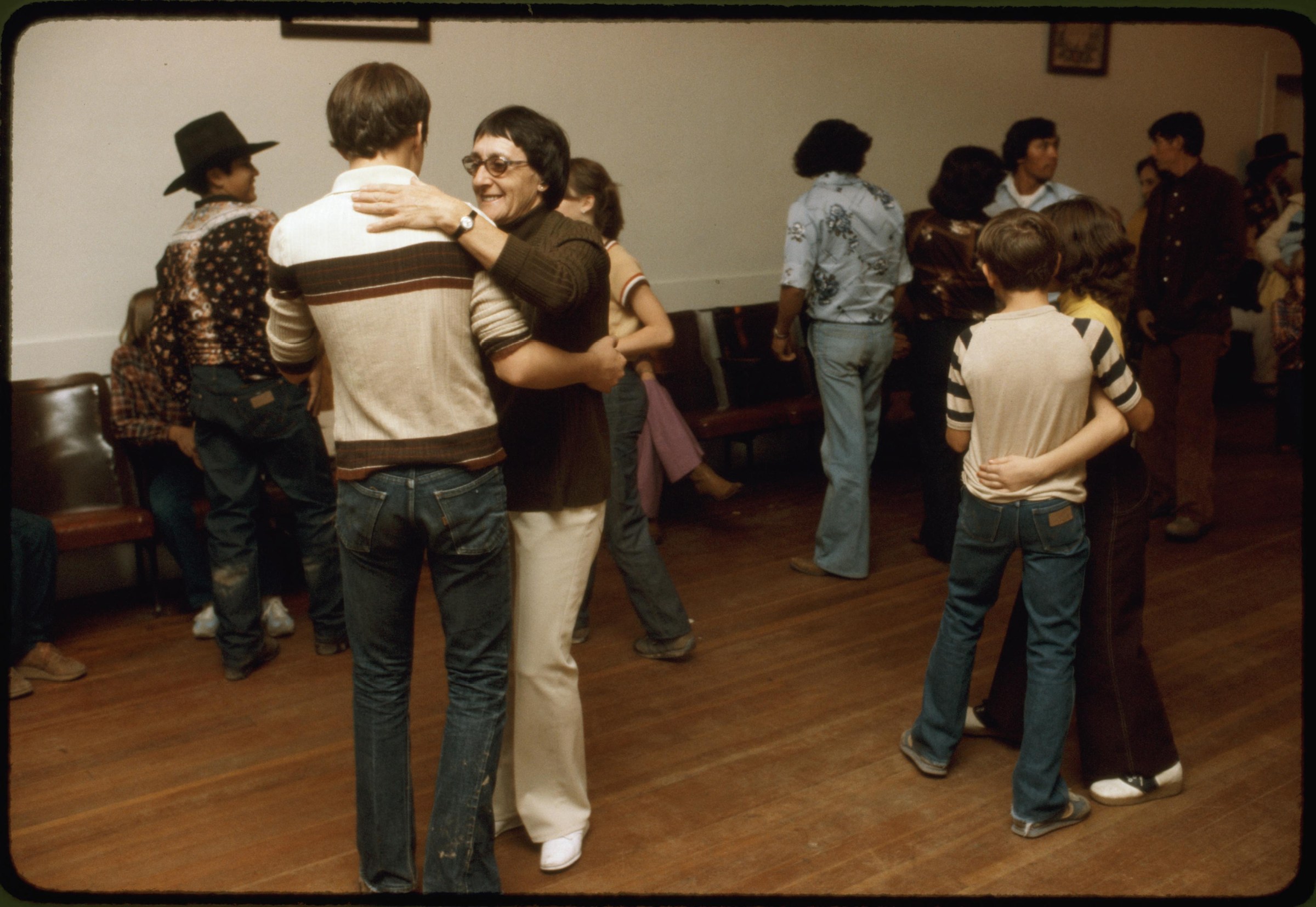
Volunteer Fireman's Dance
Unknown artist
- Collection:
- Prints & Photographs
- Source:
- Library of Congress
- Rights:
- Rights vary by item — check the source record before reusing this image. Source record ↗
- Recorded as:
- Library of Congress — no known restrictions (verify per item)
This image documents the lived practice of American social dance in non-theatrical contexts—how folk dance functioned as community participation and informal pedagogy. For dance historians, it provides evidence of how dances like square dance and contra dance were taught and danced in rural and small-town America in the 1970s, showing the role of fire departments and similar organizations as hosts and transmitters of these traditions.
What you are looking at
A group of children and young teenagers gather in a wood-floored indoor space, likely a community hall or fire station, in what appears to be an informal social dance. In the foreground, a woman wearing glasses and a brown cardigan dances with a young boy in a striped shirt, her arms around him in a gentle, instructional embrace. Around them, other children stand in pairs or small clusters, some dancing, others watching and waiting their turn. A child in a cowboy hat stands to the left; another boy in a light-colored shirt with horizontal stripes is visible in the center-right. The lighting is warm and overhead, typical of institutional interiors of the period. The dress is casual—jeans, simple shirts, modest sweaters—and the atmosphere is one of community participation rather than performance, suggesting a teaching or social event where children are learning to dance together.
The dancing
The primary dancers—the woman and boy in the foreground—hold a simple closed position appropriate for teaching a young child: her arms encircle his shoulders and back, his posture is upright and relaxed. The boy's feet appear to be in basic, weight-centered movement. Other children visible in the background show varied stances: some are in loose partner holds, others stand with arms at their sides or on their partners' shoulders, suggesting informal instruction or social dancing rather than technique-driven movement. The group's spacing and attention suggest turn-taking and observation, typical of participatory dance teaching.
The dance depicted
This appears to be American social dance instruction or community participation, most likely square dance, contra dance, or similar folk-regional social forms popular in American fire department and community hall contexts in the 1970s. The informal setting, mixed-age group, and the adult (possibly a caller or teacher) engaging children one-on-one point to a teaching moment within a larger community event. The simple upright posture and closed holds are consistent with historic-american-contra or folk-regional forms, though the exact style cannot be determined from posture alone. The title "Volunteer Fireman's Dance" suggests this is documentation of a social or fundraising event hosted by a local fire department.
How it was made
This is a color photograph, likely a 35mm slide or transparency given the warm, slightly saturated color palette and the grain visible in the image. The photograph appears to be documentary in intent—candid framing, natural lighting, handheld composition—suggesting it was taken as part of systematic documentation or archival record-keeping rather than artistic composition. The color transparency format indicates professional or semi-professional documentation, consistent with Library of Congress photographic collection practices in the 1970s.
About this work
This is documentary photography of American social dance in a community setting, capturing a moment of intergenerational dance instruction or participation at what the title identifies as a volunteer fireman's dance. The image documents folk-regional social dance practice as it occurred in everyday institutional spaces, showing how such dances functioned as participatory community events and teaching moments rather than performances for an audience. The photograph is valuable as evidence of how American social dance traditions were transmitted and practiced outside formal theatrical or competitive contexts.
How to look at it
Notice the teaching moment: the adult woman's careful, nurturing hold and the child's attentive posture show how dance knowledge was transmitted interpersonally in these community settings. Observe the mix of active dancers and observers in the background—the turn-taking and social structure of the event. The casual dress and institutional setting (the plain walls, simple wooden floor) establish this as a working community event rather than a formal performance or competition. The photographer chose to capture an instructional moment rather than a moment of peak action, emphasizing the social and pedagogical function of the dance.
The period
In the 1970s, American folk and social dance traditions experienced renewed interest as part of broader cultural movements toward heritage preservation and community participation. Square dance, contra dance, and similar forms remained popular in rural and small-town contexts, often hosted by civic organizations like volunteer fire departments. These dances served simultaneously as social events, fundraisers, and informal education in cultural tradition. The Library of Congress's documentation of such events reflects the period's investment in recording vernacular American culture before it was perceived to be disappearing.
Where it lives
This photograph is held in the Library of Congress Prints & Photographs Online Catalog, suggesting it was part of a systematic documentation project, likely the Federal Writers' Project or a similar Depression-era or post-war effort to record American community life and culture.
Dance in this work
Questions about this work
What is a volunteer fireman's dance?
A social dance event, typically a square dance or contra dance, hosted by a volunteer fire department as a community gathering and often as a fundraiser. These events were common in rural and small-town America and functioned as participatory social occasions where people of all ages danced together, often with live music and a caller. They served to raise funds for the fire department while maintaining community social bonds and cultural traditions.
What dance style is being taught here?
The image does not provide enough detail to identify the specific style with certainty. Based on the informal setting, the simple closed position, and the title's reference to a fireman's dance, it is most likely a form of American social dance such as square dance, contra dance, or a regional variation. The instructional context and mixed-age group are typical of how these dances were taught and practiced in community settings.
Why does the Library of Congress have this photograph?
The photograph appears to be part of a documentation project aimed at recording American community life and cultural practices. The Library of Congress systematically collected such images to preserve evidence of how Americans lived, worked, and gathered together, particularly in rural and small-town contexts.
More dance artwork





