49 works in this view — arrow keys or swipe to move between them.
Dance in Art
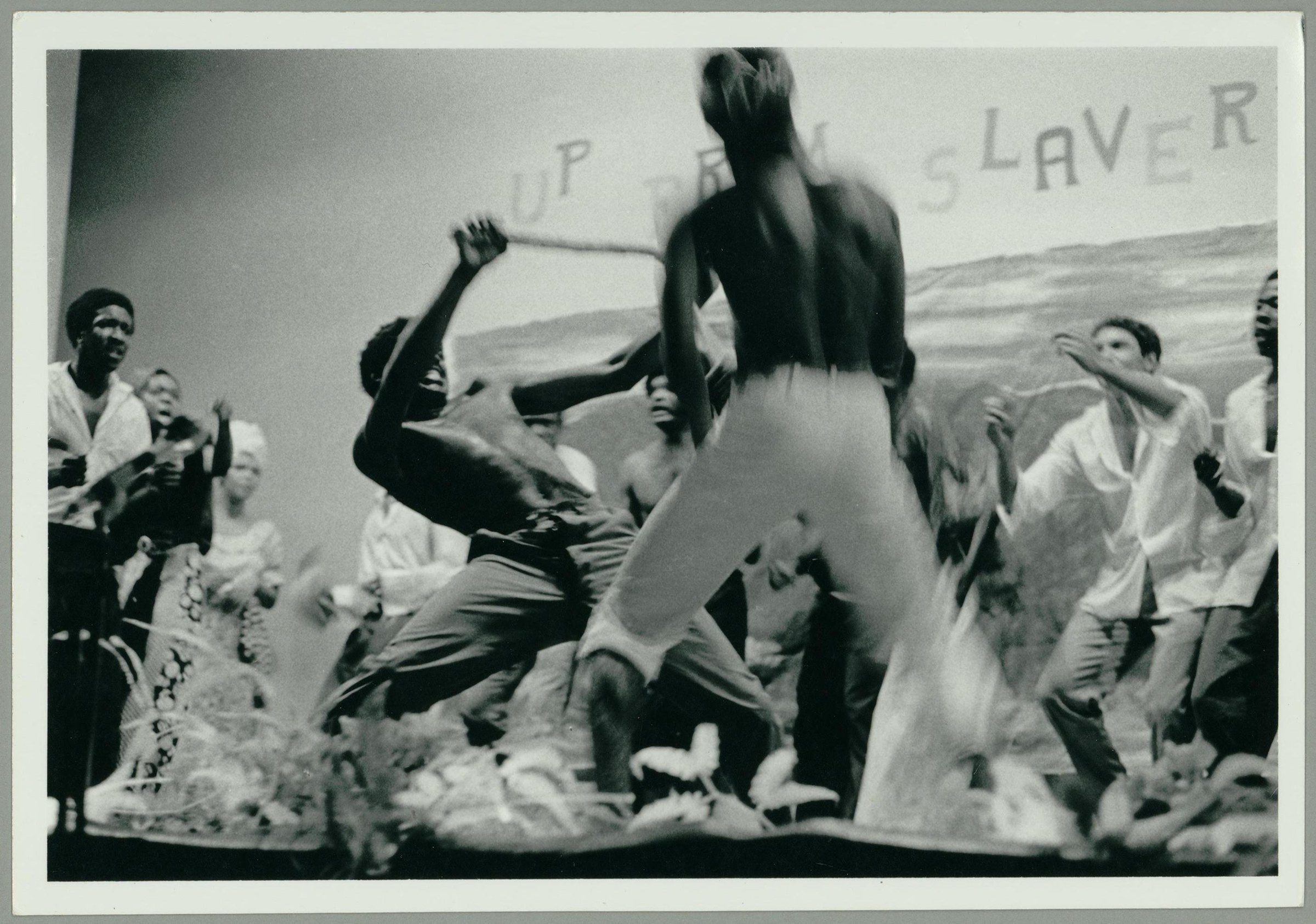
Dance Performance.
Unknown artist
- Collection:
- Prints & Photographs
- Source:
- Library of Congress
- Rights:
- Rights vary by item — check the source record before reusing this image. Source record ↗
- Recorded as:
- Library of Congress — no known restrictions (verify per item)
This photograph provides rare visual documentation of acrobatic partner dance as lived practice and public entertainment in the early 1970s, capturing not only the technical feat but the social context of performance. It is valuable evidence for understanding how acrobatic traditions were maintained, transmitted, and experienced outside of formal theatrical or circus institutions, and for recognizing acrobatics as a form of dance history rather than athletics alone.
What you are looking at
A dynamic outdoor performance scene, photographed in black and white from a elevated vantage point. Shirtless male dancers perform acrobatic movements on what appears to be a sandy or earthen stage, their bodies angled and inverted mid-lift or throw. Surrounding them on all sides is a crowd of spectators — men, women, and children in casual 1970s dress (jeans, light shirts, sweaters) — who watch intently from close range. The spectators form an informal circle or perimeter, some leaning in, creating an intimate, participatory atmosphere. The landscape behind them appears arid and open, with distant hills visible in the hazy background. The photograph captures a moment of athletic suspension or acrobatic sequence, with at least one performer elevated above another's shoulders while a second performer appears mid-motion or mid-throw. The loose, informal gathering and outdoor setting suggest a festival, demonstration, or community celebration rather than a formal theatrical performance.
The dancing
At least two shirtless male performers are visible, their bodies in extreme positions: one appears to be supported at or above shoulder height by another, while a third figure is caught mid-airborne movement or being thrown upward. The performers' musculature is clearly defined, and their limbs are extended or arched in acrobatic positions requiring significant strength and coordination. The spectators' posture — leaning forward, heads turned upward to track the action — indicates they are following rapid, high-flying movement. There is no closed ballroom frame or ballet turnout; the movement is explosive, three-dimensional, and focused on height and inversion.
The dance depicted
This appears to be acrobatic dance or partner acrobatics (adagio style), emphasizing lifts, throws, and aerial suspension. The performers are executing feats of strength and balance that require intimate partner coordination. The outdoor setting, informal crowd, and athletic rather than lyrical quality suggest this may be a street performance, festival demonstration, or folk acrobatic tradition rather than staged theater. The composition — freezing a moment of highest lift or flight — emphasizes the spectacular, weight-defying moment that would have been the climax of a sequence. Without additional context or recognizable costume, it is difficult to tie this to a specific regional or stylistic tradition, but the emphasis on male partnership, explosive power, and public celebration points toward traditions of partner acrobatics found globally, particularly in folk or circus contexts.
How it was made
This is a black-and-white photograph printed as a gelatin silver print on paper. The medium allows for sharp focus on the acrobatic figures in the middle distance while capturing the crowd's response across the full depth of field. The photographer has positioned the camera above the action, looking down, which emphasizes the height of the lift and the crowd's enclosure around the performers. The grain and tonal range are consistent with 1970s photojournalistic or documentary photography. The photograph was evidently taken outdoors in natural daylight with sufficient shutter speed to freeze rapid motion, a technical requirement that became practical for documentary photographers in the 1960s–1970s.
About this work
This photograph documents an acrobatic performance or demonstration, likely from the early 1970s based on the clothing and photographic technology. The image captures a moment of spectacular partner acrobatics — probably a lift or throw at its apex — framed by an audience of spectators who form an informal circle around the performers. The work is valuable as documentary evidence of acrobatic dance performance outside institutional settings: it shows how such performance was staged, consumed, and experienced as community or popular entertainment during this period. The photograph's composition — elevated viewpoint, crowd engagement, emphasis on weightlessness and power — tells us that acrobatic performance was conceived as public spectacle designed to astonish and gather people.
How to look at it
Look at the moment the photographer chose: the acrobatic figures at their highest or most inverted point, where the feat of strength and coordination is most visible. Note how the crowd's body language — their forward lean, upturned faces, close proximity — tells you this is a moment of climax that was expected and anticipated. The composition, shot from above, emphasizes the defiance of gravity that the acrobats are demonstrating. The casual dress and outdoor setting signal that this is not a formal or ticketed event but a public gathering or demonstration.
The period
The photograph dates to 1971, a period of significant documentation of vernacular and community performance practices in American and international visual culture. The 1960s and 1970s saw growing interest in folk traditions, street performance, and non-Western dance forms among photographers and cultural critics. Simultaneously, partner acrobatics and adagio dance remained active traditions in circus, street performance, and folk contexts, though they received less institutional dance-world attention than ballet or modern dance. The informal, outdoor setting and documentary approach reflect the era's interest in capturing dance as it occurred in everyday and community contexts rather than only in theaters.
Where it lives
The photograph is held in the Library of Congress Prints & Photographs collection. It was catalogued with minimal descriptive information, suggesting it arrived as part of a larger archival deposit or collection without detailed documentation of the performers, location, or specific context.
Dance in this work
Questions about this work
What is the dancers' relationship to the crowd?
The spectators are not seated in a theater; they form an informal, close circle around the performers, creating an intimate and participatory atmosphere. This suggests a street performance, festival, or community demonstration rather than a formal staged event. The crowd's proximity and forward lean indicate they are actively engaged and following the action moment by moment.
Why are the performers shirtless?
Shirtless performance is typical for male acrobatic and adagio dancers because it allows spectators to see the precise lines, musculature, and weight shifts required for the movements. It also emphasizes the vulnerability and human effort of the feat — the acrobat's body is fully exposed, making the feat of strength and control more striking.
Is this circus or dance?
This is acrobatic dance, which sits at the intersection of circus and theatrical dance traditions. Partner acrobatics (adagio) is a recognized dance form with its own technique, partnership principles, and performance contexts. However, the outdoor, informal setting here suggests it may also be documented as street performance or folk demonstration rather than as staged circus or theater.
What era does the clothing suggest?
The spectators' clothing — casual jeans, light shirts, sweaters, and hairstyles visible in the photograph — is consistent with early 1970s casual wear. The photograph's grain and black-and-white stock also align with 1971, the date given in the catalogue.
More dance artwork