49 works in this view — arrow keys or swipe to move between them.
Dance in Art
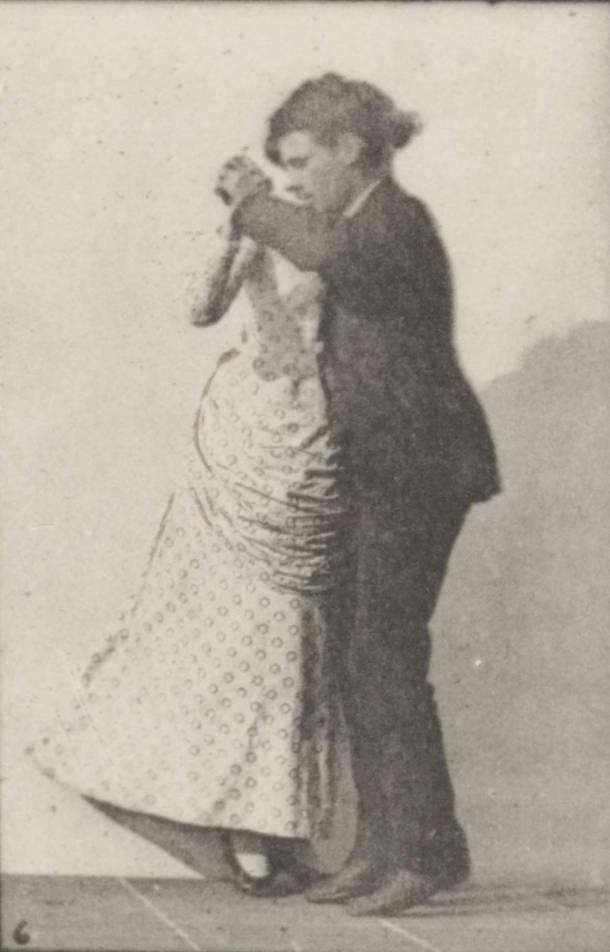
Man and woman dancing a waltz (rbm-QP301M8-1887-197a~6)
Muybridge, Eadweard, 1830-1904
- Source:
- Wikimedia Commons
- Rights:
- Public domain — free to use, share and adapt.
- Recorded as:
- public_domain
This image is one of the earliest systematic photographic studies of ballroom dance, predating motion pictures and offering unique evidence of how the waltz was actually performed in the 1880s—the posture, spacing, and momentum of real dancers rather than artistic convention. For dancers and historians, it provides documentary evidence of period technique and style at a moment when the waltz was reaching the height of its cultural dominance.
What you are looking at
A man and woman are captured mid-waltz in profile against a plain background. The woman wears a light-colored dress with a fitted bodice and skirt gathered at the waist, the fabric catching mid-movement. The man wears a dark suit jacket. They are positioned in a close embrace typical of ballroom dancing, the man's right arm around the woman's back, their bodies angled in the characteristic spiral of the waltz. The photograph is taken from the side, emphasizing the upright posture and the vertical line of their bodies as they turn. The image is grainy and faded, consistent with early photographic processes.
The dancing
The couple occupies a closed ballroom position with the man leading from behind and to the side of his partner. The woman's left arm extends toward the man's shoulder, while his right arm supports her back. Both dancers maintain an upright frame with their heads positioned apart rather than together, following period ballroom convention. Their bodies are positioned at a slight angle to suggest forward motion and the rotational element of the waltz. The woman's skirt shows clear fabric displacement from the turn, indicating captured momentum rather than a static pose.
The dance depicted
This is a waltz, one of the most popular ballroom dances of the nineteenth century, characterized by the closed position, three-step pattern, and continuous turning motion seen here. The waltz had dominated European and American social dance since the early 1800s and remained the standard couple dance throughout the century Muybridge was working. The image captures the essential feature of the waltz—the rotating, spiraling movement of partners turning across the floor in closed embrace.
How it was made
This is a photogravure, a printmaking process that reproduces a photograph through engraving. The catalogue record identifies it as part of Muybridge's *Animal Locomotion* series, published as a portfolio of plates in 1887 by the Photo-Gravure Company in Philadelphia. Photogravure allowed the reproduction of photographic images with rich tonal gradation and fine detail, making it suitable for wide circulation as a bound series. The technique produces a permanent intaglio print, more durable than a photograph and suitable for repeated viewing and study.
About this work
This plate documents one frame of a waltz, captured as part of Eadweard Muybridge's systematic photographic study of human movement. *Animal Locomotion* was an ambitious attempt to break down all forms of human and animal motion into consecutive phases, and the inclusion of social dancing alongside locomotion and athletic movement reflects late-nineteenth-century ambitions to understand movement as a scientific subject. The work combines two distinct modes of observation: the ballroom dance as a performed social art, and the camera as an instrument of motion analysis. For historians of dance, the image is valuable precisely because it treats the waltz as worthy of the same detailed, frame-by-frame scrutiny as walking or running, asserting that social dance is movement deserving systematic study.
How to look at it
Notice the exact moment Muybridge chose to freeze: the dancers are mid-turn, the woman's skirt still displaced by the rotation. The photograph captures not a stationary pose but a moment of continuous motion, which is why the posture appears so dynamic. The side profile is deliberate—it allows the viewer to assess the vertical alignment of the couple's frames and the angle of their bodies relative to each other. Look at how the man's right arm curves to support the woman's back without pulling her off her axis, and how her left arm extends without rigidity. This is ballroom posture under movement, not a portrait.
The artist
Eadweard Muybridge (1830–1904) was a British-born photographer pioneering the study of motion through sequential photography. Beginning with his famous photographs of a galloping horse (1878), he developed methods for capturing consecutive phases of movement using multiple cameras or a single camera with rapid exposures. *Animal Locomotion*, commissioned by the University of Pennsylvania and published in 1887, was his monumental synthesis: 781 plates documenting human figures and animals in motion, including walking, running, jumping, climbing, and various forms of work and recreation. His work bridged photography, biomechanics, and art, influencing both scientific illustration and artistic practice.
The period
The waltz was at the height of its popularity and respectability in the 1880s, having evolved from its earlier, more controversial form into the standard ballroom dance of polite society across Europe and America. The rigid, upright posture visible in this image reflects the aesthetic ideals of Victorian ballroom dancing—decorum, control, and formality within the frame of the closed position. Simultaneously, the late 1880s saw growing scientific interest in human motion, driven by advances in photography; Muybridge's work exemplifies this convergence of artistic documentation and scientific ambition. The publication of *Animal Locomotion* coincided with the early development of motion pictures, and his sequential frames prefigured cinema.
Where it lives
This plate is identified as part of Muybridge's *Animal Locomotion: An Electro-Photographic Investigation of Consecutive Phases of Animal Movements*, published in 1887 by the Photo-Gravure Company in Philadelphia under the auspices of the University of Pennsylvania. The original work exists in portfolio form; this image was accessed via Wikimedia Commons.
Dance in this work
Questions about this work
Is this a photograph or a print?
It is a photogravure, a printmaking process that reproduces a photograph through engraving. Muybridge's original images were photographed, but this version was printed as an intaglio plate for distribution as part of the *Animal Locomotion* portfolio. This allowed multiple copies to be produced and circulated.
How do we know this is a waltz and not another dance?
The closed ballroom position, the upright frame of both dancers, the three-quarter turn visible in their body angle, and the period costume all point to the waltz. The catalogue identifies it as such. The waltz was the dominant couple dance of the era and the primary dance performed in closed position.
Why did Muybridge include social dancing in a study of animal locomotion?
Muybridge's project was broadly defined as an analysis of all human movement, including work, sports, and social interaction. Dancing was treated as a valid form of human motion worthy of the same systematic documentation as walking or running, reflecting late-nineteenth-century scientific interest in understanding all forms of bodily movement.
What can we learn about Victorian ballroom dancing from this image?
The image documents the posture, spacing, and frame typical of 1880s waltz technique: upright spines, closed position with controlled arm placement, and the characteristic rotational movement. The formal dress and the side-profile composition reflect the ballroom convention of presenting the couple as a unified, controlled entity moving through space.
More dance artwork