49 works in this view — arrow keys or swipe to move between them.
Dance in Art
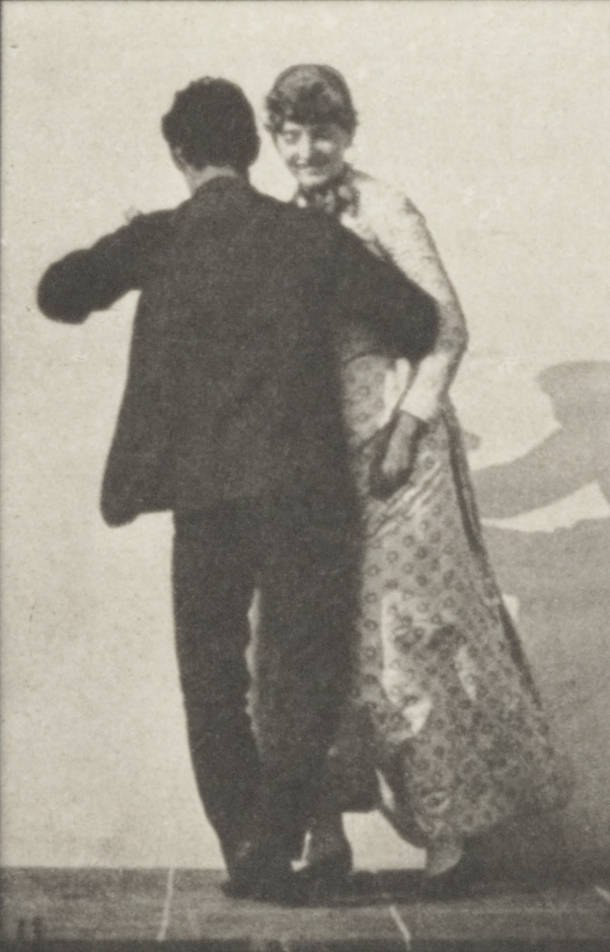
Man and woman dancing a waltz (rbm-QP301M8-1887-197a~13)
Muybridge, Eadweard, 1830-1904
- Source:
- Wikimedia Commons
- Rights:
- Public domain — free to use, share and adapt.
- Recorded as:
- public_domain
Muybridge's waltz plates are among the earliest scientific photographic documentation of social ballroom dance. They provide precise visual evidence of how the waltz was performed and partnered in the 1880s, before modern standardized techniques and competitive rules reshaped the dance. For historians and dancers, they are both a kinetic record and a reminder that photography—understood today as a freeze-frame medium—was originally developed by Muybridge precisely to unlock and reveal motion that the human eye cannot fully perceive.
What you are looking at
A man in dark formal dress and a woman in a light patterned dress are captured mid-waltz against a plain light background. The photograph is one frame from a sequence documenting consecutive phases of movement. The man is seen from behind, his body angled and his right arm extended; the woman faces the camera with a slight smile, her head tilted toward her partner. Her patterned skirt is gathered and lifted by the motion of the dance. The lighting is even and frontal, typical of the photographic studio setup. The poses show the dancers at different moments within the waltz step, revealing the mechanics of the partnered turn and the relationship between the two bodies.
The dancing
The man and woman are in closed ballroom hold, with the man's right hand at the woman's back and her left hand resting on his shoulder. The woman's right hand is held in his left. Both dancers show clear weight distribution appropriate to the waltz—the man's body is angled and mobile, the woman's frame is upright and responsive. Their relative positioning and the woman's lifted skirt suggest they are captured mid-rotation or mid-step, showing the continuous motion of the dance rather than a static pose. The photographs in this sequence are stills from continuous movement, allowing the viewer to mentally animate the dance by moving through the frames.
The dance depicted
This is a waltz, one of the most widely danced ballroom forms of the nineteenth century. The image documents how the waltz was actually performed at the time—the hold, the body angles, and the footwork visible in the sequential frames. The catalogue identifies this as plate 197 from Muybridge's *Animal Locomotion*, a systematic photographic study of human and animal movement. The waltz was social, taught, and performed in ballrooms across Europe and North America; this documentation captures it as a living practice rather than as a stylized representation. The sequential nature of the plates allows reconstruction of the full step cycle.
How it was made
This is a photogravure, a photomechanical process that translates a photographic negative into an inked printing plate, allowing mass reproduction. Muybridge's originals were taken with multiple synchronized cameras mounted on a frame; the published *Animal Locomotion* presents these as intaglio prints on paper. This technique made the images reproducible and distributable in the 1887 publication, reaching an audience far larger than direct access to the negatives or prints would permit. The photogravure process rendered fine tonal gradations and detail, important for anatomical and kinetic study.
About this work
This is one plate from Eadweard Muybridge's monumental *Animal Locomotion* project, a photographic investigation of human movement conducted between 1872 and 1885 under the auspices of the University of Pennsylvania. Muybridge's method—multiple cameras capturing sequential phases of an action—was designed to document locomotion in scientific detail. The waltz plates are unusual within the broader project, which focuses primarily on pedestrian mechanics; they represent a deliberate inclusion of a social, partnered dance. The work sits at the intersection of photography, science, dance documentation, and art, creating a visual archive of how people actually moved when dancing together.
For dance historians and practitioners, *Animal Locomotion* is an invaluable record of nineteenth-century ballroom technique before the codification and standardization of modern competitive ballroom. The sequential frames make visible the weight transfers, timing, and partnering that written descriptions or still images alone cannot convey. This particular plate shows not just a moment but a legible fragment of motion, inviting the viewer to reconstruct the complete waltz action across the sequence.
How to look at it
View this image as one frame within a sequence. The catalogue lists multiple variants of plate 197 (numbered ~1 through ~18), suggesting that there are at least 18 individual photographs documenting consecutive phases of the same waltz action. By moving through these frames in order, the viewer can mentally reconstruct the full rotational pattern of the waltz step and observe the precise timing of weight transfer between partners. Pay attention to the woman's skirt—its position and drape in each frame reveals weight and rotation. Notice also the man's angle of approach and retreat, and how the woman's frame remains stable despite the rotation, showing the principle of partnership in ballroom dance. The frozen moment in this particular plate captures a mid-turn position, with both dancers clearly supporting their own weight while responding to the partnered momentum.
The artist
Eadweard Muybridge (1830–1904) was an English photographer who revolutionized the study of motion through sequential photography. His work began with the famous 1878 study of a galloping horse, which settled a Victorian-era dispute about whether all four hooves left the ground simultaneously. The success of that project led to the far more ambitious *Animal Locomotion*, for which Muybridge worked with the University of Pennsylvania to photograph over 20,000 images of animals and humans in motion. His methodology—using banks of synchronized cameras triggered in rapid succession—was technically innovative and conceptually influential, anticipating cinema and shaping how twentieth-century artists and scientists understood human movement. While best known for animal locomotion, Muybridge's human subjects included ordinary people performing everyday actions and, notably, dancers.
The period
The 1880s were a period of rapid development in both photography and ballroom dance. The waltz, which had scandalized earlier generations, had become the dominant social dance of the respectable middle and upper classes across Europe and North America. Simultaneously, photography was shifting from a specialized craft to an increasingly accessible technology; by the 1880s, sequential and instantaneous photography were being used to investigate motion scientifically. Muybridge's project belongs to this context: a moment when photography could be deployed as an analytical tool, making visible the mechanics of movement that had previously been studied only through written description, notation, or the trained eye of a master teacher. The inclusion of dance within a broader scientific study of animal locomotion also reflects nineteenth-century attitudes toward human movement as a subject of legitimate scientific inquiry.
Where it lives
This image is from the published *Animal Locomotion: An Electro-Photographic Investigation of Consecutive Phases of Animal Movements* (1887), printed by the Photo-Gravure Company in Philadelphia under the auspices of the University of Pennsylvania. The original negative was taken between 1872 and 1885 as part of Muybridge's larger motion study project. The work is held in the USC Digital Library and is accessible through Wikimedia Commons.
Dance in this work
Questions about this work
Is this actually a photograph?
Yes, but in a technical sense: the image is a photogravure, a printing process based on a photographic negative. Muybridge's negatives were taken with cameras; the published plates were then etched and printed as intaglio prints. The final image you see is a print made from a photomechanical plate, not a photographic print, but the image originates from direct photography.
Why did Muybridge photograph dancers?
Dance was a form of human locomotion, and Muybridge's project aimed to document all forms of human movement. Dance also represented complex, partnered motion that revealed principles of weight distribution, timing, and balance. Including dancers in *Animal Locomotion* extended the study beyond simple walking and jumping to skilled, learned movement performed by trained individuals.
How does this compare to modern waltz technique?
The hold, frame, and relative positioning visible here are recognizable to modern ballroom dancers, but there are differences. Nineteenth-century waltz was less standardized than the modern International Standard Waltz taught today. The sequencing and step size appear looser, and the technique was more variable depending on regional tradition and individual teacher. Muybridge's plates document practice before competitive standardization.
How many photos are in this sequence?
The catalogue record indicates at least 18 variants of plate 197 exist (~1 through ~18), suggesting that at least 18 individual photographs captured consecutive phases of the same waltz action. Viewing them in sequence creates a continuous animated sequence that reveals the full rotational pattern.
More dance artwork