49 works in this view — arrow keys or swipe to move between them.
Dance in Art
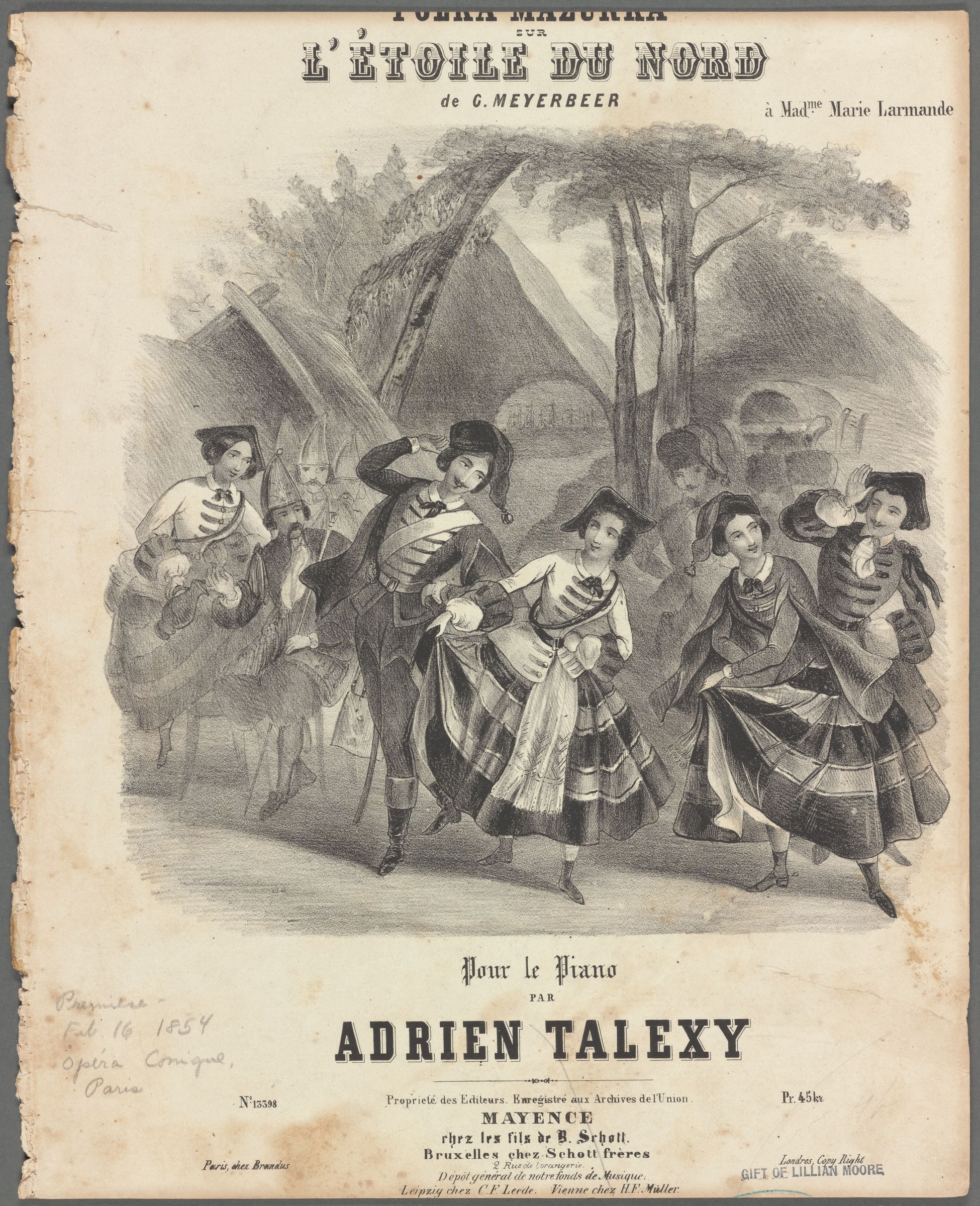
Polka-mazurka sur L'étoile du nord de G. Meyerbeer
Adrien Talexy
- Source:
- Wikimedia Commons
- Rights:
- Public domain — free to use, share and adapt.
- Recorded as:
- cc0
For dance historians, this image is concrete evidence of how the polka-mazurka was actually performed—the body positions, the energy, the social context, and the costume—in a moment before photography made such documentation routine. For historians of popular culture, it shows how sheet music covers functioned as mass media for disseminating dance and music to a broad, non-elite audience; the military subject matter and the dedication to a named woman performer indicate networks of professional and amateur dancers that shaped European social life. The survival of such covers in archives like Wikimedia Commons makes them accessible records of a vanished ballroom world.
What you are looking at
This is a sheet music cover illustration for a polka-mazurka based on Meyerbeer's *L'Étoile du Nord* (The North Star), dedicated to Mme Marie Larmande. The scene depicts a military camp or bivouac in a Nordic setting, with a large canvas tent at left and evergreen trees rising behind. Six figures in military dress—likely soldiers or officers of the Imperial Russian army, judging by the striped tunics and tall hats—are arranged in two distinct groups across the composition. In the foreground, four figures dance or move in lively poses: two couples in a playful, energetic configuration, their bodies angled toward each other in a social dance gesture. Their skirts and coat tails catch the movement mid-turn. Behind them, two additional figures watch or wait, one adjusting his hat. The entire scene is rendered in the light, detailed style of mid-nineteenth-century fashion illustration, with careful attention to military uniform detail and the fabric of the dancers' clothing. The mood is festive and informal—a moment of recreation within military life.
The dancing
The dancers adopt the characteristic closed or near-closed positions of ballroom dance of the 1850s, with bent knees and forward-leaning posture that suggests the quick, bouncing character of the polka. The two principal dancers in the center occupy the frame with active, turning movements; their arms are raised and bent, and the woman's voluminous skirt swings outward, indicating rapid rotation. The body weight appears distributed for momentum rather than stasis, and the footwork—though not explicitly detailed—is implied to be quick and small-stepped. The standing figures maintain upright military bearing, their postures a contrast to the dancers' abandon.
The dance depicted
This is a polka-mazurka, a nineteenth-century social dance that hybridized the bouncing, energetic polka (in 2/4 time) with elements of the mazurka's characteristic accents and nationalist Polish character. The polka emerged in Bohemia around 1830 and spread rapidly through Europe; by the 1850s it was the dominant social dance in ballrooms and, as here, in military and civilian recreations alike. The mazurka fusion represented a fashionable elaboration suited to concert and domestic performance. The military setting—a common subject in popular prints of the era—suggests this was danced in off-duty moments by soldiers, or that the music and dance had military associations. The illustration confirms the dance was performed in closed or semi-closed partnerships with active turning, rapid footwork, and uninhibited joy.
How it was made
This is a lithographed sheet music cover, a reproductive medium that allowed rapid, economical distribution of popular music to domestic performers and military bands. Lithography's capacity for tonal gradation and fine line is evident in the careful cross-hatching that models the figures' forms and the landscape recession. The technique allowed the artist to achieve the naturalistic but stylized representation typical of commercial music covers of the 1850s—readable at a glance, flattering to the performers imagined, and suitable for both retail sale and gifting. The presence of printing marks and publisher information (Mayence, B. Schott; Paris, rue Bergère) confirms this as a commercial product with transatlantic distribution.
About this work
This is a mid-nineteenth-century lithographed sheet music cover illustrating a fashionable social dance—the polka-mazurka—in a military setting. It documents both the appearance and the cultural context of a ballroom dance at the height of its popularity: performed not only in formal settings but in camps and informal gatherings, by military personnel, and celebrated in popular prints and music for domestic consumption. The work is a window into how dance was choreographed, dressed, and circulated in the 1850s, and into the relationship between musical fashion and social practice. It belongs in a gallery of dance in art because it is simultaneously a primary source for dance history and a period artifact showing how dance was visualized and commodified.
How to look at it
Observe the moment the artist has chosen: the dancers are caught not in a static pose but in the midst of rapid turning and forward motion. The bent knees, raised arms, and swinging skirts all indicate tempo and energy. Note how the military uniforms—the striped tunics, tall hats, and formal bearing of the onlookers—establish the dance as a moment of pleasure within military discipline, a theme popular in both literature and visual culture of the period. The composition's division between active dancers and watching soldiers suggests the social function of the dance: performance and display for the pleasure of the group. Finally, notice the care taken with fashion detail—the cut of the jacket, the fullness of the skirt, the style of the military coat—which dates the image precisely to the mid-1850s and tells us that dance was inseparable from fashionable dress.
The artist
Adrien Talexy was a French music publisher and illustrator active in the mid-nineteenth century. His lithographs for sheet music covers represent the commercial illustration practices of Second Empire Paris, where music publishing was a major industry and covers were vehicles for fashionable imagery. Talexy worked in a naturalistic but decorative idiom suited to domestic settings and the tastes of middle-class music consumers. His signature on this cover places him among the many skilled draftspeople whose names are now largely forgotten but whose work documented the visual culture of music and dance.
The period
The polka was the dominant social dance of the 1850s across Europe and North America, arriving at a moment of industrial expansion, increased urbanization, and growing middle-class leisure culture. The polka-mazurka represented a specifically Romantic-era hybrid, combining the Bohemian polka's democratic, high-spirited character with the mazurka's fashionable Slavic nationalism—a marker of cultural taste in an era fascinated by folk and exotic forms. Simultaneously, military life and military style were highly visible and aestheticized in popular imagery, particularly during the Crimean War (1853–56) and the lead-up to the Franco-Prussian War. Meyerbeer's *L'Étoile du Nord*, first performed in 1854, was a grand opera set in Russia and was itself a commercial success; arranging its themes for piano and for social dances was standard practice. Sheet music covers like this one were the primary visual and commercial medium through which new dances and music reached provincial and domestic audiences.
Where it lives
This work is held on Wikimedia Commons as a reproduction of a published sheet music cover. The original was published by Mayence and B. Schott in Mayence (Mainz), with a Paris edition distributed by the publisher at rue Bergère. Such covers were produced in quantity and distributed commercially, making them accessible to modern researchers through digital archives.
Dance in this work
Questions about this work
What is a polka-mazurka?
A polka-mazurka is a nineteenth-century social dance that combined the polka (a bouncing, quick-stepping dance in 2/4 time, originating in Bohemia around 1830) with elements of the mazurka (a Polish folk dance with characteristic accent patterns and nationalist connotations). The fusion created a fashionable hybrid performed in ballrooms and often arranged for concert or domestic piano performance. It represents the Romantic era's taste for folk and ethnic forms repackaged for elite audiences.
Who was Mme Marie Larmande?
Mme Marie Larmande is identified only as the dedicatee of this arrangement. Dedications on sheet music often honored patrons, notable amateur performers, or professional dancers and musicians who had performed the piece; she may have been any of these, but the archive does not preserve further information about her identity or her relationship to the work.
Why are the dancers in military dress?
Military settings were popular subjects in nineteenth-century popular imagery, reflecting both the visibility of military life in society and the Romantic fascination with military costume and discipline. Soldiers' off-duty recreation was a common theme in prints and illustrations, and the idea of soldiers dancing at ease was commercially and culturally appealing. The specific setting here may also reflect the opera *L'Étoile du Nord*, which is set in Russia and features soldiers.
How do I know this depicts a polka-mazurka and not another dance?
The title on the cover explicitly identifies it as a 'polka-mazurka sur L'étoile du nord.' The visual evidence—the bent knees, forward-leaning posture, rapid turning, and the energetic positioning of the couples—is consistent with the known character of the polka, which required quick footwork and bouncing action. Without the title, the dance would be harder to identify with certainty, but the combination of text and image confirms the attribution.
More dance artwork