Mazurka
Also known as: Mazourka, Polish Mazurka
- Origin
- Poland
- Era
- 1800–1860
- Rhythm
- 3/4 time
- Tempo
- 159-180 BPM
- Character
- Syncopated, energetic, accent, spirited
History & Cultural Context
The Mazurka descends from a family of Polish folk dances in triple meter — the mazur, oberek, and kujawiak — that originated in the plains of Mazovia and appear in Polish lute and organ tablatures as early as the 16th century. After spreading through Polish society in the 17th century, the dance entered Western European ballrooms in the early 19th century, reaching peak fashion in the salons of Paris and London during the 1830s and 1840s, where it also served as a gesture of solidarity with partitioned Poland. Its music carries strong, irregularly placed accents on the second or third beat of the bar. Fryderyk Chopin is credited with bringing the mazurka into art music through his mazurkas for solo piano. The dance remains central to Polish culture: the national anthem, Mazurek Dąbrowskiego (1797), is itself a mazurka.
Regional Variations
"origin_year_start": 1550, "origin_year_end": 1860
Signature Figures
- Accent
- Syncopated Step
Notable Codifiers
- Henri Cellarius
- Allen Dodworth
- Friedrich Albert Zorn
Mazurka Playlists
Curated collections on the LODance YouTube channel — performances to watch, lessons to learn from, and the right music to practice with. Tap a collection to play.
▶ Performances · Open on YouTube →
Mazurka Music & Tempo
Drawn from 25 Mazurka tracks in the LODance music library.
Example tracks at practice tempo
- Mazurka in D Major, Op. 33 No. 2 — Frédéric Chopin108 BPM
- Mazurka in A Minor, Op. 17 No. 4 — Frédéric Chopin92 BPM
- Mazurka from A Life for the Tsar — Mikhail Glinka112 BPM
- Mazurka in B-flat Major, Op. 7 No. 1 — Frédéric Chopin100 BPM
- On the Beautiful Blue Danube (Mazurka adaptation) — Johann Strauss II120 BPM
- Mazurka in G Minor Op. 67 No. 2 — Frédéric Chopin116 BPM
Who governs Mazurka
Federations, councils and examining bodies with a recorded role in this style. No single organisation can tell you this — each one knows only itself.
Mazurka in performance
15 staged works in the Limelight catalogue contain Mazurka, 1846–1976 — 14 of them in a named act or number.
- Paquita1846Ballet · Joseph Mazilier, Marius PetipaAct II · Mazurka des enfants
the Mazurka des enfants added to the final act in the 1881 revival — A national-character mazurka danced by children, forming part of the divertissement Petipa added to close the ballet. Source: "This included the Paquita pas de trois for the first act and…
- Le papillon1860Ballet · Marie TaglioniAct I · Scene 1
Act I, first tableau, at Hamza's castle during the hunting-rest scene — A partnered couple dance performed between Prince Djalma and Farfalla within the mimed narrative, immediately followed by a kiss of thanks and Hamza's jealous reaction that triggers the…
- L'Île Enchantée1864BalletMazurka
No. 6, Mazurka — A named mazurka number followed by its own solo Variation, used as a national/character dance interlude in the divertissement structure. Source: "No. 5 Pas de deux No. 6 Mazurka No. 6a Variation"
- Coppélia1870Ballet · Arthur Saint-Léon, George BalanchineAct I
Act I, the village-festival mazurka — a mazurka number for the festival scene, part of the original Delibes score and reworked with new steps by Balanchine in the 1974 production while keeping the mazurka form Source: "Balanchine created new choreography fo…
- Swan Lake1877Ballet · Julius Reisinger, Lev Ivanov, Marius PetipaAct III · Mazurka
Act III, No. 23 — Mazurka, in the ballroom divertissement sequence — A character mazurka danced by the ball guests, set to a marked 'Tempo di mazurka', interpolated among the national divertissements presented to Siegfried. Source: "No. 23 Mazurka: Tempo di…
- Die Puppenfee1888Ballet · Joseph HaßreiterAct I · Scene 1 · Divertissement of national dolls (Ländler, Polka, Spanish Dance, Mazurka, Tarantella, Fairy Doll's waltz)
Scene 1, the sequence of national character-doll dances — a doll in Japanese costume performs a mazurka among the toy shop's national character dances Source: "Japanese Mazurka and the Harlequin"
- Swan Lake1895Ballet · Lev Ivanov, Marius PetipaAct II · Grand Pas d'action (Black Swan Pas de Deux)
Act III (Act II), the Grand Divertissement — A staged Mazurka performed by an ensemble with a lead soloist, singled out at the premiere as a sensation and encored. Source: "Perhaps the biggest sensation was the Mazurka, danced by a group of dancers with Fel…
- Raymonda1898Ballet · Marius PetipaAct III · Le festival des noces
Act III, interpolated Mazurka in the Hungarian wedding divertissement — A stylised Mazurka number inserted into the Hungarian-themed wedding festivities, alongside the Palotás and Grand cortège hongrois. Source: "interpolation: Mazurka (Insertion from Glazu…
- Aschenbrödel1901BalletAct II
Act II, mazurka for the stepsisters — A named mazurka performed by the comic stepsister roles, using the mazurka's hop-step rhythmic pattern as character dance within the ball divertissement. Source: "a mazurka for the stepsisters"
- Ballet · Léonide MassineAct one act · Playing-card mazurka
The playing-card doll number — A discrete character number for dolls costumed as playing cards, danced as a mazurka, one of the string of national/character dances performed for the shop's customers. Source: "followed by other dolls dressed as playing cards…
- Checkmate1937Ballet · Ninette de ValoisThe Red Knight's Mazurka
The Red Knight's Mazurka, a named solo number for the Red Knight — A discrete dance number is explicitly titled as a mazurka, indicating the Red Knight's solo is set to mazurka rhythm and character within the larger classical framework, rather than pure aca…
- Gaîté parisienne1938Ballet · Léonide MassineAct I
The cocodettes' and billiards-players' entrance — The group of six cocodettes and three billiards-player escorts is described dancing this specific stylised period couple/group form as an entrance number. Source: "The group dances about the room in a rousin…
- Graduation Ball1940Ballet · David LichineMazurka Flirtation
Mazurka Flirtation — A named mazurka danced by the Headmistress and Old General as a courtship duet, staged as in-story period ballroom dance. Source: "the Headmistress and the Old General dance a "Mazurka Flirtation," revealing their attraction"
- Ballet · Frederick AshtonMazurka, Op. 25 No. 3 (orchestrated by Robert Irving)
the Mazurka number danced by the men — A bravura, virtuosic mazurka performed collectively by the male dancers as a self-contained demonstration number, set apart from the women's variations and the principal pas de deux. Source: "The men dance a bravura ma…
- Other Dances1976Ballet
Throughout, threaded through the classical pas-de-deux structure — Mazurka-derived stamping steps and a distinctive arm carriage drawn from Slavic character dancing are folded into the otherwise academic ballet vocabulary. Source: "He also noted the use of…
Every claim above is quoted from a cited source and names where in the work the style appears. Claims we could not place or could not quote are held back from this list and shown on the work’s own page instead. Browse the full performance catalogue →
What to Wear
Attire guidance for Mazurka and other Historic Gilded Age Ballroom dances. Each card below is sized to the moment — class, practice, social, or competition — because the wardrobe shifts as the stakes do.
Reading the cards
In Class
Regular practice wear with smooth-soled shoes.
Social Dancing
Victorian/Edwardian ball events: women in corseted gowns with trains, men in white tie or period suits. Some events are less strict and welcome Edwardian-inspired modern formalwear.
Competition
Not competed; performed at Victorian balls and historical society events in period costume.
Shoes
Women: pointed-toe shoes with French heels (2"). Men: patent leather shoes or period boots. The era bridged between flat dancing and the heeled Latin shoes of the 20th century.
In Practice
Many Gilded Age groups practice corset-management — modern dancers underestimate how much the corset changes posture and breath.
Price Range
- Budget: Repurposed modern formalwear with period-adjacent silhouette; entry French-heel shoes $80–140.
- Mid: Reproduction Gilded Age gowns and white-tie pieces $400–1,500.
- Premium: Hand-tailored Edwardian costume $2,000–8,000+.
Quick Tips
- •Suede-soled shoes allow controlled sliding and pivoting — essential for most partner dances.
- •Avoid rubber soles on dance floors; they grip too much and can cause knee injuries.
- •Bring a separate pair of clean shoes for the dance floor to keep it in good condition.
Recommended Gear for Mazurka
Essential equipment and apparel selected for dancers learning Mazurka.


As an Amazon Associate, LODance earns from qualifying purchases. Affiliate disclosure
Sources & Further Reading
Where This Dance Is Documented
Zorn (1887); Polish national dance sources
An editor's note on where the technique for this dance is actually written down — sometimes a named book, sometimes the fact that no such book exists. A judgement, not a count of what we hold.
Cultural & Historical Context
Mazurka emerged from Poland during the 1800s—1860s. Understanding the cultural roots, musical traditions, and social circumstances of this era enriches appreciation for the dance's characteristics and significance.
Formative Influences
Codifiers & Standardizers:
Henri Cellarius, Allen Dodworth, Friedrich Albert Zorn
Signature Movement Vocabulary:
Accent, Syncopated Step
Primary Source Documents
The Library of Dance contains public-domain primary sources for dance history. Copyrighted modern syllabi are indexed with purchase links to their respective copyright owners. Search by dance name or codifier to discover primary source documents.
Last reviewed: October 2026 — This dance profile synthesizes historical research, cultural documentation, and contemporary practice knowledge to provide authoritative context.
Related Dances
More in Historic Gilded Age Ballroom
Polka
The Polka was a lively, bouncy couple dance from Bohemia that became enormously popular across Europe and America during the 19th century, featuring characteristic hop and turn.
Schottische
The Schottische was a moderate-tempo couple dance with a distinctive step-hop pattern, becoming popular in Victorian ballrooms and remaining part of folk traditions.
Galop
The Galop was a rapid, energetic couple dance with a distinctive galloping action, becoming a popular finish to Victorian ballroom evenings.
Victorian Waltz
Victorian waltz variations including the Redowa combined elements of waltz and polka with elaborate choreography, representing Gilded Age innovation in ballroom dancing.
Laendler
The Laendler was an Austrian peasant couple dance with turning action that influenced the development of the modern waltz and remains part of Alpine folk traditions.
Breakdown
A fast solo percussive dance created by enslaved African Americans, danced to fiddle and banjo tunes in quick duple time and often performed as a challenge between dancers. It carries one of the core movement vocabularies from which buck dancing, flatfooting and American tap descend. Its commercial spread in the 1840s and after ran through blackface minstrelsy, which took the material from Black dancers and sold it as caricature.
Clog
A percussive step dance performed in wooden-soled clogs, developed among mill and mine workers in northern England and built largely on hornpipe rhythms. It moved onto the music-hall stage as a championship solo turn in the nineteenth century and crossed to North America, where it fed both Appalachian step traditions and the variety stage. With African American percussive dance it is one of the two roots of American tap.
Hornpipe
A solo percussive dance in duple time, closely tied to a tune type of the same name and strongly associated with sailors through its long life on the theatrical stage. It is one of the three principal hard-shoe dances in Irish step dancing and the rhythmic basis of English clog. Its dotted, swung rhythm gives it a distinctly heavier and more deliberate feel than a reel.
Jig
A lively step dance in compound time, the central solo form of Irish dancing and a staple of Scottish and English fiddle repertoire. It exists in several distinct meters and shoe types, from the light 6/8 double jig to the slow, heavily percussive treble jig in hard shoes. The word has also served, in England and America, as a loose and sometimes derogatory label for percussive dance generally.
Reel
A fast dance in even duple time built on an alternation between an interweaving travelling figure and setting steps danced on the spot. It is one of the oldest continuously danced forms in the British Isles and the structural ancestor of a great deal of Scottish, Irish and North American social dance. The name refers at once to a tune type, a floor figure and a whole family of dances.
Strathspey
A Scottish dance and tune type in 4/4 distinguished by the Scotch snap, a short note on the beat followed by a longer dotted one, which gives it a jagged rhythm and a stately, sustained movement quality. It takes its name from the strath, or broad valley, of the River Spey. In both Highland and country dance it is conventionally paired with a reel, the slower dance setting up the faster one.
Country Dance
A figured set dance for groups of couples, worked through a repeating sequence of figures with the couples progressing to a new neighbour each time through the tune. It was the dominant social dance form in England for well over a century, and it is the root stock from which the French contredanse, the Cuban contradanza, the quadrille and the American contra dance all grew.
Habanera
A slow duple-time couple dance from Cuba, and the rhythmic cell that carries its name — a dotted first beat pulling against an even bass. It was made by Black and mixed-race Cuban musicians and dancers out of the imported contradanza, and it travelled back across the Atlantic into Spanish salons and stage music while also feeding Argentine tango and Brazilian maxixe.
Maxixe
A fast, syncopated close-hold couple dance from working-class Rio de Janeiro, built by Afro-Brazilian musicians and dancers who put the syncopation and body movement of lundu into the step patterns of the polka and the Cuban habanera. It was the first urban popular dance Brazil made for itself, and its rhythmic language runs directly into samba.
One Step
One step to each beat of a brisk two-four, with nothing else that has to be memorised. That simplicity made it the entry point for the social dance boom of the 1910s, and it is the direct ancestor of the American Peabody as well as one of the strands feeding the foxtrot and the quickstep.
Redowa
A turning couple dance in three-four from the Czech lands, taken up in Paris ballrooms in the mid-1840s on the back of the polka craze. Its step leaps rather than glides, which gives it a springing, pursuing quality quite unlike the smooth continuous swing of the waltz.
Varsovienne
A slow triple-time couple dance in the mazurka family that appeared in Parisian ballrooms in the early 1850s and took its name from Warsaw. It is recognisable by the pause: the couple glides, then holds a pointed foot on an accented beat, so the dance alternates between travel and arrest.
Viennese Waltz
The rotary couple dance of nineteenth-century ballrooms: continuous turning in a closed hold at speed, danced socially and improvised rather than assembled from a syllabus. It emerged from alpine Ländler and Deutscher turning dances in the 1780s and defined social dancing through the Strauss era, and the modern competition dance of the same name is a twentieth-century codification of it rather than the same thing.
What did dancers wear?
Mazurka belongs to the Regency & Victorian (1800s) era. See how attire shaped the choreography — and the other way around.
Explore Regency & Victorian attire →Mazurka in art
Browse the gallery →Works our catalog identifies as depicting mazurka.
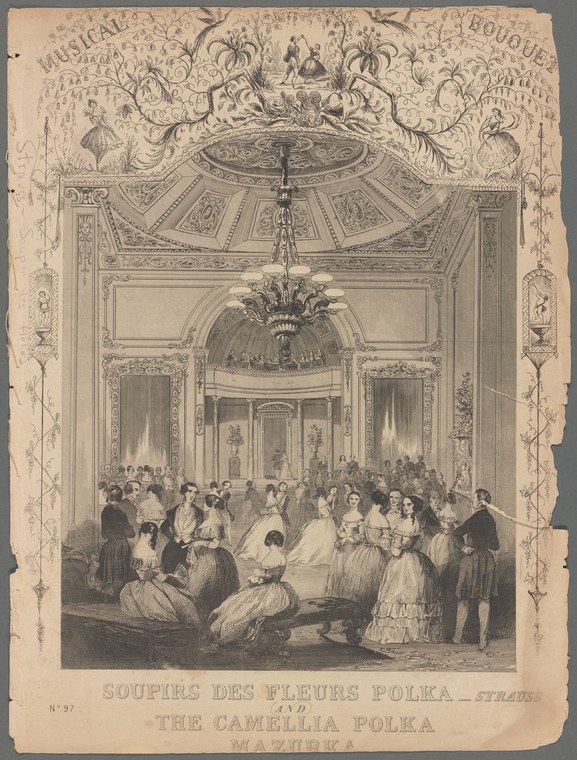
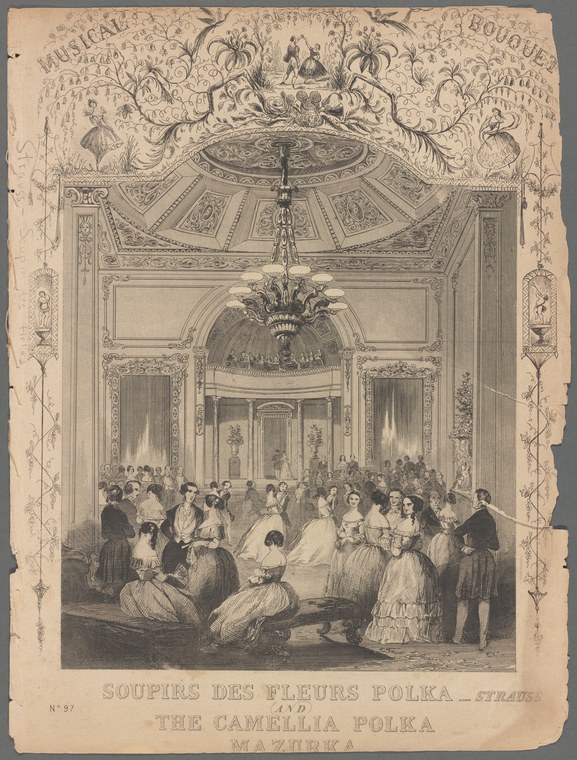
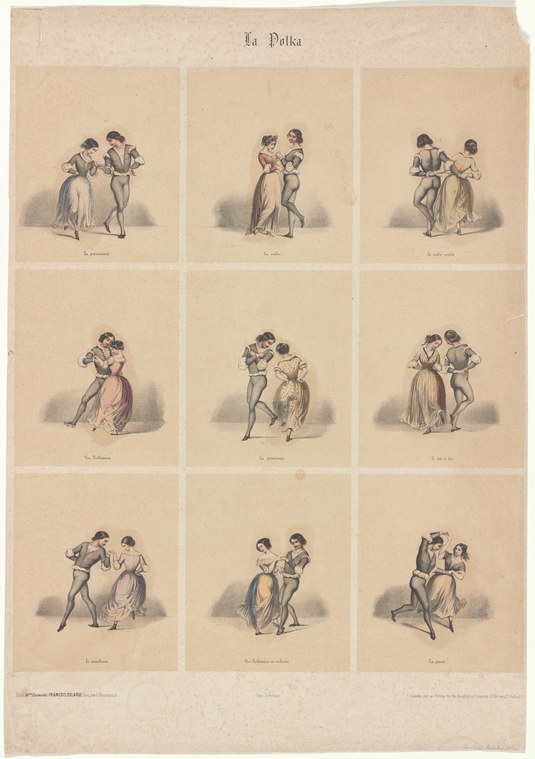
Polka and mazurka
Unknown artist · 2019
public_domain
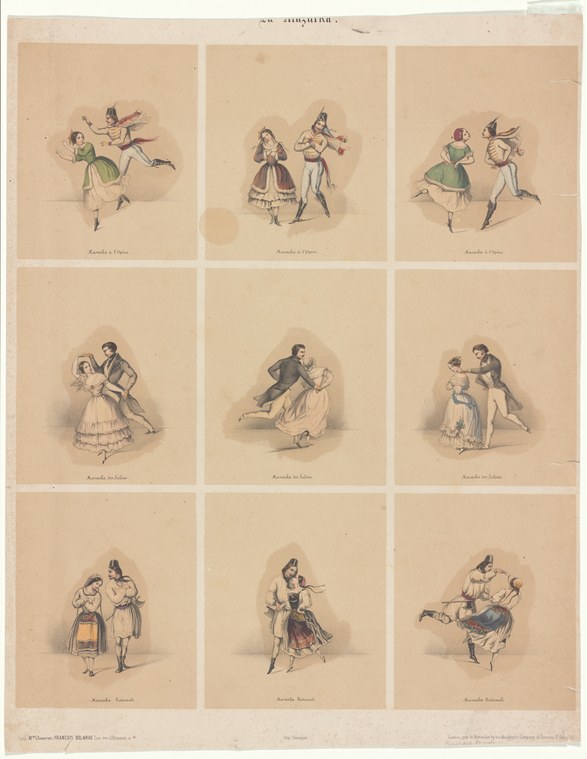
Polka and mazurka
Unknown artist · 2019
public_domain
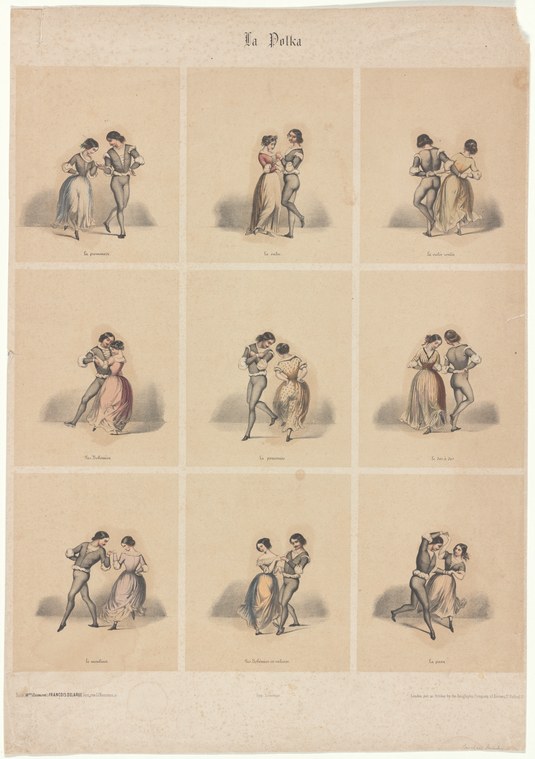
Polka and mazurka
Unknown artist
public_domain
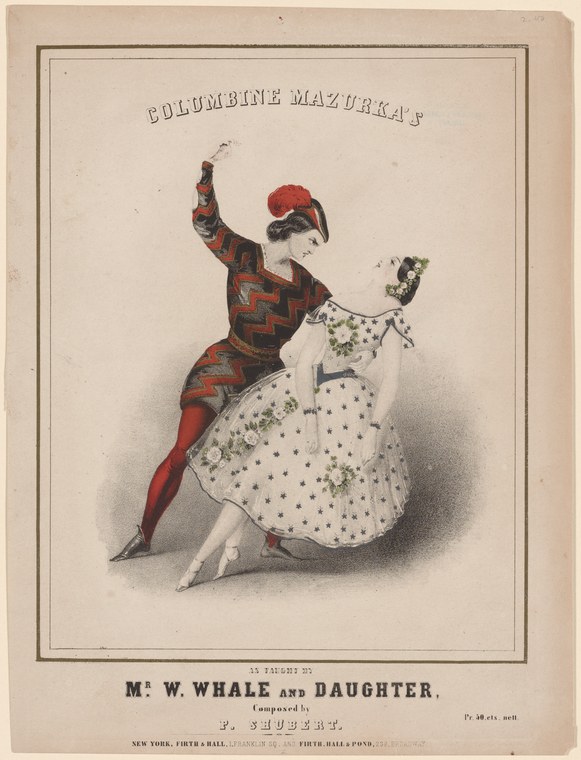
Columbine mazurkas
Unknown artist
Public Domain
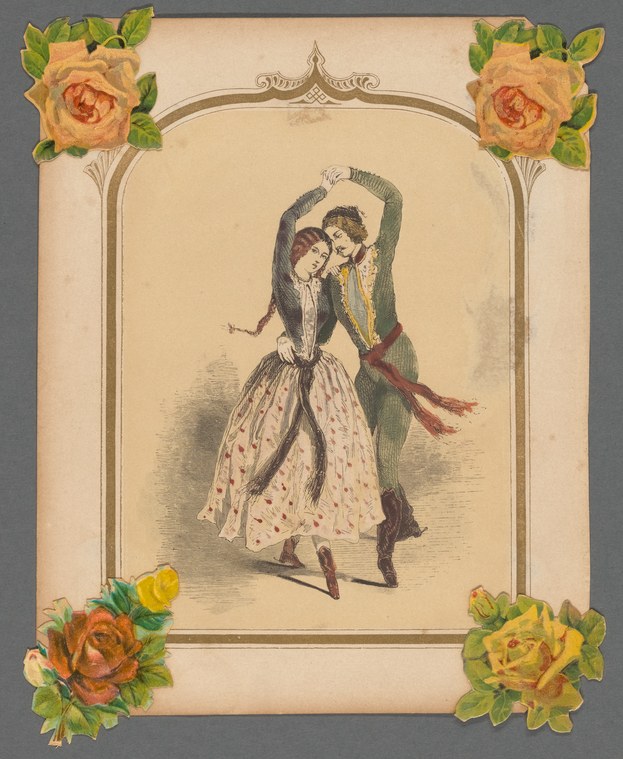
La valse mazurka, dite la Cellarius
Unknown artist
Public Domain
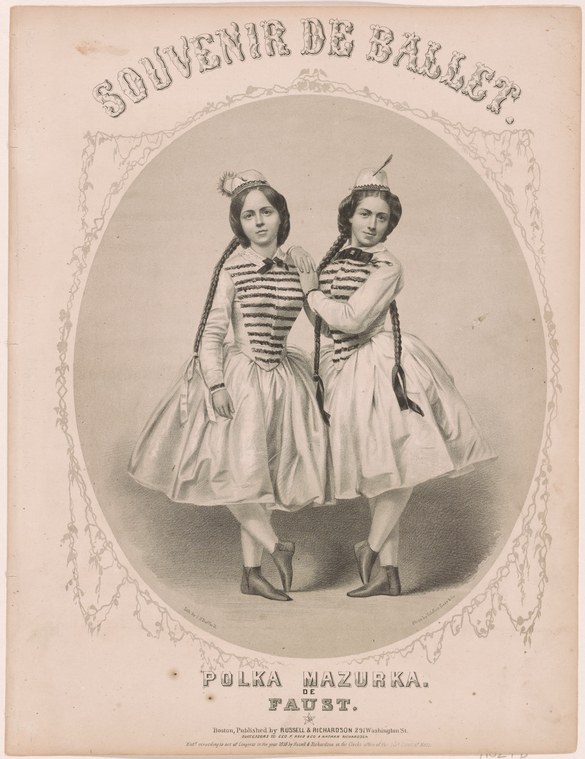
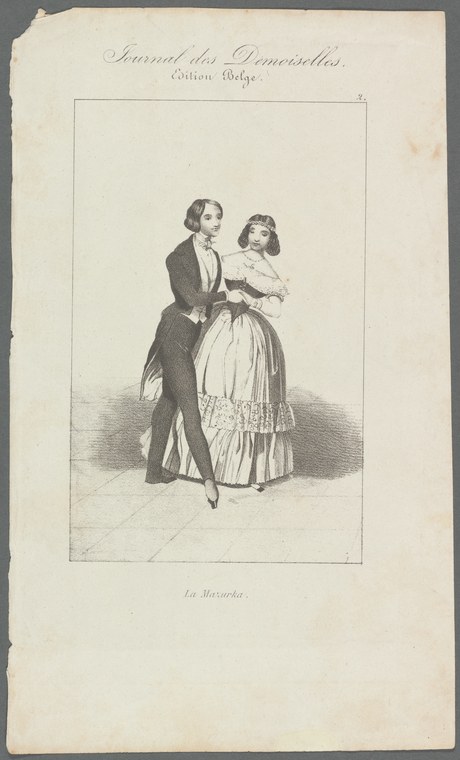
La mazurka
Unknown artist
Public Domain
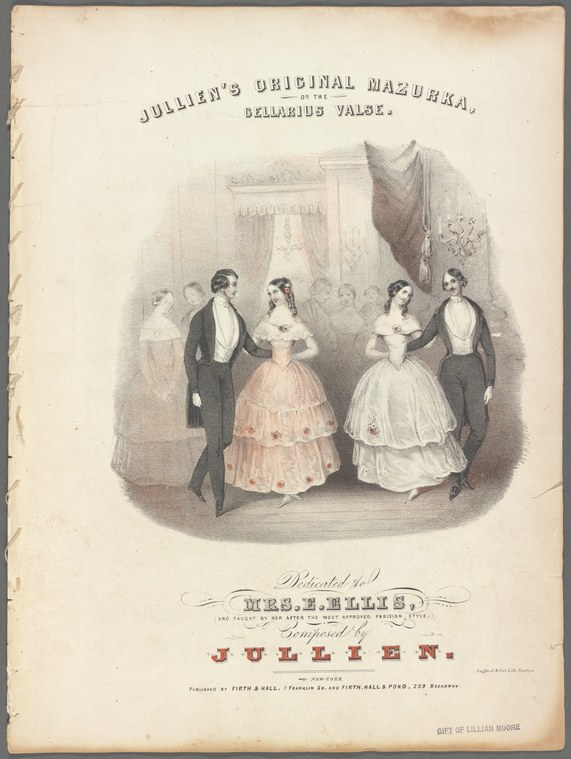
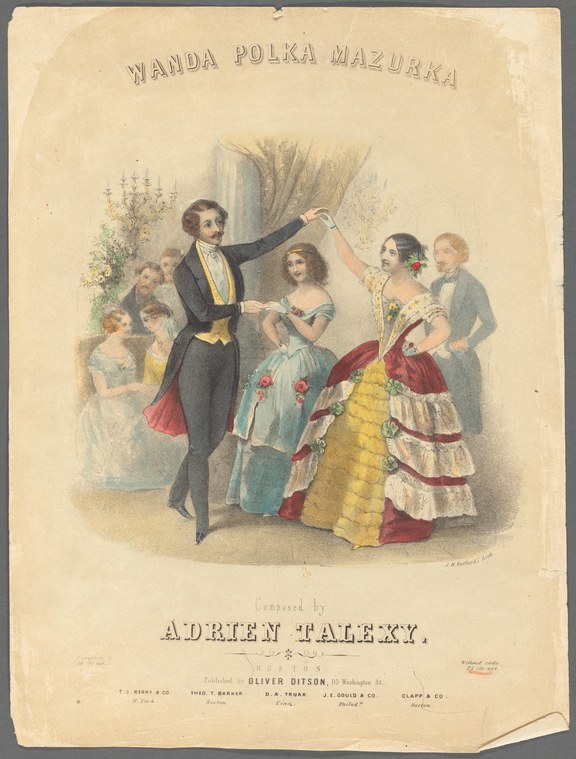
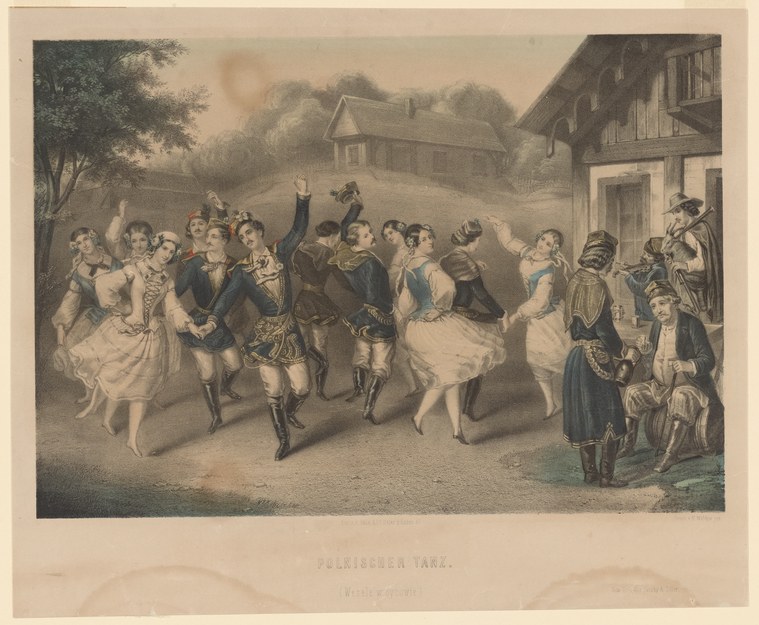
Polnischer Tanz: (Wesele w oycowie)
Unknown artist
Public Domain
Continue Exploring
Lineage of Dance
500 years of dance evolution
Champions of Dance
Winners of marquee national & world titles
Language of Dance
161 dance terms & translations
Listening of Dance
Tempo, timing & musicality tools
Gallery of Dance
5,700+ artworks from museum collections
Attire of Dance
Evolution of dance dress across eras
Keep the thread going
Dance history, technique, and the occasional rabbit hole — in your inbox. Thoughtful, infrequent, unsubscribe anytime.
Free. No spam. One click to leave.