49 works in this view — arrow keys or swipe to move between them.
Dance in Art
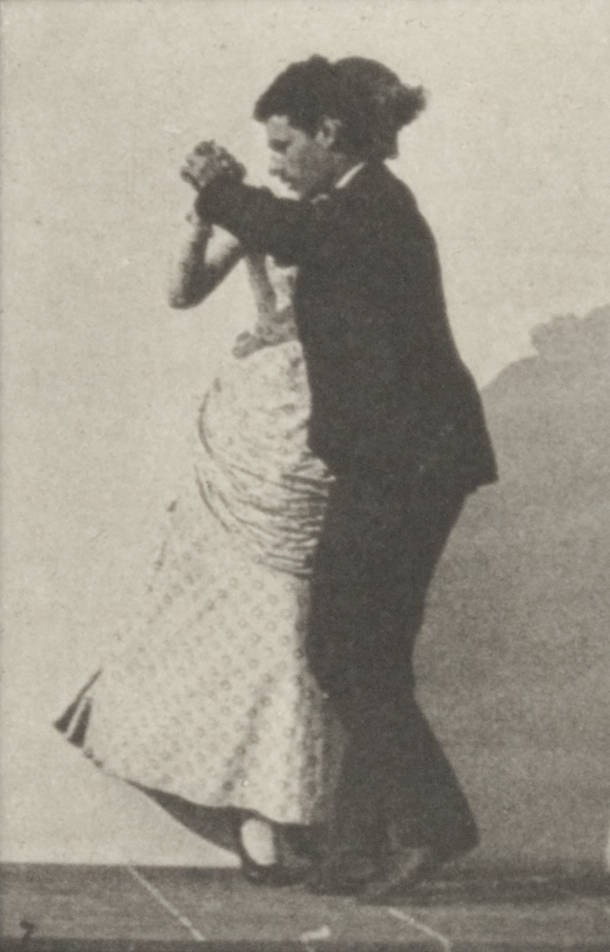
Man and woman dancing a waltz (rbm-QP301M8-1887-197a~7)
Muybridge, Eadweard, 1830-1904
- Source:
- Wikimedia Commons
- Rights:
- Public domain — free to use, share and adapt.
- Recorded as:
- public_domain
This is among the earliest photographic documentation of ballroom dance technique, capturing the waltz in a form that made movement visible and reproducible to a wide audience. Muybridge's sequential photography established a template for movement analysis that would shape dance pedagogy, physical education, and eventually cinema and performance. For historians of social dance, this image is an irreplaceable record of 1880s ballroom posture and styling.
What you are looking at
A single photograph showing a man and woman in a formal waltz position. The man, in dark formal dress with jacket and light trousers, stands behind and to the side of the woman, his right arm raised to frame her shoulder, his left arm extended. The woman wears a light-colored dress with visible pleating or gathering at the waist and skirt, her posture upright and formal. The photograph is taken against a plain backdrop and lit evenly, casting soft shadows. The image appears to be one frame from a sequence of consecutive poses, as suggested by the plate numbering and the Muybridge archive. Both figures maintain the rigid, composed bearing typical of late-19th-century ballroom dance instruction and documentation.
The dancing
The couple occupies a closed ballroom position characteristic of the waltz: the man's right arm is raised to shoulder height with hand positioned to frame the woman's back, while his left arm extends downward and outward. The woman's left arm appears to rest on or against the man's right arm. Both dancers stand at a formal distance and angle typical of period waltz technique. The woman's weight appears centered and upright, with her skirt displaying the structured silhouette of 1880s fashion. Neither figure shows dynamic weight shift or the loose naturalism of social dancing; the pose is static and demonstrative.
The dance depicted
This is documentary evidence of the waltz as performed and taught in the 1880s. Muybridge's 'Animal Locomotion' series applied sequential photography to human movement, including social dancing, to decompose motion into its constituent phases. The waltz was the dominant couple dance of the era and a standard subject for movement analysis. The image captures the formal ballroom hold and posture rather than a moment of active turning or traveling—it functions as a teaching image showing the correct frame and positioning rather than a snapshot of motion. The archival context and the series format suggest this was created for instruction or scientific documentation rather than as fine art.
How it was made
This is a photogravure (as stated in the source citation), a photomechanical process that translated a photographic original into an intaglio printing plate, allowing mass reproduction. The plate was photographed directly, printed from a metal matrix, and bound into the multi-volume 'Animal Locomotion' publication (1887). The photogravure process permitted fine tonal gradation and detail while fixing the image as a permanent printed artifact, making it reproducible and distributable to institutions, studios, and scholars. This was a sophisticated technology for the 1880s, and its use by Muybridge for dance documentation indicates the scientific seriousness with which movement study was pursued.
About this work
This is one plate from Eadweard Muybridge's groundbreaking 'Animal Locomotion' archive, a systematic photographic study of human and animal movement published 1872–1885. Plate 197 documents the waltz hold and frame as performed in the 1880s, captured in a static pose that served both as scientific record and as teaching material. The work belongs to the earliest phase of photography applied to dance study, predating cinema and representing a pivotal moment when visual technology enabled the detailed preservation and analysis of movement that had previously existed only in written description or dancers' memory.
Muybridge's waltz documentation is historically significant because it fixes the ballroom conventions of the Gilded Age with optical precision. The formal posture, the distance between partners, the arm frame, and the tailored silhouettes of the era's clothing are all preserved in archival form. For dancers and historians, this image serves as primary evidence of how the waltz was actually held and positioned in this period—not reconstructed from dance manuals but captured from living bodies.
How to look at it
Attend to the formal geometry of the hold: the angle of the man's right arm, the distance and alignment of the two bodies, the symmetry and uprightness of posture. This is not a candid moment but a posed demonstration—the dancers have arranged themselves for the camera in the manner of a teaching photograph. The stillness itself is informative; it shows the static frame from which the waltz's rotating travel would unfold. Notice the clothing: the woman's pleated skirt and fitted bodice, the man's formal tailcoat and striped trousers, which constrained and shaped the movement possible in the period. This is the ballroom waltz as a social ritual of positioning and propriety, not as dynamic motion.
The artist
Eadweard Muybridge (1830–1904) was a British-American photographer and inventor whose work in sequential and motion photography pioneered the technical foundation for cinema. Beginning in the 1870s, he developed high-speed photographic methods to decompose animal and human movement into analyzable phases. His major commission, 'Animal Locomotion,' was conducted under the auspices of the University of Pennsylvania and resulted in over 20,000 photographic plates documenting human activity—including labor, athletics, dance, and gesture—with unprecedented precision. Muybridge's work straddled art, science, and instruction, and it exerted enormous influence on artists, anatomists, physical educators, and early filmmakers. His dance documentation was among the first systematic visual records of ballroom and social movement.
The period
The 1880s were the apex of the Victorian waltz: it dominated ballroom culture and was taught formally in dancing academies throughout Europe and North America. Simultaneously, this period witnessed the emergence of photography as a tool for scientific analysis. The waltz had been the subject of instruction manuals and written descriptions for nearly a century, but Muybridge's optical capture made visible the precise mechanics that words could only approximate. The publication of 'Animal Locomotion' in 1887 coincided with the codification of competitive ballroom technique and represented a cultural moment when human movement was being systematized, preserved, and disseminated as never before. This work emerged just as social and theatrical dance were beginning to be documented photographically, a practice that would accelerate with the advent of moving pictures.
Where it lives
This plate is from 'Animal Locomotion: An Electro-Photographic Investigation of Consecutive Phases of Animal Movements,' the monumental collection photographed by Eadweard Muybridge and published in 1887 by the University of Pennsylvania's press under the Photo-Gravure Company's production in Philadelphia. The work is held in the USC Digital Library and was made publicly accessible through Wikimedia Commons. It is Plate 197 of the multi-volume published set.
Dance in this work
Questions about this work
Is this a single photograph or a composite?
This appears to be a single pose from Muybridge's sequential series. The 'Animal Locomotion' methodology typically captured multiple consecutive frames of the same action in sequence on a single plate or series of plates. The filename variants (rbm-QP301M8-1887-197a~1 through ~18) suggest this image is part of a numbered sequence, likely showing the waltz from different phases or angles. The static pose indicates this is a single captured moment, not a composite image.
Why would Muybridge photograph dancing?
Muybridge's stated goal was to document all forms of human movement—labor, athletics, walking, gesturing, and social activity—to analyze locomotion scientifically. Dance was significant because it represented complex, coordinated human motion and because it was culturally important and codified. His waltz documentation served multiple audiences: physical educators seeking to understand human mechanics, dance teachers seeking to refine technique, artists studying human form and movement, and the growing scientific interest in biomechanics. The work was positioned as both art and science.
How does this compare to other waltz depictions of the era?
Unlike painting or illustration, photography could not exaggerate or idealize; it recorded what was actually in front of the lens. This meant Muybridge's waltz documentation is more anatomically and sartorially accurate than contemporary painted or drawn ballroom scenes. However, the posed, static nature of the photograph differs from painted scenes that capture motion and energy. This is a teaching document—a display of correct form—rather than a scene of actual dancing performance or the experience of the waltz in motion.
More dance artwork